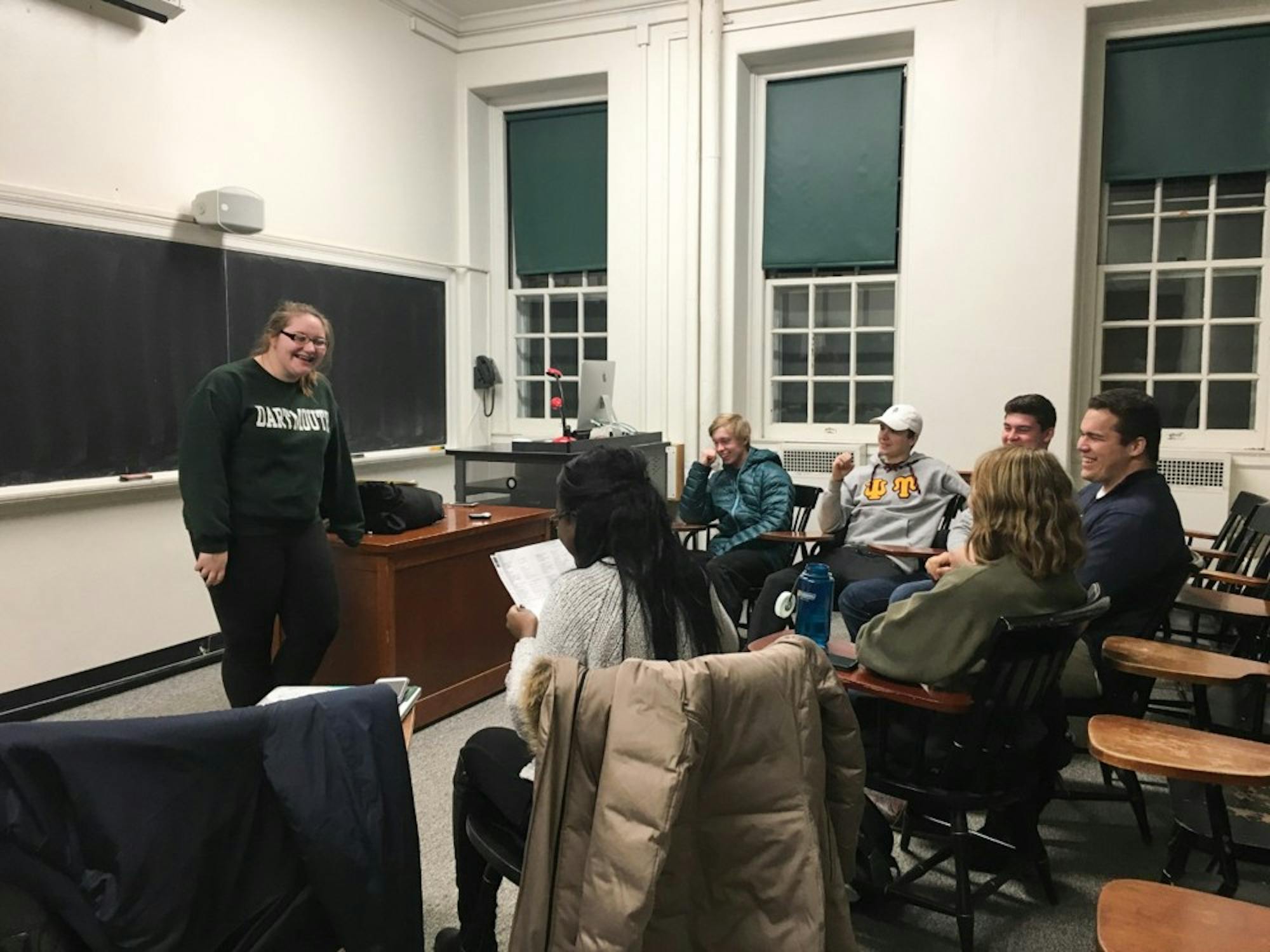
Walking past a Dartmouth language drill session, a student may hear a cacophony of words — a mix of broken sentences in Spanish, French, German or one of the other nine languages offered on campus. Each voice brings a new way of speaking the language: some words mispronounced; some accents perfect; words tumbling over each other as students repeat after the drill instructor and attempt to sound out syllables, paying close attention because they never know when they’re going to get called on.
Since 1965, the Rassias method, which includes the drill process, has been a cornerstone of Dartmouth’s language learning experience. Former French and Italian professor John Rassias, who taught at Dartmouth from 1965 until he died in 2015, developed the method during his time in the Peace Corps. Its aim was to help volunteers about to leave for other countries gain quick fluency in the language, Spanish and Portuguese professor Jim Citron said in an interview with The Dartmouth.
The method is known for drill, a dedicated time for students to practice speaking the language apart from professor-led instruction. For an hour, the student drill instructor implores students to speak, often catching them by surprise, making them form sentences in unique iterations.
“Drill is just one piece of the Rassias method,” Citron said. “It’s one of over 40 different techniques that are part of the method, but the gist of the method is to get people communicating quickly in the language.”
Rassias brought his method to Dartmouth when he arrived as a professor in 1965, founding the Rassias Center for World Languages and Cultures to promote language understanding and the drill method. Since then, drill has been adopted by all of Dartmouth’s spoken language departments and has become a common feature of Dartmouth’s language learning experience. Rassias’s method was further popularized by a “60 Minutes” highlight in 1982 praising his innovation and an appearance on The Tonight Show in 1980, where he did drill live on air.
Kathy Boak ’82, who studied French under Rassias on campus and abroad during her French LSA in Blois, described his class as “scary and exciting and fun.”
“You were constantly engaged,” Boak said. “You never knew when you were going to be asked for the response.”
Both then and now, the Rassias method has embraced the improvisation of language with a large emphasis on speaking and repetition.
Citron said the process embodied Rassias’s ideology that “you speak to learn, you don’t learn to speak.” He added that Rassias was “an actor before he was a teacher” and strived to facilitate “choreographed spontaneity” in the classroom, similar to the dynamics in acting.
Bernie Sheahan ’81, who took two French theater classes with Rassias and studied with him on the French LSA during her time at Dartmouth, described how Rassias’s method was designed to replicate the way young children learn language by encouraging students to speak rapid-fire without inhibitions.
“[Rassias’s] blend of language teaching and theater was what succeeded in the breakthroughs,” Sheahan said.
Rassias had a reputation for his snapping and pointing method: Even if his eyes were on one student, he would “snap and point” at a different student to choose who would speak, Boak said.
“Part of the fun of it was you never knew when you were going to be asked for the response,” Boak added.
Boak recalled how Rassias applied his method to the French LSA in 1980, sending students out in pairs to various villages around Blois, France with only a toothbrush per person?
“We had a mission to find certain people, let’s say the mayor or whoever, and we stayed with various people from the village, who then showed us around,” Boak said. “We were able to survive on our own with just our language skills, and that was a very memorable and confidence-building exercise.”
Cindy Sherwood ’82, who also had Rassias as a French professor and studied with him during the same French LSA, said Rassias’s method was “a radical approach to language.” Sherwood added that Rassias and his teachings “brought me out of my shell in a way that no other professor had” and helped her feel more comfortable with public speaking.
“The Rassias method turned the traditional method on its head,” Sherwood said. “We weren’t studying from a textbook.”
Studying abroad with Rassias was a transformative experience for students like Sherwood, who gained proficiency in French as a result of her time in France.
“By the time LSA was over, I was absolutely able to be conversant in French,” Sherwood said. “The next summer, I actually spent [time] as a camp counselor for French children. I was the only non-French person doing it.”
Thirty-five years after their LSA with Rassias, the cohort still meets for reunions, Sherwood said.
“We shared this experience that was so profound that it has bound us together as a group,” She said.
Since its early days at Dartmouth, the Rassias method has spread beyond the campus to schools across the world. According to Sheahan, when he was at Dartmouth, approximately 200 university campuses around the world utilized the Rassias method, including the International School of Paris and other international schools. During his sophomore winter, Sheahan was sent to Paris by Rassias to use the method to teach French to students in kindergarten through sixth grade, an experience he described as “very successful.” Rassias’s impact spread far beyond Paris, however.
“[Rassias’s] single biggest contribution was bringing the method to the Peace Corps, because that then was used in hundreds of different countries,” Sheahan said.
Today, the Rassias Center runs “training programs for teachers all over the world,” in addition to training teachers and drill instructors at Dartmouth, according to Citron.
“We've had programs in Spanish for healthcare professionals for the last many years that I’ve been teaching in, and for 13 years … I directed a program that was a partnership between the Rassias Center and the World Fund to train public school English teachers in Mexico in the Rassias method,” Citron said.
The Rassias method has gained particular traction in Mexico, where the method’s effectiveness was tested in a two-year study. According to Citron, students who were taught with the Rassias method had higher chances of going to college and obtaining a job by age 30. Teachers who taught with the method also expressed much more satisfaction in their profession, Citron added.
While the method was developed long ago, the “underpinnings of the method haven’t changed,” Citron said.
“It's always going to be changing, and the teachers are very empowered to use the aspects of it that make sense for the context in which they're teaching,” Citron said.
Simone Wuttke ’27, who took two terms of drill for German and later worked as a German drill instructor, said drill fosters an environment where students can feel free to make mistakes.
“It was really cool with them because you could see how much they actually progressed throughout the term and how they were actually learning to speak the language instead of just trying to repeat the exact word that I said,” Wuttke said.
Beatrice Reichman ’27, who worked as an Arabic drill instructor, said the drill process also created a “very positive experience” for her as an instructor..
“[The method] builds community within your class and other students taking the language,” she said.
Decades after Rassias arrived as a professor at Dartmouth, his impact on his students, past and present, is felt in each drill session today, even the ones starting at 7 a.m.
“He had just this incredibly special ability to make each person that he taught … feel unique and like we had amazing talents,” Sherwood said.
Madeline Kahn Ehrlich '29 is a reporter from upstate New York. She is considering studying English and Public Policy. She enjoys creative writing, art and reading historical fiction.