
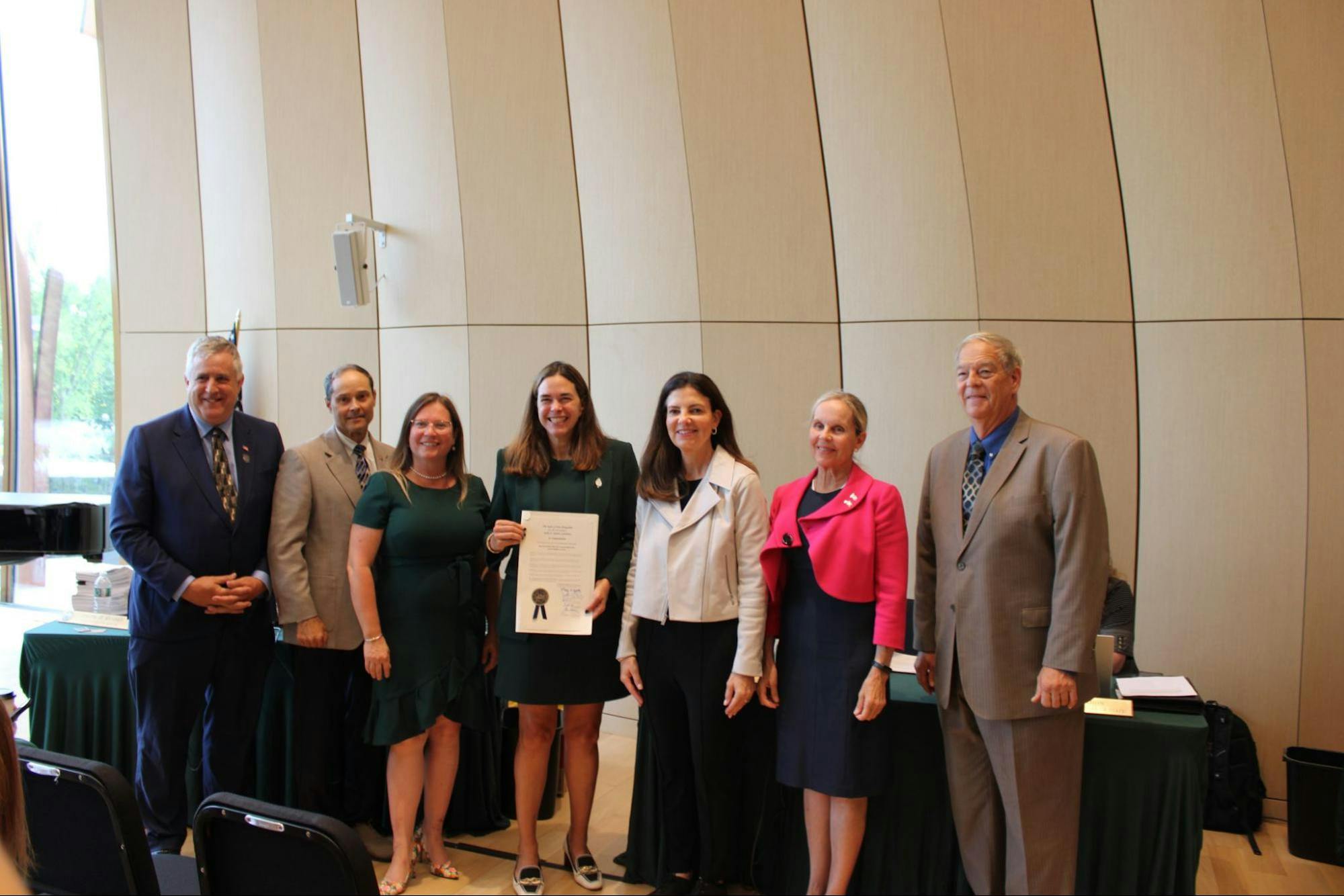
On Sept. 16, the New Hampshire Executive Council and Gov. Kelly Ayotte hosted their biweekly meeting in Hanover for the first time since 2014. The meeting provided an opportunity for the Dartmouth community to engage with local government officials and witness policy in action.
The N.H. Executive Council is comprised of five representatives, one for each of the state’s five districts, and is designated the power to approve contracts, judicial and executive appointments and expenditures exceeding $10,000. It is the only state executive council with similar power in the country.
Every summer, the Executive Council’s biweekly meetings are held in rotating districts around the state. This time, Executive Councilor Karen Liot Hill ’00 hosted the meeting at her alma mater.
“It was an opportunity for the state government — the governor, the council and our state commissioners –– to learn more about Dartmouth College’s efforts in our state, as well as an opportunity for Dartmouth students to see how our state government operates,” Liot Hill said in an interview with The Dartmouth.
At a breakfast meeting, College President Sian Leah Beilock presented ongoing Dartmouth initiatives, including expanding housing, improving free speech and rural healthcare access, according to Liot Hill. Dartmouth Health chief clinical officer Edward Merrens spoke about the challenges facing rural healthcare providers. Local elected officials, state representatives and Dartmouth students also attended.
Beilock wrote in an email statement to The Dartmouth that the College is “committed to helping solve our collective challenges around housing and rural healthcare, to name a few.”
“When New Hampshire succeeds, Dartmouth succeeds and vice versa,” she wrote.
Liot Hill said expanding rural healthcare access will “require ongoing partnerships” between the College and the state. She noted that the federal government cut Medicaid spending by $1 trillion last July.
“Those cuts are going to impact rural parts of the country, like New Hampshire, even more acutely,” Liot Hill said. “There’s a lot of work to do to navigate what is already a challenging situation and becoming a crisis situation.”
The council’s business meetings routinely begin with commendations –– honors that the host district’s councilor chooses to give to certain people. Liot Hill saw this as an “opportunity” to honor three “trailblazing women in New Hampshire,” including Beilock.
In an interview with The Dartmouth, councilor Joseph Kenney said Beilock was recognized for being a “very good” leader.
“She’s well spoken, very bright and someone who cares,” he said. “They’re [students] very fortunate to have her. And she’s also the first female Dartmouth president, which says a lot about her and her leadership qualities.”
“Receiving a commendation was a wonderful surprise, and I view it as a reflection of the work our entire community does to achieve Dartmouth’s academic mission,” Beilock wrote.
During the business meeting, the executive councilors and governor covered the 128 items on their agenda. They approved approximately $30 million in fuel assistance for low income residents, approximately $26 million in home efficiency rebates and a $20 million contract with the National Endowment for Health for population health programs as a part of the federal rural health transformation project.
Rockefeller Center for Public Policy postgraduate policy fellow JJ Dega ’26, who attended the business meeting, told The Dartmouth that he found it “inspiring” to see the councilors and governor discussing topics that “really affect” New Hampshire residents, such as infrastructure, and heard similar opinions from other students that were present.
“Students are saying that it was great to see them taking these issues so seriously,” he said.
Councilor David Wheeler told The Dartmouth that the council aims to be “accessible” to the public.
“They can come to those meetings, and they can talk to almost any commissioner in the state face to face, which makes New Hampshire great — to be able to have people have close access to their elected and government officials,” he said.
After the meeting, the executive councilors had lunch with students and faculty involved in the Rockefeller Center Policy Research Shop, a group of students and faculty mentors that provide state legislators and officials with non-partisan research.
“The interaction between the students and the state government is very beneficial,” Kenney said.
“In many cases, they can do a lot of research and work that state government officials don’t have time to do.”
Ayotte and councilors Janet Stevens and John Stephen did not respond to requests for comment.
Kay Alvito ’29 is a news reporter from Rio de Janeiro, Brazil studying comparative literature and creative writing. On campus, she is very involved with the arts as a member of the Rude Mechanicals classical theatre company and the dance group Street Soul.


