
Update appended (Aug. 14, 3:19 p.m.): This article was updated to include an interview with Democratic candidate for Vermont governor Amanda Janoo on Friday morning.
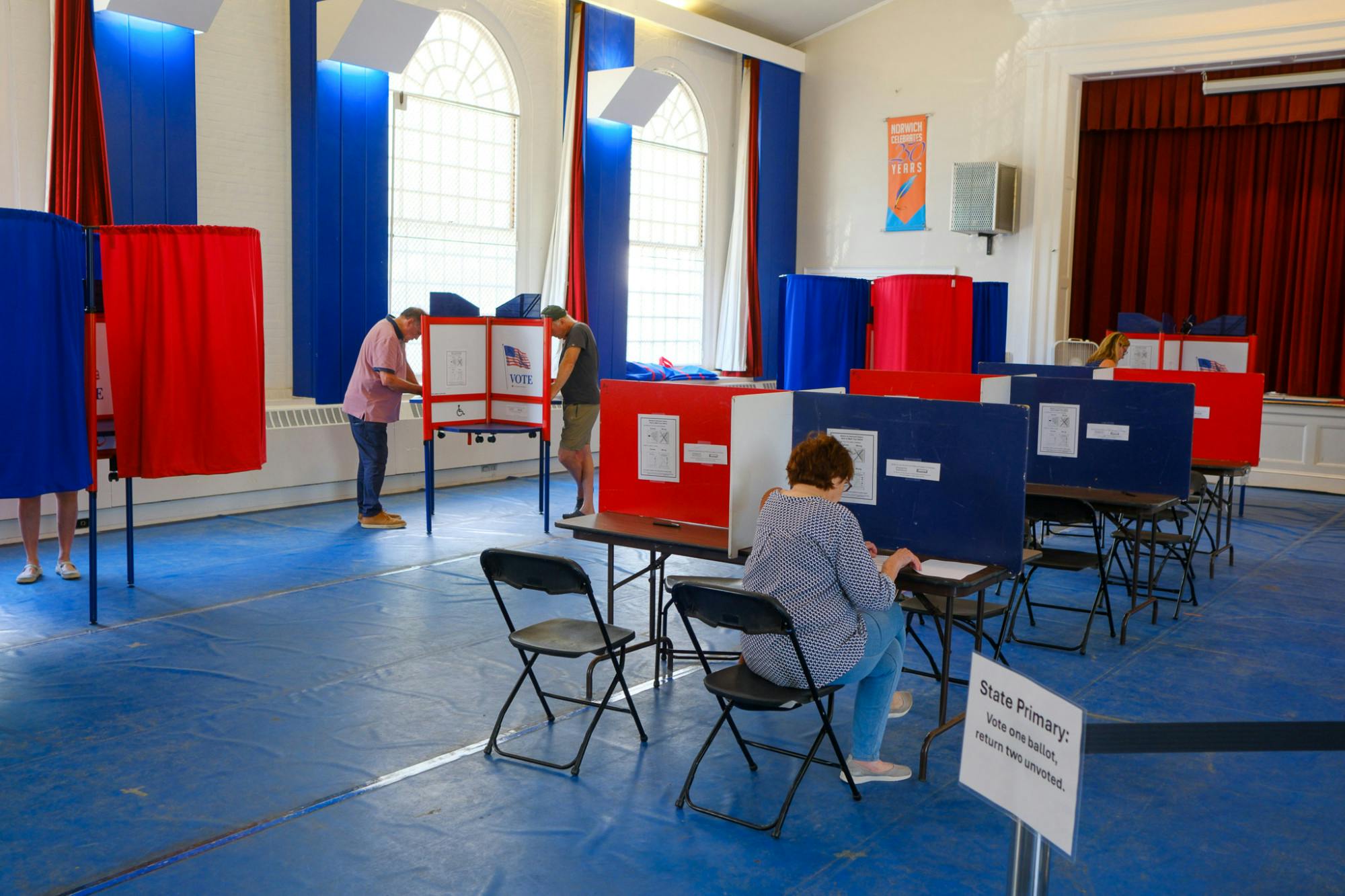
On Aug. 11, Vermont held primary elections for governor, lieutenant governor, the U.S. House of Representatives, the state legislature and county and local seats. The Dartmouth spoke to candidates across the state about their campaigns, experiences with constituents and outlooks for November’s general midterm election.
Voters cast 111,445 ballots, representing a voter turnout of 22%, up from 15.3% in the 2024 August primary, according to the Vermont Secretary of State’s Office.
This year’s primary elections come during an era of increased scrutiny by the federal government on voter registration and election processes. The Trump administration has been requesting full voter rolls to verify whether states have noncitizens as registered to vote. On July 7, U.S. Assistant Attorney General Harmeet Dhillon ’89 sent letters to election officials across the country warning that the Department of Justice would pursue criminal prosecution against state election officials who allow noncitizens to vote.
In an interview with The Dartmouth, Vermont secretary of state Sarah Copeland Hanzas said that the state is in “compliance” with all federal voting laws. She said that the DOJ reached out last September asking for the state’s “full unredacted voter files” to verify compliance with federal law. Copeland Hanzas added that Vermont state law does not permit the state to “share” those files with the federal government.
Non-citizens are “not going to risk a deportable offense, and they’re not going to risk never being eligible for citizenship just to be able to cast one ballot,” she said.
Copeland Hanzas said the only “verifiable instances of election fraud” happen when eligible voters are denied their right to vote. She added that such election fraud would happen in “record numbers” if the Trump administration kept pushing for “verification of citizenship” on voter rolls.
“Denying an American their right to vote is voter fraud,” Copeland Hanzas said. “And it is being proposed and hammered and slammed down our throats by this administration and it is frankly outrageous.”
Governor and lieutenant governor races
Economist Amanda Janoo won the Democratic nomination for governor with 49.1% of the vote, narrowly beating out former child care advocacy executive Aly Richards, who won 46.5% of the vote.
In an interview with The Dartmouth, Janoo said a “major motivation” for her campaign was the rise of “techno-fascism” and the “merger” between artificial intelligence companies and the federal government.
Janoo said that artificial intelligence is the “most urgent and existential threat” to humanity, and said that the “majority of people” in Vermont oppose data center construction.
“When all branches of the federal government are seemingly aligned towards this authoritarian nationalist agenda, my hope now lies with states,” Janoo said. “Our promise was that we would be a bulwark against authoritarianism and a living laboratory of democracy.”
On affordability, she said she would push for “wealth taxes” on stocks, dividends and inheritance. She added that her administration would “definitely” push for tax relief for working-class Vermonters.
“For example, with the property tax, it’s really just about shifting the property tax burden, because right now we actually have a regressive property tax structure that puts the majority of the burden on working- and middle-class Vermonters,” Janoo said. “And even our income tax structure, it still puts the burden on middle class Vermonters, largely.”
Janoo is also a proponent of a universal primary and preventative care program, adding that the private healthcare industry is “profit oriented” and has “ an incentive for you to be sick.” She added that universal healthcare could save the government “up to $300 million a year” from “reduced” emergency room visits.
“In Norwich, for example, or Stratford or Tunbridge, a lot of these small towns have started to hire their own community nurses as a way in which to sort of navigate this healthcare crisis,”” Janoo said. “And I think that’s a great model.”
Janoo argued that Vermont’s rising cost of living comes from the current state government’s “deficit mindset” and perceived “lack” of economic capital in the state.
There is a belief in Governor Phil Scott’s administration that “we don’t have enough people, we don’t have enough investment, we don’t have the right businesses,” she said. “So all of our policies have been oriented towards attracting that from the outside, as opposed to investing in what we have.”
Scott, who has served as governor since 2017, won the Republican nomination in the uncontested primary. While Scott has been a historically popular governor, his approval rating fell from 71% to 51% in July.
Phil Scott campaign spokesperson Emma Shouldice said in an interview with The Dartmouth that while Janoo “tapped into” voters’ frustrations with the Democratic party, Scott’s position as a “moderate” is key to bridging differences across the aisle.
“When people say, ‘Do we need two more years?’ and ‘He’s been doing this a long time,’ we believe the job is not done,” Shouldice said. “We need his continued steady leadership to navigate these trying times in Vermont.”
Shouldice added that she can “pretty much promise” on behalf of Scott that there will be no new taxes or fees passed under the next Scott administration, if re-elected.
Vermont Afghan Alliance leader Molly Gray, who previously served as the state’s lieutenant governor from 2021 to 2023, won the Democratic nomination for lieutenant governor with 60.7% of the vote, beating out former AmeriCorps member Ryan McLaren and educator Esther Charlestin. McLaren and Charlestin finished at 27.6% and 11%, respectively.
Gray’s campaign priorities include building more “affordable housing” and instituting “universal primary care,” according to her campaign website.
Incumbent John Rogers won the Republican nomination for lieutenant governor in an uncontested primary. Rogers is running on “opposing unnecessary taxes” and “reducing unnecessary regulations” for businesses.
Vermont State Senate races
The Vermont State Senate is composed of 30 members from 13 counties. The number of senators per county varies depending on the district’s population. All 30 seats are up for reelection this November.
Windsor County, which encompasses the towns of Thetford and Norwich, has three Senate seats. This means each party sends three candidates through the primary to the general election. Currently, the county is represented by Alison Clarkson, Joe Major and Rebecca White. All three are Democrats.

Candidates canvass outside of polls in Norwich, Vt., on Aug. 11. From left to right: Lauren Morando Rimh, Ryan McClaren, Becca White, Jim Masland and Dee Gish.
Following the announcement of Clarkson’s retirement from the legislature, the Democratic field widened to a six-person race for three spots in the general election. Incumbents White and Major secured the top two spots in the race, with 26.7% and 19.6% of the vote, respectively. State Rep. Elizabeth Burrows, D-Windsor-1, won the third spot with 16.4% of the vote.
Burrows defeated Pomfret, Vt. Selectboard chairman Benjamin Bricker and State Rep. Heather Chase, D-Windsor-Windham. Former firefighter Christopher Dube trailed in last place.
White, a resident of White River Junction, said that affordability is an issue that “persists” from her previous term, and one she would keep advocating for in the State Senate.
“And then I would also like to work on affordable housing,” White said. “I would like us to tax second homeowners in a way that actually disincentivizes vacation and second homeownership and third and fourth homeownership.”
The Republican primary was uncontested among local farmer Andrea Murray, engineer Jack Williams and former small business owner Jonathan Gleason.
In an interview with The Dartmouth, Gleason said that for many young people, the so-called American dream “just isn’t there anymore.”
“I personally work with a lot of younger people in college, post-college and so forth,” Gleason said. “They are really struggling with opportunity in the sense that they can't afford a house, they can barely afford their rent, even though they’re working very hard.”
Gleason added that he would advocate for “tax relief” in the form of lowered income and property taxes. He added that he would push for removing the “red tape” around business regulations and focusing on taxing them.
“We can attract more business, more commerce to Vermont, more industry,” Gleason said. “That’s who you tax — those people can afford to pay the taxes because it’s a business.”
In Orange County, just north of Windsor and across the Connecticut River, candidates vied for one spot in the state’s highest legislative chamber.
State Rep. Monique Priestley, D-Orange 2, decisively won the Democratic primary, gaining 70.9% of the vote. The race was contested by former Vt. Department of Labor employee Rose Lucenti, who ended with 29.1% of the vote.
According to her campaign website, Priestley is advocating for “infrastructure to improve daily life” in rural Vermont and to “protect Vermonters’ data” from technology companies.
Incumbent John Benson went uncontested in the Republican primary. He was appointed to the senate position by Gov. Phil Scott in February to fill a vacancy left by Sen. Larry Hart’s resignation.
In an interview with The Dartmouth, Benson said affordability is “top of mind” for many of his constituents.
Benson added that he is a proponent of the Vermont Promise, a legislative platform introduced by senate Republicans in July that outlines major legislative goals for the party. According to the platform’s website, senate Republicans aim to “revitalize rural Vermont,” “fully fund roads and bridges” and “eliminate costly energy mandates and reduce carbon emissions.”
Vermont State House races
The Vermont House of Representatives is made up of 150 members whowhich represent 104 legislative constituencies. All 150 seats are up for election in 2026.
Windsor-Orange-2 — which encompasses nearby Norwich and Stratford — had a competitive Democratic primary. The district sends two representatives to Montpelier.
Accountant and budget auditor Dee Gish won 41.4% of the vote, defeating 14-term incumbent James Masland, who came out with 26.2% of the vote. Education advocate Lauren Morando Rhim came in second with 32.4% of the vote.
No Republicans filed to run for this race.
Morando Rhim said in an interview with The Dartmouth at the polls in Norwich on Aug. 11 that there is a “tension of commitment” between a focus on quality public schools and higher property taxes for Vermonters.
“We have to figure out how to get more students in the schools,” Morando Rhim said. “The per pupil decreases because we’re so small, there are inefficiencies.”
In an interview with The Dartmouth, also outside the polls in Norwich, Masland echoed Morando Rhim’s points, saying that “we” — the three Democratic candidates — “are all in favor of education.”
“We [Democratic candidates] all need to bring down healthcare costs,” Masland said. “We all support working families.”
Windsor’s first district — which encompasses Hartford and Windsor — also had a three-way Democratic primary for two seats in the state house. No Republicans filed to run in Windsor-1.
Former Guarini Institute director John Tansey and former elections specialist Dylan Morse ousted incumbent John Bartholomew with 40.7% and 37.5% of the vote, respectively. Bartholomew ended with 21.7% of the vote.
Morse said that cost of living is the “top line,” adding that Vermonters are “really stretched” with housing costs and healthcare prices.
“I’d like to really do our due diligence to look at what universal primary care can look like in Vermont,” Morse said. “And on top of that, I want to revisit policies in Vermont that have sort of stunted some of the growth that we might actually want, be it local agriculture businesses, community events, or the housing for everyday people.”
Morse added that it is essential to grow the “tax base” by making Vermont a place to “attract” young workers to.
Tansey, reflecting on his experience at Guarini, said that “public service” has been his “passion” throughout his professional career.
“Dartmouth itself is a very diverse place,” Tansey said. “And so I think being open to new ideas, working closely with people from all different walks of life and [it’s important to] to try to make progress together.”
Iris WeaverBell ’28 and Teo Steverlynck-Horne ’28 contributed to reporting.
Correction Appended (Aug. 14, 11:00 p.m.): A previous version of this article erroneously claimed voter turnout declined in this primary compared to the August 2024 primary. The article has been corrected to reflect that turnout actually increased.
Jared Gonzalez Arce '29 is a news reporter from California majoring in history. Out of The D, Jared is in surf club and loves music.


