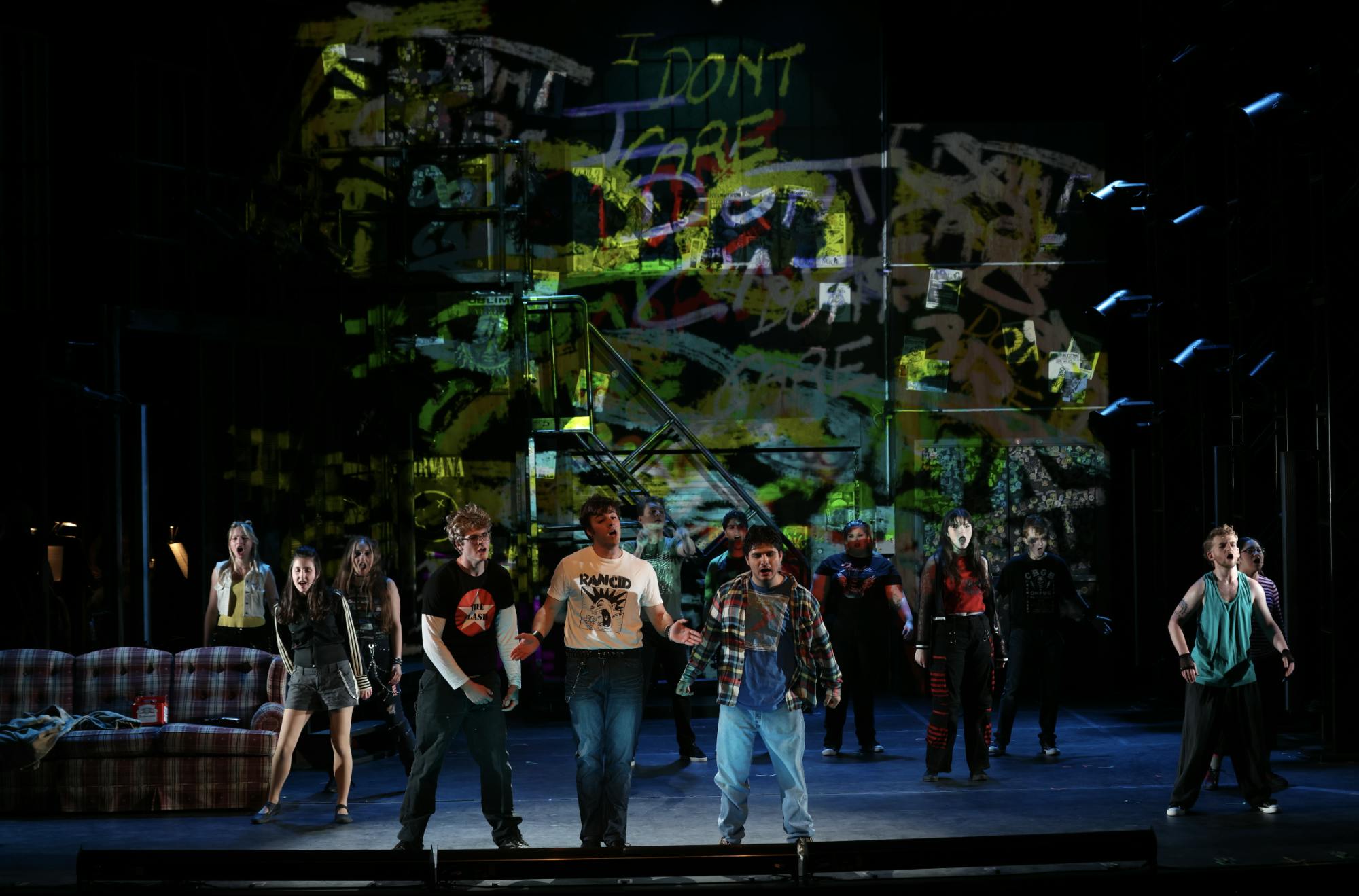
Projections of former President George W. Bush, the war on terror and news clips from the post-9/11 era filled the wall behind a troupe of disgruntled youth. As a fast guitar riff kicked into gear, the words “don’t wanna be an American idiot” rang out like a gunshot from one of the performers before the rest of the company fell into song about war, propaganda and national tension.
The Hopkins Center for the Arts and Dartmouth’s theater department staged “American Idiot” from May 27 to 31. The show is a rock opera musical based on Green Day’s 2004 album of the same name, told through 90 minutes of music with no intermission.
Green Day released “American Idiot” in response to national anxiety following the Sept. 11 attacks and the ensuing wars in the Middle East. The album confronts drug use, hopelessness and aimlessness among young people during an uncertain period. The musical is a loose adaptation of the album and its themes, according to theater department senior lecturer Keith Coughlin, who oversaw and directed the production.
“It is mainly a story stitched together through music, but what’s really interesting is there is very much a story, so a story of three young men searching for their place in society and in life,” Coughlin said.
“Jesus of Suburbia” opens the show and introduces three young friends — Johnny (Lucas Filippone ’26), Will (Max Scott ’29) and Tunny (Brendan Chapman ’29) — who want to escape their suburban lives and parents in the early 2000s.
Johnny and Tunny resolve to leave for New York City, but Will stays behind after learning his girlfriend is pregnant. The two become disillusioned with city life and begin to cope in different ways: Tunny enlists in the military after seeing an idealized image of a soldier on television (“Are We the Waiting”), while Johnny turns to drugs and adopts a punk alter ego, St. Jimmy (“St. Jimmy”).
As the story progresses, Tunny loses a limb in the war, Will’s girlfriend leaves with their child as he grows more negligent and Johnny gets sober and becomes a straitlaced businessman. The three reunite in their hometown, where they reflect on their experiences, dreams and ambitions.
Filippone, who also fronts the student band Shark, said he enjoyed bridging his own experience with rock music and the punk influences of his character Johnny, alongside his castmates.
“Doing that with the creative team who’s working on it, and this particular cast also, is great because everyone is so energetic and so passionate about the project,” Filippone said. “It makes it really, really easy to have a really good time.”
Despite being more than 20 years old and tied to the 2000s, the music still connects with the present, background performer Jordan Loughran ’27 said.
“The music really helps bridge that gap, and a lot of people still know Green Day, even without the context of [‘American Idiot’],” Loughran said.
Many of the show’s themes, such as disillusionment and aimlessness, continue to resonate with audiences because the present political climate echoes the same tensions of the 2000s, Coughlin said.
“It has a lot of relevance, even still in this moment — young people searching for their place in life in the midst of chaos and war,” he said.
Stage manager Aidan Lewinter ’28 said the story is about the trial and error of growing up.
“It’s like teenage or young adult angst, like coming of age, coming into yourself, figuring out who you are, making the wrong decisions and then figuring that out and falling into traps,” Lewinter said.
The musical uses punk rock — a genre associated with anti-establishment youth movements — as a vehicle for protest, Filippone said.
“We’re in another moment of intense political divide, and I think it’s in times like these when punk is really important because it is just an unfiltered assault on injustice,” he said. “That’s part of why I think it’s super sick that we’re doing this show right now.”
The performance included long breaks of silence between songs, giving listeners time to absorb their weight, according to Filippone.
“Green Day is a lot, especially when trying to tell a larger story, and so those moments of pause allow the audience to kind of soak it in,” he said.
The theater department brought in several professionals to recreate the look of the 2000s, focusing on costumes, makeup, lighting and set design.
“All of our designers, directors and music directors are seasoned professionals,” Coughlin said.
The production is one of the department’s largest since the Hopkins Center closed in 2022 for renovations, according to Loughran. Moore Theater, where the production was performed, reopened in 2025 along with the rest of the performing arts center.
“We haven’t had a big show in the Hop since ‘Pippin,’ which was 2022, so this is the first big musical back in the Hop where we really wanted to do something big and experiential,” Loughran said.
The professional crew and large-scale production also raised the stakes for the students involved, Lewinter said.
“I will say it is a higher stress environment, and you have to be really focused,” he said. “Things move very fast, and making sure just you’re on top of everything is important because it can be easy to miss a cue.”
Lewinter said the caliber of the student cast stood out the most.
“As someone that’s behind the scenes and has been in the rehearsal process, everyone is so incredibly talented,” he said. “The team of students they put together for this is incredible — incredible dancers, incredible singers.”