
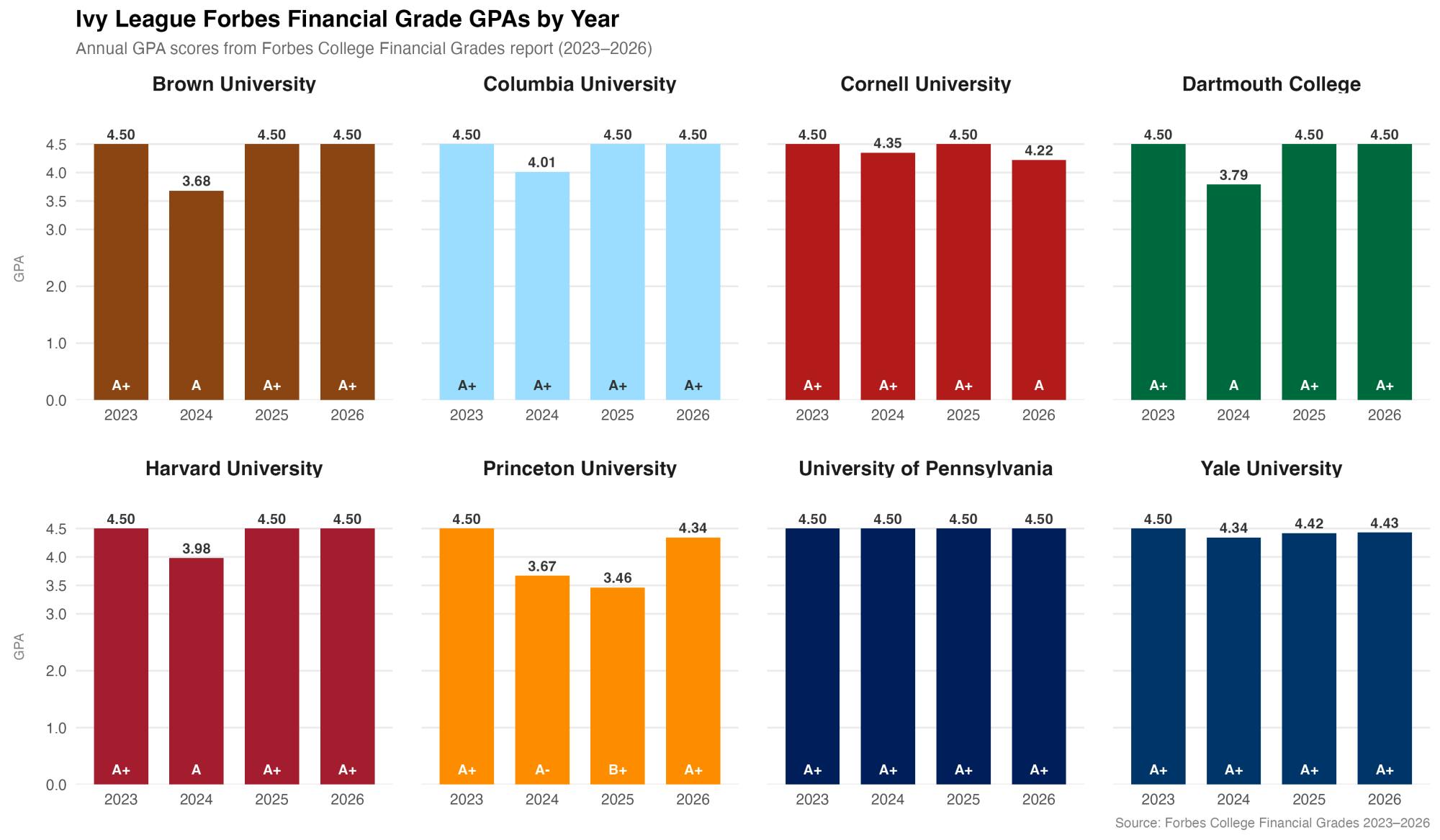
On May 22, Forbes Magazine awarded Dartmouth an “A+” and “perfect GPA” of 4.5 in its annual college financial grades report for 2026. Included in its grading were over 900 private, non-profit American colleges; more than half scored “C” or worse, 27% received the lowest grade of “D” and no less than 192 were found to be, in Forbes’ words, “looting” their endowments to stay open.
This is the second year in a row Dartmouth has earned a perfect grade from Forbes after taking a dip to an “A” and 3.79 grade in 2024. Brown University, Columbia University, Harvard University and the University of Pennsylvania also earned perfect GPAs this year. Dartmouth’s endowment returned 10.8% in 2025, the lowest return in the Ivy League.
College chief financial officer R. Scott Frew wrote in an email statement to The Dartmouth that the College is on “strong financial footing,” though not “immune to the pressures facing higher education.” Under the One Big Beautiful Bill Act, the College will face a 4% tax on endowment returns, up from a 1.4% tax.
“Our asset base and diversified revenue mix are central to that strength, allowing us to plan for the long term and to continue investing in our academic mission,” Frew wrote.
Frew added that the Forbes grades are a “useful lens” into the College’s financial health, but that their methodology is “best suited to identifying institutions in distress.”
“Some components work in our favor, such as endowment per student and our revenue mix,” Frew wrote. “Others are counterintuitive. The share of students on institutional aid … is treated as a negative, on the view that some schools use discounting to drive enrollment.”
On Jan. 25, College President Sian Leah Beilock published an op-ed in the Wall Street Journal outlining priorities for higher education including a “commitment to affordability” among colleges.
“If the public no longer believes [that college] is a good investment, that’s a problem,” Beilock wrote. “Solving it starts with lowering the cost.”
College spokesperson Jana Barnello wrote in a statement to The Dartmouth that the College’s “commitment to making a Dartmouth education affordable will not waiver.”
“Over the last decade, we have increased our financial aid budget more than 100%,” Barnello wrote. “Dartmouth meets 100% of demonstrated need for every admitted student, regardless of citizenship.”
Forbes’s grades are based on data collected by the Department of Education’s National Center For Educational Statistics and the higher education analytics consulting firm Perspective Data Science.
In calculating the grades, Forbes considers a college’s ability to cover debt, ability to operate on reserve funds, change in net assets, endowment per student, enrollment growth, instruction expenses per student, net tuition revenue per student, reliance on tuition revenue, unrestricted net assets and coverage of educational expenses by tuition, donations and investment revenue, according to their methodological report.
Economics professor Bruce Sacerdote ’90 wrote in an email statement to The Dartmouth that Dartmouth’s financial “success” is due to the “generosity of the alumni, great investment management and thoughtful allocation of our resources,” Sacerdote wrote.
“As an alumnus, I am particularly proud that we are focused on using those resources to benefit the student experience in commitments to financial aid, more housing, more research and internship opportunities, student wellness and outdoor and travel experiences,” Sacerdote wrote.
Alex Klee ’29 is a reporter from Woodbridge, Conn. He plans to major in economics and minor in math. He enjoys live music, skating and climbing.


