
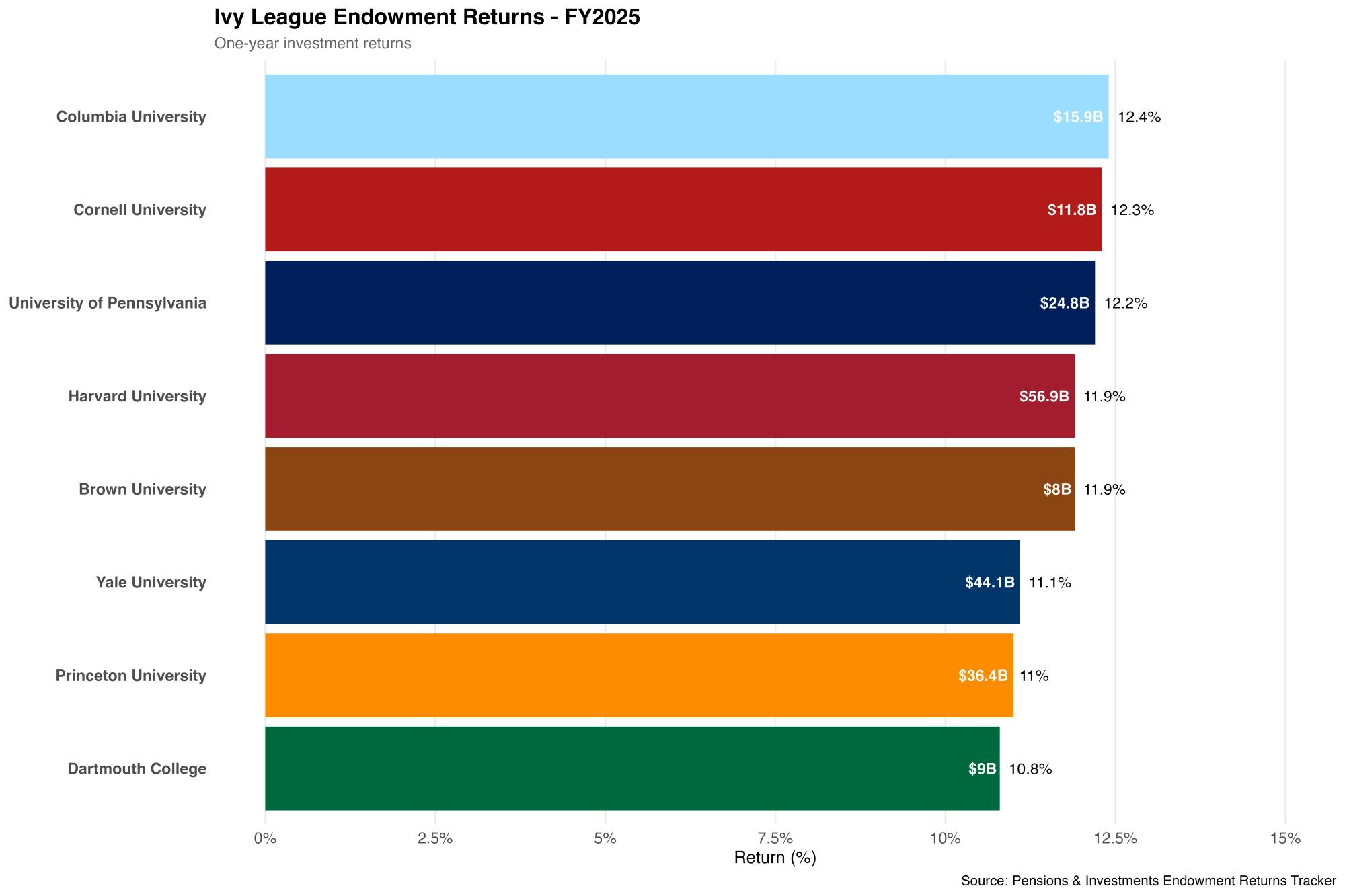
Dartmouth’s endowment returns for 2025 lagged behind other Ivies at 10.8%. Columbia topped the Ivy League in terms of investment returns at 12.4%, while Dartmouth was the lowest of the eight.
The endowment jumped from $8.3 to $9 billion, as reported to the Board of Trustees in their October meeting. Endowments are intended to provide continuous financial support through an annual distribution, typically constituting 5% of the endowment’s value.
Of the gains, the endowment distributed a record $453 million — 5.5% of the total. This accounted for 30% of Dartmouth’s operating costs for fiscal year 2025.
To be sure, Dartmouth’s more muted performance would be consistent with a more cautious investing approach that could mitigate losses in a market downturn. Despite its comparatively weaker performance, Tuck School of Business professor Jonathan Lewellen said that analyzing Dartmouth’s financial situation on “a per student basis,” and considering the “size of our faculty,” makes the College’s finances look “pretty good.”
Professors said the endowment is becoming harder to liquidate in exchange for performance. Economics professor Eric Zitzewitz said that the Dartmouth endowment has shifted away from the strategy of investing 60% in stocks and 40% in bonds, and instead has been increasing allocations to private equity, venture capital and hedge funds.
A criticism of these types of investments — or alternative assets — is that they have not been as lucrative in the past few years, and that “they can’t be as readily liquidated if you have a downturn,” Zitzewitz said.
“That’s something that's increasingly concerning university leaders this year,” he said. “We have a bit of budgetary pressure coming from the various things that the Trump administration's doing.”
In August, The Dartmouth reported that the College plans to borrow $450 million by selling bonds to fund capital projects, including new housing. This follows a trend of universities selling bonds to address potential fiscal challenges. The number of bonds universities have issued is up 36% in 2025, according to Bloomberg.
The lack of liquidity worries some “university leaders” because they “want to make sure that the institution is going to be able to handle both an adverse policy environment and an economic recession if we happen to get both at the same time,” Zitzewitz explained.
Dartmouth’s endowment is made up of 6,600 endowed gifts, which are typically donated with a “specific purpose,” according to the Investment Office website. They are collected by the Dartmouth Investment Office into a single portfolio.
A College spokesperson declined to comment on the endowment performance.
Economics professor Bruce Sacerdote ’90 said that the endowment is “critical” to funding “absolutely everything” that the College does, including financial aid, faculty salaries and support for research, teaching, housing and athletics.
Nonetheless, Zitzewitz said that the College’s endowment has seen “reasonably steady, good performance” for “several years in a row.”
Lewellen, Sacerdote and Zitzewitz all commended the College’s strong “long-term financial health” and “long-run success.”
Only “a very small number” of other institutions would not “happily change places” with the College “in terms of financial health,” Zitzewitz added.
Alex Klee ’29 is a reporter from Woodbridge, Conn. He plans to major in economics and minor in math. He enjoys live music, skating and climbing.


