
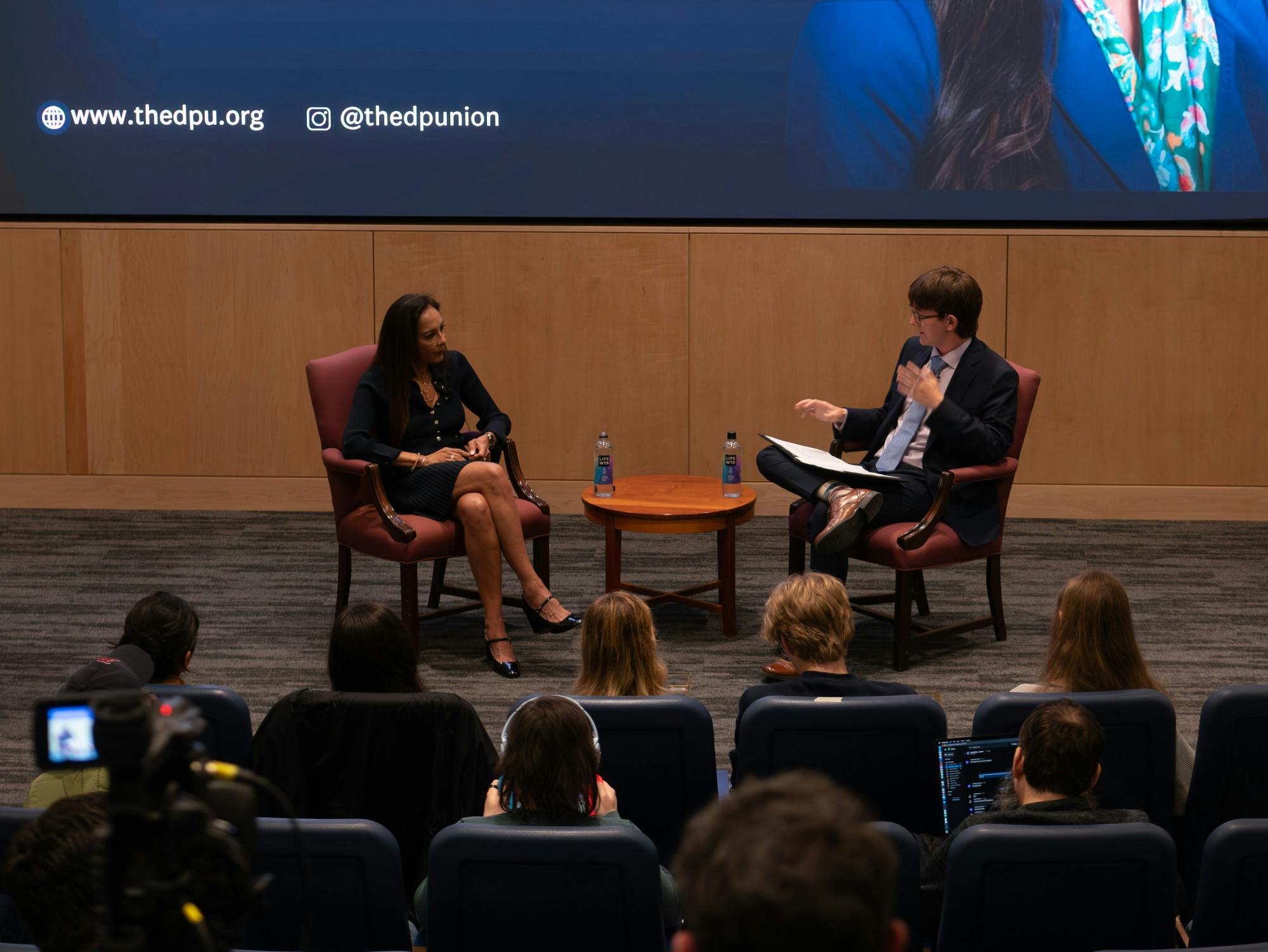
On May 14, United States assistant attorney general for civil rights Harmeet Dhillon ’89 joined the Dartmouth Political Union for a moderated conversation and open forum Q&A on her work in the Department of Justice.
Approximately 75 people attended the event in Cook Auditorium, according to DPU president Roger Friedlander ’27. The event’s livestream on YouTube received more than 400 views as of May 18.
Dhillon was nominated by President Donald Trump and confirmed by the Senate in April 2025. She is the first Republican woman and Republican of Indian descent to head the civil rights division. Created by the Civil Rights Act of 1957, the division “works to uphold the civil and constitutional rights of all persons in the United States” and “enforces federal statutes prohibiting discrimination,” according to the DOJ website.
Under Dhillon, the office has initiated civil rights investigations against higher education institutions it says practiced racial discrimination in admissions processes and inaction against the harassment of Jewish students.
On the morning of the event, the DOJ wrote in a press release that a civil rights division investigation found that Yale Medical School discriminated based on race in admissions.
At the event, Dhillon said that YMS admissions were “unfair” to white and Asian applicants.
“An African American student is 27 times more likely to be invited for an interview at Yale with the same [Medical College Admission Test] score as an Asian,” Dhillon said.
Dhillon said that Dartmouth, in contrast, is not in her “scope.”
“You do not seem to be violating federal civil rights law in any way that I’m going to get around to in the years I have left at this job,” Dhillon said.
Dhillon has publicly praised President Beilock’s response to pro-Palestinian protests at Dartmouth. Nearly a year after Beilock facilitated the arrest of 89 individuals on the Green during a protest, for example, Dhillon wrote “My team met with Sian Beilock Monday at @TheJusticeDept and I was so impressed to learn how Dartmouth (my alma mater) is getting it right, after all these years. Kudos to Dartmouth! I heard Jewish student applications are way up!” in a post on X.
When asked about her thoughts on the Supreme Court’s decision in Students for Fair Admission v. Harvard — which ruled that most race-based affirmative action programs in college admissions violate the equal protection clause of the 14th Amendment — Dhillon said that she “believes in the constitutional vision of the individual having rights, not groups having rights.”
“That kind of group retribution and group justice is inconsistent with the Constitution,” she said. “Adjusting outcomes is not the American way.”

When asked about how her office decides what cases to take on, Dhillon said that she focuses on “impact litigation” because her division has “limited budgets and staffing.”
“What you have to do is pick the best investigation cases where you hopefully create precedent and have a deterrent effect,” Dhillon said. “We don’t view ourselves as responsible for taking on every case.”
Dhillon said she often faces “pressure” from lawmakers “of both parties, frankly more on the Democrat side” to “impose speech codes” on college campuses , but has “declined to do that” because she is a “firm believer in the First Amendment.”
A “speech code” is any regulation or policy that prohibits protected speech or expression, often on the basis of content or viewpoint, according to the Foundation for Individual Rights and Expression, a prominent free-speech organization.
“People will say to me, ‘They’re wearing keffiyehs, they’re flying flags, they’re shouting slogans,’” Dhillon said. “I’m like, okay, that’s the First Amendment. If you don’t like it, you say something else.”
Dhillon highlighted examples of “imminent threats” that “cross the line” that her division has taken action on, including at the University of California, Davis and University of California, Los Angeles: “We’ve seen professors lock their hands together and prevent Jewish students from getting into classes,” she said. “You see no-go-zones in UCLA, where Jews are not allowed to cross the campus.”
Former New Hampshire Republican Party chairman Chris Ager — who supported Dhillon’s unsuccessful 2023 bid for Republican National Committee chair — said in an interview after the event that he “liked” Dhillon’s discussion of “protecting unpopular speech.”
“You have to draw a line when conduct becomes threatening or hurtful,” Ager said.
Attendee David Kriegsman ’29 said he noticed that Dhillon was “committed, at least in speech” to “equal protection.”
“The problem with the civil rights division and the Department of Justice is it seems to only go after the types of discrimination that the current administration is interested in pursuing,” Kriegsman said.
Alex Klee ’29 is a reporter from Woodbridge, Conn. He plans to major in economics and minor in math. He enjoys live music, skating and climbing.


