
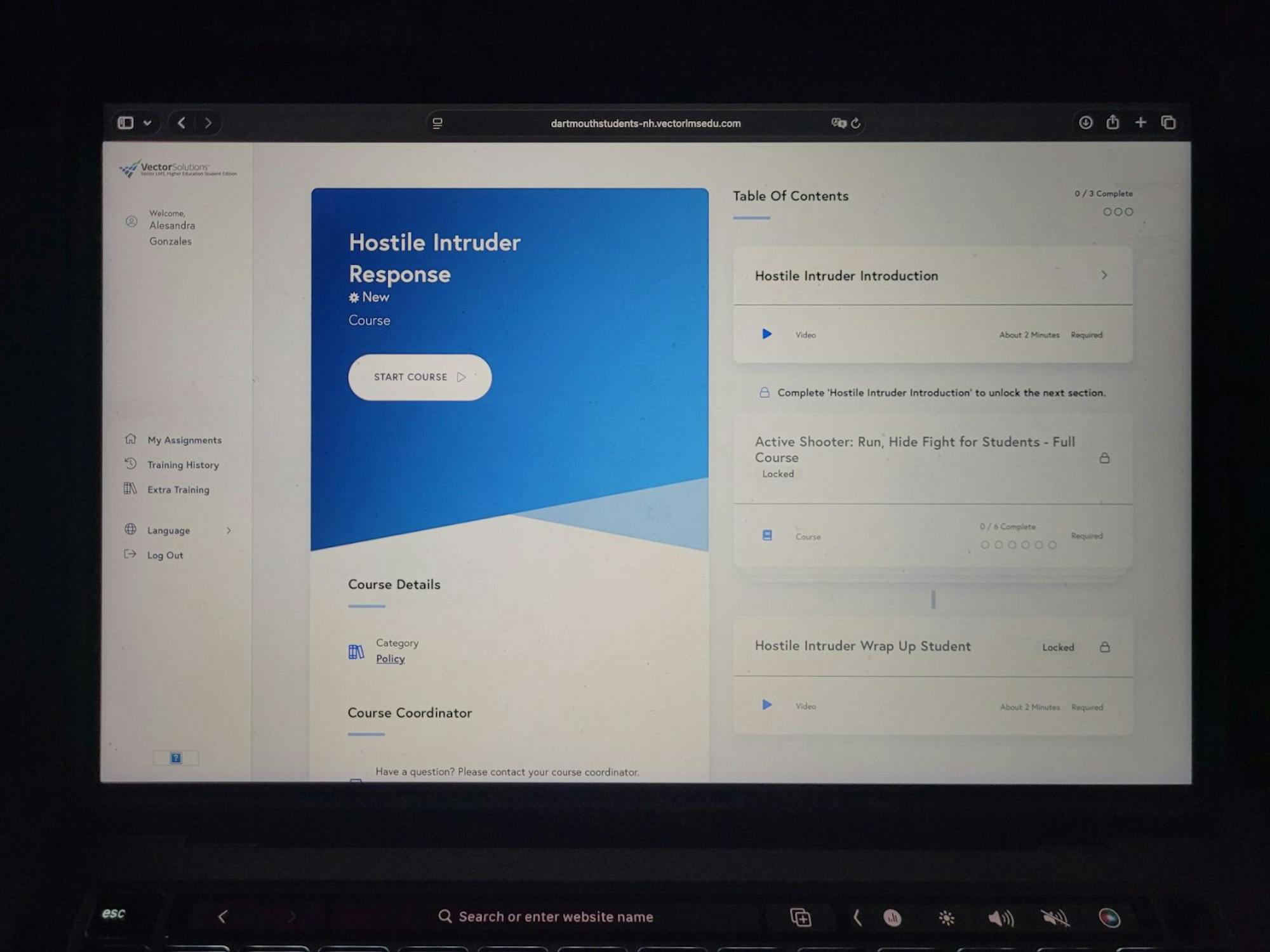
On May 6, the College rolled out a new online hostile intruder training module as part of broader campus safety and emergency preparedness efforts. The training is designed to provide students, faculty and staff with strategies for responding to emergencies, according to Dartmouth Safety and Security director Keiselim Montás.
The new training is a self-paced online course comprised of three modules that takes approximately 18 minutes in total to complete. The College also continues to offer two-hour hybrid hostile intruder defense workshops several times per term.
Swartz said the online module allows Dartmouth to reach a broader audience while introducing community members to additional in-person training opportunities.
“The concept about the online workshop is that it’s relatively short, so you can learn a lot in 20 minutes,” Swartz said.
In a May 5 email to campus, Montás explained that the training is being “enhanced” by wider efforts to create a “secure and connected campus.” The “enhancements,” which include upgraded “access control” and a cross-campus “video management system,” were first approved in 2022.
Montás wrote in his email to campus that “engagement” the module “will help shape how we build on [security training] going forward.”
Following a mass shooting at Brown University in December 2025 — in which two students were killed and nine were injured — Dartmouth administrators told The Dartmouth that Safety and Security was undergoing a “complete review” of emergency preparedness plans.
According to Montás, recent violent incidents on college campuses highlighted the need to expand access to emergency response training by transitioning to an online format that would be more accessible to more people.
“Dartmouth’s geographic location is a double-edged sword because we have this sense that we are in this little green bubble, that we are quite safe and nothing happens,” Montás said in an interview with The Dartmouth. “The fact that we are in a relatively safe small community doesn’t exempt us from the potential of being at risk.”
The new training teaches practical response strategies such as “run, hide, fight,” how to recognize potential threats and Dartmouth-specific reporting protocols. Each module pairs short instructional videos with multiple-choice and true-or-false questions. The course concludes with a short quiz to reinforce the material.
Campus emergency manager Ron Swartz said in an interview with The Dartmouth that the online training is based on the “run, hide, fight” model, in which the first step in an emergency scenario is to avoid the threat whenever possible. If escape is not possible, individuals should attempt to deny access to the intruder by finding a secure location or barrier.
“The third part of the model is to defend yourself if you have to fight for your life,” Swartz said, adding that self-defense should be considered a “last resort.”
Dartmouth’s in-person workshops use a similar “avoid, deny, defend” framework.
“Across the country, there are several different models that cover the same three concepts,” Swartz said.
The training also includes statistics about violence on college campuses and scenario-based guidance for responding to emergencies, such as an active shooter or different emergency response services. In an introductory video, the module cites a study commissioned by the Citizens Crime Commission of New York City — a non-profit focused on criminal justice and violence prevention policy — which found that 437 people were shot in 190 college campus shooting incidents between 2001 and 2016.
The course also highlights the importance of recognizing warning signs of potential violence.
“This course is designed to familiarize you with the warning signs that someone may become violent,” one introductory video said. “We will discuss situational awareness, explore how to assess an emergency situation and review ‘run, hide, fight’ procedures.”
According to Swartz, the hybrid workshops, which are “open to the campus community,” include discussions about Hanover-specific emergency response systems and the role of law enforcement, which are also mentioned in the hybrid modules. They also include conversations about injury control, violence prevention resources and recognizing warning signs of people in crisis.
“We try to get people to watch out for each other,” Swartz said. “That little intervention can make a huge difference.”
Montás said that the College’s approach to security relies on community. He is “hopeful” that the online training will have a one-hundred percent completion rate, he added.
Nidhi Nadgir ’29, who completed the training, said the sections that focused on stress responses and decision-making during emergencies were “really helpful.”
“The premise of the hostile intruder response training was pretty strong in some sections, especially those focused on understanding our body’s reactions to stress and procedures in high-pressure situations,” Nadgir said.
However, Nadgir said some of the training’s interactive questions felt “unhelpful.”
“There was one that asked ‘True or false: Situational awareness allows you to identify suspicious people or activities,’” Nadgir said. “I just felt like some of those questions were a bit obvious.”


