This article is featured in the 2026 Winter Carnival Issue.
The Hanover Department of Public Works provides vital construction, maintenance and utility services year-round. During the winter months, they take on the formidable challenge of clearing layers of snow and ice while continuing their regular work, often operating in subzero temperatures.
In this line of work, much of the effort goes into making problems effectively “disappear,” Public Works director Peter Kulbacki said.
To learn more about winter operations, The Dartmouth spoke with three Department of Public Works officials: Utilities maintenance supervisor Maura Anderson, highway operations supervisor Chris Berry and Kulbacki.
If there was one thing you wish everyone knew about your job, what would it be?
MA: How important it is to think about the infrastructure in the ground. You think about your road conditions, you think about how your road lines look or how a park looks. You can’t necessarily see the water mains and the sewer mains, but they have an important job to do.
CB: Just how hard it can actually be and the long hours that are involved in it.
What’s the worst winter the department has had to deal with and what made it so difficult?
CB: Last winter was pretty tough on us and not necessarily because of the winter itself, but because I had about eight brand new employees working for me at that time. Everybody did a great job, but it was a huge learning curve for a lot of the guys.
PK: Back in 1998, we had an ice storm. Anything above about 1,500 feet in elevation, ice just covered: every road, all the trees. Lots of power lines were down, so people were without power for weeks on end. We had to cut trees after the power lines were disconnected so we could clear the roads up, and then we had to clean up after that. Snow was not so much of an issue. We’re set up for that. But icing is really the worst thing we see. That would be the ice winter that I hope never to repeat.
What do operations during a bad snowstorm look like? How do they change?
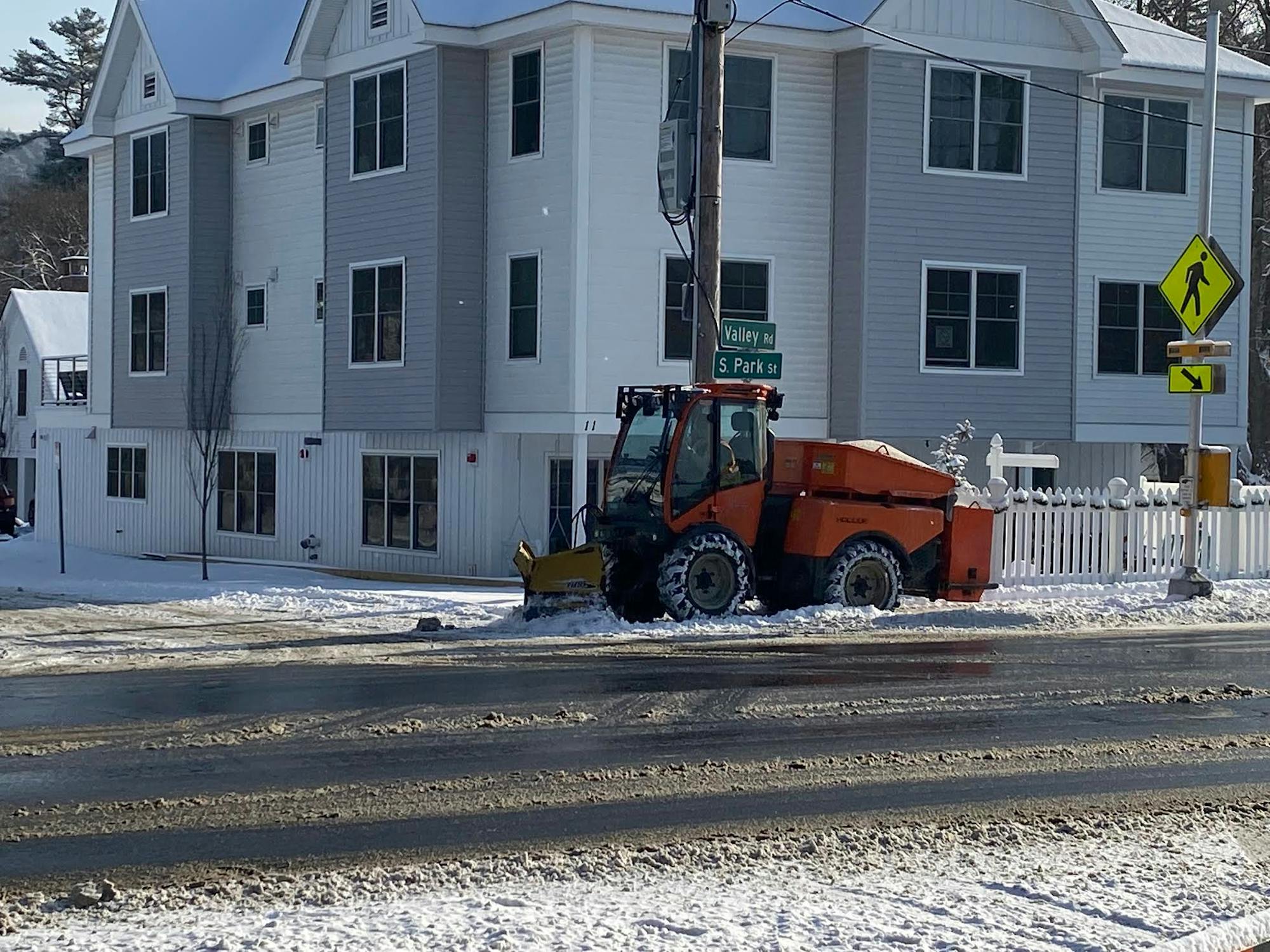
MA: Winter operations are all hands on deck. The highway crew plows and puts out material to mitigate slippery roads. My department runs the sidewalk tractors. We help each other out and take care of each other across departments to make sure everything gets done in a safe way.
CB: Everybody has an assigned plow route, so operations go pretty smoothly once we get into the swing of things. But the weather can change. It may start out as snow and switch to freezing rain, which probably is the most stressful work we have to do. Right now, there’s also a pretty big salt shortage. So we’re trying to manage the same level of service with a little bit of salt versus what we normally have.
Have you noticed the type of winter weather changing over your time in public works?
CB: I hear a lot about it, and it really hasn’t changed from what I can see. We still get snow. It’s still cold. We do seem to get more icing events than we used to, but all in all I don’t really see where things have changed that much.
PK: Absolutely. We’ve seen warmer, wetter weather. Over the last 30 years it’s become less snowy and more icy. We’d rather plow snow than deal with ice. The plow truck operators have to be on those icy roads and it's very difficult.
Are there certain populations or areas in the Upper Valley that are disproportionately impacted by the snow?
MA: I worked in Lebanon before coming to Hanover, and Hanover definitely has a lot more foot traffic due to students at the College. Probably the biggest difference is that it’s definitely a higher standard of maintenance in that regard.
CB: The downtown Hanover area is a priority just because of the population. And then we have other parts of town where there’s about 18 miles of road and maybe 10 houses along the whole route. So that doesn’t necessarily take priority.
What services does the department provide to Dartmouth’s campus? Do these services differ from the services it provides in other parts of the town?
PK: There are a number of town roads that go through campus. So, we maintain all the utilities, water, sewer, drainage, sidewalks, parking spaces, plowing and any repairs along those roads. Other roads like Tuck Mall are private roads, so we don’t do anything on those. Other than that, we shovel and maintain fire hydrants or may be involved with a water main issue.
What strategies and technologies have proven most effective at managing the unpredictability of winter weather in the Upper Valley?
CB: I’ve been doing this for 31 years now. The use of brine, which is considerably cheaper and just as effective as rock salt, has made a huge impact on things. Most importantly, that lowers the cost of maintaining the roads in the winter months as far as de-icing.
PK: Predictive weather models have gotten a lot better. We used to hire a meteorologist with a side business who would fax us daily, letting us know if there was a storm coming. We also now have cameras around town to help us see snow accumulation — like on top of the Hanover Inn and Berry Library — so we can tell what’s happening downtown versus higher elevations. We also have technologies that track how much salt we’ve been using. This helps us maintain a balance because too much is harmful to the environment. We spend a lot of time trying to find that balance, but we err on the side of using more for safety.
Does the snow or ice ever affect the wastewater or stormwater systems?
PK: In freezing weather, we start having issues with the road surface and moisture going into the soil. If you have a crack in the road, you can get some penetration and ice lenses start building up. Those create potholes and also as the frost moves down into the soil, it can get down almost five feet, causing water main breaks.
What’s the biggest challenge on the horizon?
MA: Having people that are interested in doing this kind of work. There’s definitely a lot of hands-on learning, but also a lot of technical and mechanical aspects to it as well. I really like to encourage people to explore whether this type of work might be for them. So, I would say that staffing challenges are certainly a considerable factor in the future.
CB: Skilled labor. It’s really hard to find guys with experience and be able to pay them what they’re worth. Private contractors pay a lot more than we do, so a lot of your skilled labor tends to go their direction versus a municipal operation.
This interview has been edited for clarity and length.
Will Sánchez '29 is a reporter from Portland, Ore., studying government and psychology.