
This article is featured in the 2026 Winter Carnival Issue.
From ice sculptures to ski jumps, frigid polar bear plunges to winter light shows, the Winter Carnival has long been one of Dartmouth’s signature traditions. Since its founding in 1910, the Winter Carnival has evolved from a Dartmouth Outing Club Ski and Snowshoe day into a campus-wide event, according to Dartmouth News.
In 1909, Fred Harris, Class of 1911, wrote a letter to the editor that was published in The Dartmouth suggesting the creation of a Ski and Snowshoe club. The letter, which is in The Dartmouth’s bound volume archives, documents Harris saying that such a club would “stimulate interest in outdoor winter sports.”
“Field day each winter might become as much an anticipated and regular event as the spring and fall track meets,” Harris wrote.
Harris put his idea into action by founding what is now the Dartmouth Outing Club. Feb. 26, 1910, marked the first field day of the Dartmouth Outing Club, also known as the first Winter Carnival, including events like cross country races, ski jumps, snowshoe races and concerts.
Rauner special collections librarian Morgan Swan said that Harris might have been inspired by the Montreal carnival, which was a city-wide winter festival.
In “Harris’s scrapbooks from his time as a student, there’s material from the Montreal Winter Carnival which predates, obviously, the Outing Club as well as the Winter Carnival,” Swan said.
The Dartmouth’s archives gave a glimpse into what Winter Carnival was like in its early days. Articles dating back to 1926 mention carnival traditions such as ski jump competitions, an ice palace, performances of the play “The Dancing Princess,” fraternity dances, a 1,000-foot long toboggan slide on Occom Pond and a formal ball with a live orchestra.
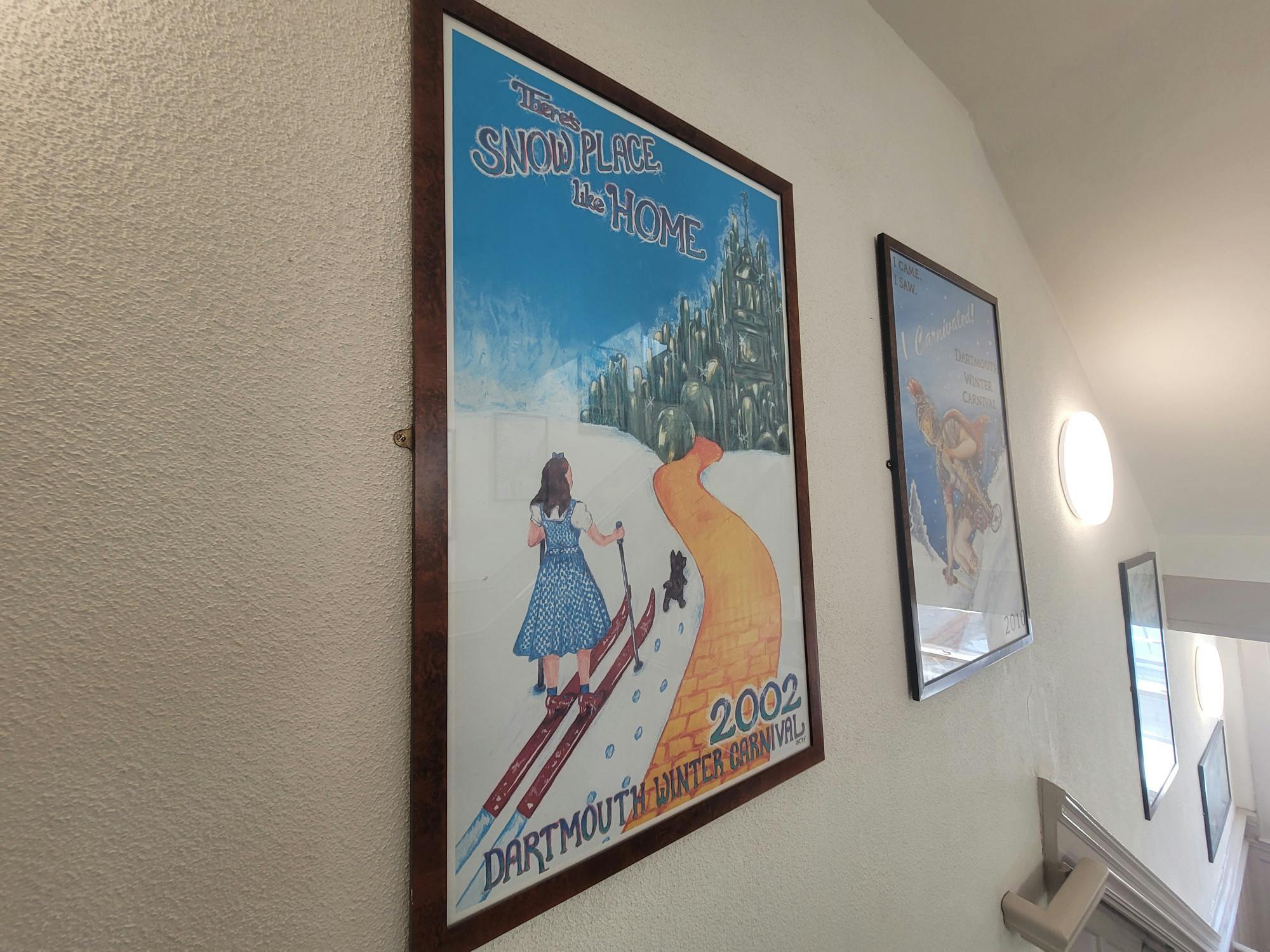
In the 1960s, the carnival began to have different themes each year, usually based on well-known book or movie titles. Some past themes include “A Midwinter Night’s Dream” (1967), “Where the Wild Things Are” (1986), “How the Grinch Stole Carnival” (1992), “Icecraft and Blizzardry” (2017) and “Jurassic Parka” (2025). This year’s theme, “The Blizzard of Oz” follows this tradition of cultural references.
Kathy Van Weelden ’76 recalled that, by the 1970s, the highlight of the weekend was a “big” concert in Spaulding Auditorium.
“I actually got to see Don McLean. You know, ‘American Pie.’ He was a big name at the time,” she said.
The carnival was one of many in the northeast, and its primary focus was skiing. VanWeelden’s classmate Mary Osgood ’76 said that the carnival “started with skiers.”
“Dartmouth, University of Vermont and Middlebury [College] had a carnival every year and they were sort of the big ski schools,” Osgood said.
Van Weelden also recalled the ski events, specifically the ski jump competition, which she called “a major event.”
“Everybody came out to the ski jump on Sunday afternoon … and that was a huge crowd and lots of people. It was fun,” Van Weelden said.
Swan pointed out that prior to coeducation, the Winter Carnival was an opportunity for men to bring women as dates to the campus.
Swan added that satire magazine the Dartmouth Jack O’ Lantern archives contain “telegrams … to send to women, to reject them or to explain why you’re not going to invite them to carnival.”
One headline from a 1926 edition of The Dartmouth reads: “26 Fraternities Entertain 493 Guests During Carnival.” This was followed by a page-long list of women’s names.
Until 1972, every year one of these women was selected as the Winter Carnival Queen.
“If your date got chosen as the Queen, you were like the prince … you get a reputation by association,” Swan said.
“Winter Carnival was sort of a microcosm of American culture at the time, especially with regard to gender roles and how men and women were perceived and the pressures that were put upon women to conform to a certain ideal,” he said. “And I think it’s hard to talk about Winter Carnival pre-coeducation without acknowledging that.”
Swan also speculated that coeducation impacted the culture of Winter Carnival.
“I think once women were on campus and became a part of the student body … there wasn’t as much commitment from the male student body to invest in carnival as a way to be able to have women come and visit,” Swan said.
Osgood, a member of the first Dartmouth class that accepted women, said that there was “a lot of antipathy” for their class.
“The first carnival, women didn’t feel very welcome — so I didn’t even stay around,” Osgood stated.
Van Weelden remembers that the carnival attracted a lot of visitors.
“Young women from all of the Seven Sisters schools came in fur coats. It was really elegant back then,” she said.
This tradition of people coming to Dartmouth continued into the 1980s. A 1986 article in The Dartmouth said “thousands” of students from other schools came for the carnival, “anxious to experience Dartmouth’s famous fraternities and winter sports.”
Black Alumni of Dartmouth Association President Maria Cole ’84 remembered Winter Carnival as a campus-wide effort.
“It brought the Dartmouth community together … Everybody invested energy into it,” she said. “Everybody knew that this was happening, and so every group, every organization, every creative outlet had a thing, whether it was a dance performance, a play, a concert and all different forms of music.”
Now, winter carnival is a mix of old and new traditions. Though the beloved ski jump competition ceased in 1993 — after the National Collegiate Athletic Association dropped ski jumping as a collegiate sport eight years earlier — the traditional ski competition still takes place at Oak Hill.
“The quality of the skiing is really high and Oak Hill is probably as good as it gets,” Osgood said.
As old traditions faded, new ones began: in 1994, students jumped into a freezing-cold Occom Pond for the first Polar Bear Swim.
This year, the Winter Carnival will take place Feb. 5 to 8, and the theme is “The Blizzard of Oz: Wicked Cold.”
Events include an ice sculpture contest, the Polar Bear Swim, the “Aca-lympics,” film showings, a skating exhibition, the “OzDust ball” at the top of the Hop, Olympics watch parties and Frost Lights, a light and sound installation over the top of Observatory Hill.
Kay Alvito ’29 is a news reporter from Rio de Janeiro, Brazil studying comparative literature and creative writing. On campus, she is very involved with the arts as a member of the Rude Mechanicals classical theatre company and the dance group Street Soul.
Madeline Kahn Ehrlich '29 is a reporter from upstate New York. She is considering studying English and Public Policy. She enjoys creative writing, art and reading historical fiction.


