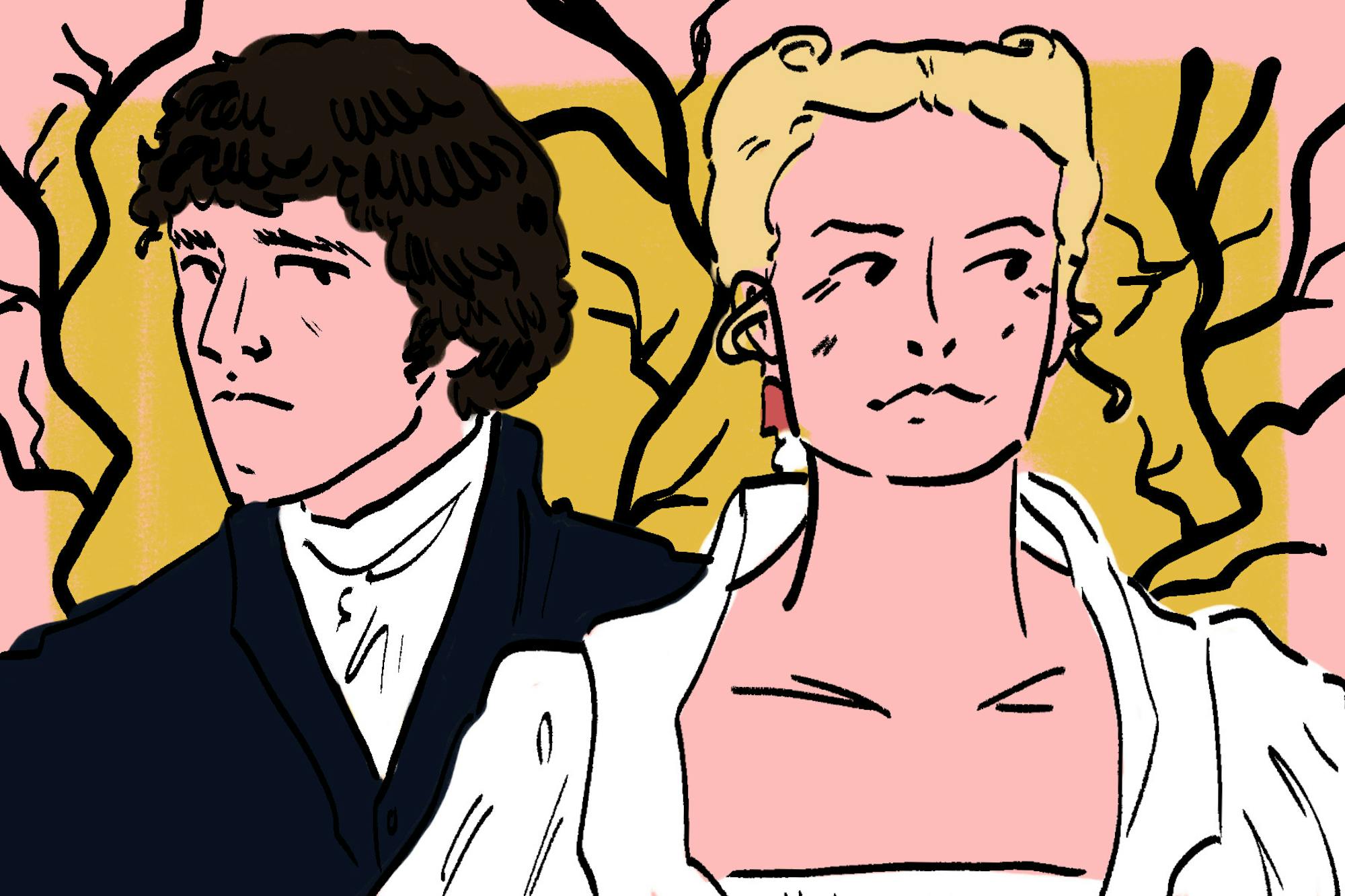
Spoilers ahead for Emily Brontë’s novel and Emerald Fennell’s film adaptation of “Wuthering Heights.”
I lost hope for Emerald Fennell’s surrealistic adaptation of “Wuthering Heights” not when its casting was announced in September 2024, or when on-set photos were leaked in March 2025, but when I read that it would be marketed as a Valentine’s Day release. At its core, Brontë’s gothic source text is not a love story, although the novel does contain fraught and passionate romance. It is instead a tale of all-consuming obsession and revenge, class struggle and structural racism.
There are numerous modern film interpretations of classic texts that manage to remain thematically faithful to their source inspirations. Consider Baz Luhrmann’s postmodern “Romeo and Juliet” or even Amy Heckerling’s glitzy “Clueless” that, despite its distinctly ’90s setting, still recreated the plot and evoked the central themes of Jane Austen’s “Emma.” While Fennell’s “Wuthering Heights” may be highly stylized and entertaining, it ultimately demonstrates little comprehension of Brontë’s novel — resulting in a starry, yet ultimately vapid, film.
Like the novel, in “Wuthering Heights,” Mr. Earnshaw (Martin Clunes) of the titular Yorkshire estate takes in a young orphan he found starving on the streets of Liverpool to be raised alongside his daughter Catherine “Cathy” (Margot Robbie). Catherine names the boy Heathcliff in honor of another brother who died in childhood, establishing their relationship’s incestual undertones. Notably, the film does not feature Earnshaw’s eldest son Hindley, whose character also appears in the book. Catherine and Heathcliff fall into a passionate love as children, but when he overhears her saying that marrying him would be beneath her, he disappears in a rage, and Catherine proceeds to marry the neighboring wealthy textile merchant Edgar Linton (Shazad Latif). Upon his return, a wealthy and jaded Heathcliff torments the couple and eventually marries Catherine’s sister-in-law Isabella Linton (Alison Oliver).
In Fennell’s defense, the quotation marks around the film’s title with which it is stylized emphasize that she is not attempting a by-the-book retelling. Still, with its casting approach and characterizations, Fennell’s “Wuthering Heights” misses some of the novel’s key thematic points, contributing to the shallowness of the adaptation.
In the novel, Brontë writes Heathcliff as racially ambiguous: The text describes him as “dark” and a “gipsy” and also refers to him by the derogatory term “Lascar,” which was used to insult South Asian workers on European ships. In one striking moment, Heathcliff tells Nelly, the estate’s housekeeper and the novel’s primary narrator, “I wish I had light hair and fair skin,” thus attesting to his struggles with his racial identity that help propel the plot.
In the film, however, Jacob Elordi, a white actor, plays Heathcliff — a casting choice that undermines this important racial theme explored in Brontë’s text. Regardless of his strong acting capabilities, Elordi was not the right choice to portray a character whose ostracization on the basis of his race leads to his vengeful spirit. Moreover, while Heathcliff’s character is thus “whitewashed,” the characters of Nelly and Edgar were cast in a “colorblind” way, meaning their race was not considered as a factor in casting. In tandem, these casting decisions feel particularly tasteless.
While Oliver is delightful to watch, the characterization of Isabella is also a prime example of the film’s dilution of some of the novel’s key themes. In the novel, Heathcliff weds her to torture Catherine and traps her in an abusive relationship, and in an infamous scene, he hangs her dog. Fennell, however, cuts that moment in favor of a sexual scene in which Isabella is chained up like a dog, winking at viewers to imply that she consents to this degradation. Fennell’s reframing of the dynamic between Isabella and Heathcliff as a representation of healthy sexual submission does not read as a celebration of women’s autonomy, but rather as a clear disregard of the power dynamics at play in Brontë’s text.
That said, Fennell excellently conveys her protagonists’ vicious, passionate nature. Upon Heathcliff’s return, everyone else essentially becomes collateral damage in their vacillating quests to be with and hurt one another. Elordi in particular convincingly spews contemptible vitriol and communicates his character’s obsessive nature with unrelenting, ominous eye contact and barely-contained lust. While Robbie is not a particularly convincing 15-year-old, her delivery, at turns petulant and wrenchingly love-struck, does effectively capture Cathy’s headstrong, selfish nature.
Stylistically, Fennell opts for a maximalist set and vivid color palette scored with Charli xcx’s new album “Wuthering Heights,” and these choices are sometimes highly compelling. For instance, presenting Edgar’s manor Thrushcross Grange like a life-sized dollhouse underscores how trapped Cathy feels. The Yorkshire moors are also portrayed as wondrously moody and beautiful. The costume designer Jacqueline Durran, best known for Joe Wright’s “Atonement” and “Pride and Prejudice,” designed a whirlwind range of costumes that she told Vogue drew combined inspiration from the Tudor period, the “New Look” of the 1950s and high-shine contemporary materials like latex and cellophane.
At the time of its 1847 publication, Brontë’s novel was considered brutal and coarse, devoting unconventional time to themes of female liberation and the racial hierarchy of late Georgian England. In her film adaptation, Fennell has stripped the story of most of this core meaning. Instead, she injects “Wuthering Heights” with excessive and shiny contemporary touches as though they automatically make the film subversive and thought-provoking for modern audiences.