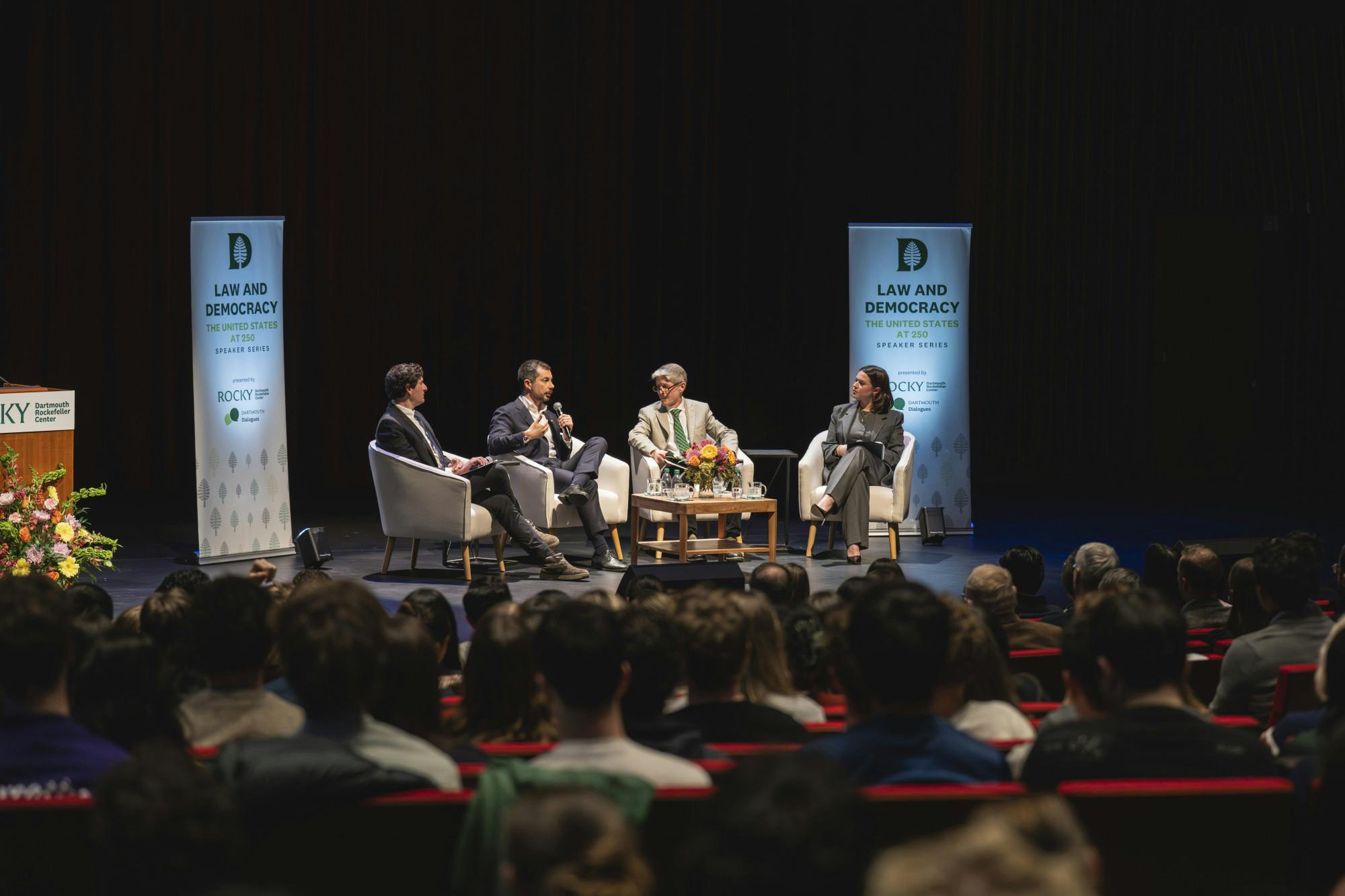
Former U.S. transportation secretary Pete Buttigieg visited Dartmouth last week to meet with students and speak on a panel about the future of American politics.
At the Rockefeller Center for Public Policy event on Feb. 20, Buttigieg told audience members that it’s “a hard time to be an American” and urged students to pursue public service.
The event — which took place at Spaulding Auditorium and was co-moderated by government professor John Carey, government professor Herschel Nachlis and Dartmouth Democrats executive director Lucia Vitali ’26 — was part of the Rockefeller Center’s “Law and Democracy: The United States at 250” speaker series. The talk drew an in-person crowd of 675 attendees along with 1,200 livestream views, according to Rockefeller Center associate director of public programs and special events Dvora Greenberg Koelling.
Before serving as transportation secretary, Buttigieg served as mayor of South Bend, Ind. from 2012 to 2020. In 2020, after launching a presidential campaign, he became the first openly gay man to win delegates in a major party presidential primary. Buttigieg is the most popular candidate among likely Democratic 2028 presidential primary voters in New Hampshire, according to recent polling by the University of New Hampshire Survey Center.
Buttigieg’s appearance at the College came as part of a three-day visit to the Granite State, according to The Boston Globe. The state historically holds the nation’s first presidential primary for both parties’ nominations, but was moved after the South Carolina presidential primary by the Democratic National Committee in the 2024 cycle.
When Vitali asked if he would announce a 2028 presidential campaign, Buttigieg laughed and replied, “Not today, but thanks for the opportunity.”
Buttigieg said that his party “struggles to imagine” the future, adding that he thought many Democrats were only offering to “reverse all of the damage” of the second Trump administration.
“I’m very worried in many different ways that my party is even more susceptible than the Republican party to a sense of looking backward, a kind of nostalgia,” he said. “If all we’re offering is … ‘we’ll make America look kind of like it did in 2023,’ we are really going to struggle.”
On policy, Buttigieg pointed to more progressive taxes, universal healthcare coverage, background checks on guns, marriage equality and comprehensive immigration reform as major issues where “60 or 70%” of Americans agree with Democrats.
“We need to foreground these things that Americans are with us on and make it clear that we could have all of those things, but we’ll lose them if we keep putting the other side in charge,” he said.
Buttigieg discussed his experience running for president as an openly gay man, which he said would’ve been seen as “preposterous” just a decade before his campaign in 2020.
“It’s amazing how much changed socially, as well as policy-wise, in a short amount of time,” Buttigieg said.
Buttigieg added that it was important that those advocating for “equality” tried to “invite and beckon” their opponents to join “the right side of history.”
“The only healthy future for this country is one where everybody on both sides of the aisle, including people who voted for [Trump], can agree that we can never go back to the way things are right now,” Buttigieg said.
When asked about his advice for students interested in public service, Buttigieg acknowledged that it’s always been “easier” and “more lucrative” to enter the private sector. Buttigieg noted that after graduate school, he worked as a consultant for McKinsey and Company, but after three years at the company realized that he “didn’t care in any deep sense” about his work.
“There’s something you can get just in terms of propulsion, in terms of meaning, from being involved in public service, and there’s nothing like it,” he said.
Buttigieg also stressed the importance of being an active participant in the current political moment.
“This moment is the kind of moment that a future generation might romanticize as having been fascinating, full of upheaval,” he said. “It’ll look really cool in a documentary in 30 years — that doesn’t make it any easier to live through.”
Buttigieg concluded his remarks by describing his vision for the United States as a “fully functional, full-scale, multiracial representative democracy,” and encouraging young people to pursue careers in public policy.
“A world where …we pulled together and decided that short-term greed [is] not a good enough reason to endanger your generation,” Buttigieg said. “Wouldn’t you like to be part of that, even if it means some tough choices as you’re graduating from college?”
Audience member Shoshana Bernstein ’26 said that Buttigieg was “great at resonating with students.”
“He’s a cool guy,” Bernstein said. “I felt like he was really great at articulating very important ideas in a really nuanced way.”
Audience member Daniel Sparks ’29 said that Buttigieg “has always been [his] hero.”
“As a gay man myself, who loves politics … he’s literally me,” Sparks added. “I think he clearly wants to run for [president], and I think we’ll see him again in three years when the primaries come.”
Will Sánchez '29 is a reporter from Portland, Ore., studying government and psychology.