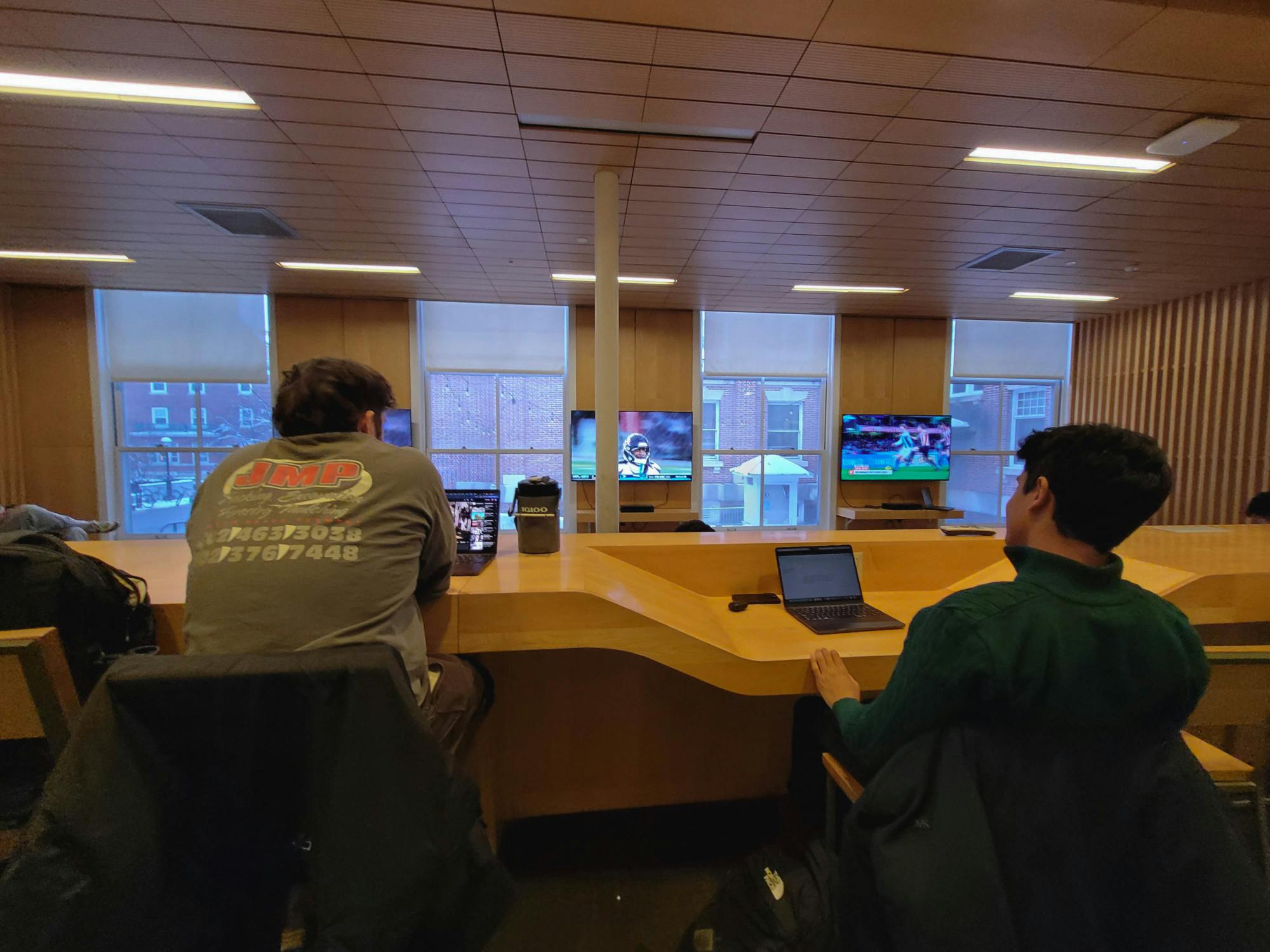
With Super Bowl LX around the corner, students and faculty members have mixed reactions to the growing influence of sports gambling apps on professional sports and campus culture.
New Hampshire law permits both online and in-person sports betting for all individuals 18 and older. Last year, sports bets on Super Bowl LIX totaled a record $1.39 billion, fueled by the expanded legalization of online and in-person sports betting.
Sports Analytics Club member Elliott Gomes ’28 said that sports betting has “taken over the casual viewers’ attention.”
“You see 20 ads for sports betting in between the plays of a game,” Gomes said. “These online sportsbooks have … really taken prominence in the annual sports landscape.”
Gomes said that he does not gamble, adding that he felt that sportsbooks were “designed to make you lose money.”
“Sportsbooks give you bad odds most of the time,” Gomes said. “The way they make money is essentially by people losing.”
Economics professor Eric Zitzewitz, who studies sports betting and prediction markets, said that while sports gamblers “think they’re better at estimating the odds of the game than other individuals in the market,” that generally “can’t be true.”
He added that students should “be careful” with sports betting because “psychological biases are built in” that can make participants think that they are better at betting than they really are.
“One of them is called biased self-attribution, where you tend to remember the bets that go well and forget the bets that go badly, and therefore you kind of end up with an inflated view of how good you are at betting in the market,” Zitzewitz said.
Gomes added that he had concerns about sports gambling impacting the “integrity” of professional sports.
“Everyone knows that sports gambling is impacting the integrity of the leagues to some extent,” Gomes said. “Nobody really knows how much that extent is.”
Atul Venkatesh ’27, who used to engage in sports betting but no longer does, said that gambling on sports is “like entertainment” even when the bettor is not profiting.
“[It’s] always pretty fun, pretty exciting [and] pretty entertaining,” Venkatesh said.
Venkatesh added that sports betting can get viewers “more involved with the game.”
“Certain players [and] certain teams who normally you wouldn’t have investment in — because you bet on them, you’re now very interested in seeing the outcomes,” Venkatesh said.
However, Sheba Duan ’27, who does not participate in sports betting, said that nobody should be gambling “unless [they’re] a mathematician.”
“I know one person who gambles, and he has lost money,” Duan said. “You can claim that you’re making some kind of reasoned decision, and that’s why you’re willing to put money behind it, but at the end of the day, it’s called gambling because there’s not a lot of certainty attached to it.”
Sebastian Lema ’29, who never puts his own money in and only uses free, in-app allowances, said he makes his bets based on his “knowledge of the sport” and “also a little bit of what team I want to win.”
Jack Sawyers ’29, who usually spends $5 to $10 as a part of in-app promotions to sports bet, said he bases his decisions on his knowledge of the sport and his opinions of the players.
“But then also I’ll sometimes look up certain statistics and see what’s expected from the players,” Sawyers added.
Zitzewitz said that students should look at the behavior of their friends who gamble on sports and “watch out for potential addiction.”
“Make sure that you know it’s something that you’re doing for a little bit of fun,” Zitzewitz said. “For some people at least, you can get addicted to this stuff.”
Alex Klee ’29 is a reporter from Woodbridge, Conn. He plans to major in economics and minor in math. He enjoys live music, skating and climbing.
Madeline Kahn Ehrlich '29 is a reporter from upstate New York. She is considering studying English and Public Policy. She enjoys creative writing, art and reading historical fiction.