
The Declaration of Independence, the Constitution, George Washington — these images represent America, but what do they say about our nation?
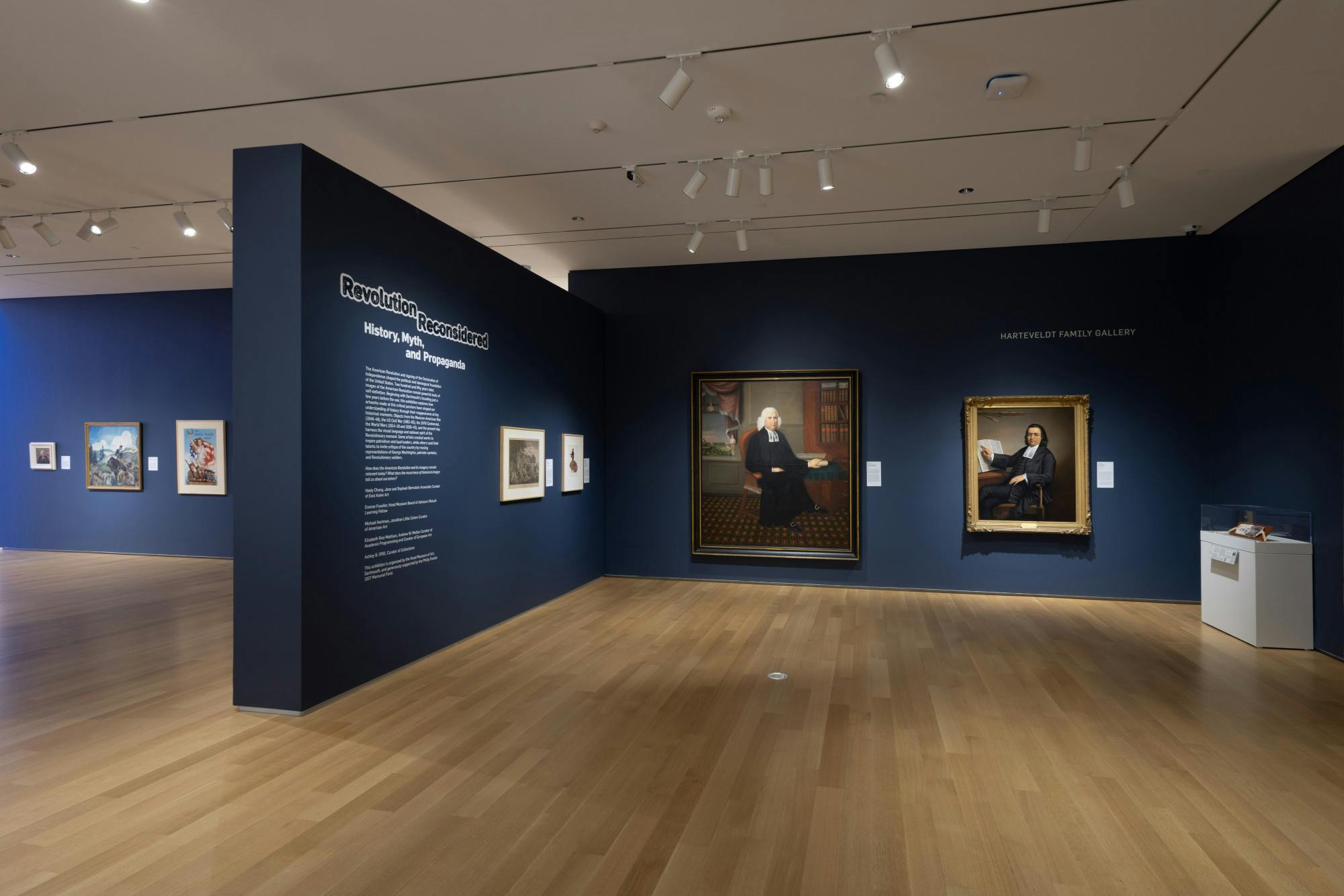
The exhibition “Revolution Reconsidered” at the Hood Museum explores how art has historically shaped America’s self-conception. Hood curator of collections Ashley Offill added that the curators particularly wanted to highlight the role of art in understanding and telling the story of America’s founding.
“One of the key goals of ‘Revolution Reconsidered’ is to draw visitors’ attention to the variety of ways that images and stories related to the American Revolution have been understood and utilized throughout the history of the United States,” Offill wrote in an email statement.
Whether they were “purchases” or “gifts and bequests,” the exhibition’s approximately 50 objects all come from the Hood’s permanent collection, according to an email statement from Offill.
In an interview with The Dartmouth, Andrew W. Mellon curator of academic programming and curator of European Art Elizabeth Rice Mattison said the exhibition “looks critically” at the historical moment of the American Revolution.
However, she said it also explores how “representations of the Revolution are refracted throughout different moments in the history of the U.S., and the ways in those images are leveraged to different ends, to craft [a] very specific version of the past.”
Accordingly, there is a section related to the founding of the United States, including a print reproduction of John Trumbull’s famous painting “The Declaration of Independence.” There are also sections spotlighting more recent historical events such as the Mexican-American War, World War II and the Vietnam War as well as historical portrayals of Native Americans — a common thread being the echoes of Revolutionary imagery.
Mattison and Offill both identified the part of the exhibition devoted to George Washington as a standout, particularly considering his importance in American iconography.
For instance, positioned next to each other, “George Washington on a Stick” and “The Commemoration of George Washington” offer contrasting visions of the often venerated first president. While the first depicts a corroded version of Washington’s inauguration portrait balanced on a stick, the second shows him ascending to heaven guided by two angels.
Offill described the second image as a “great example” of how “George Washington transitions from a historical entity into a saint-like, almost defied figure as a way to promote American strength.”
“[This section] highlights the use and reuse and manipulation of imagery so clearly,” Mattison added.
Jake Keil ’29, who recently viewed the exhibition, pointed out the ironies inside the depictions of Washington.
“The most interesting thing is that the art is portraying Washington as a god or a heavenly figure — when he and his ideas for the U.S. government in general were about making a president more of a human than a king,” Keil said.
These musings are in line with the curators’ hope that the exhibition will “generate a lot of discussion,” according to Mattison.
Specifically, she said she hoped it would inspire college and local students to “think critically about the work that images are doing in terms of framing our understanding of the past.”
Olivia Sapper ’29 is a reporter from Darien, Conn., and is majoring in Government.


