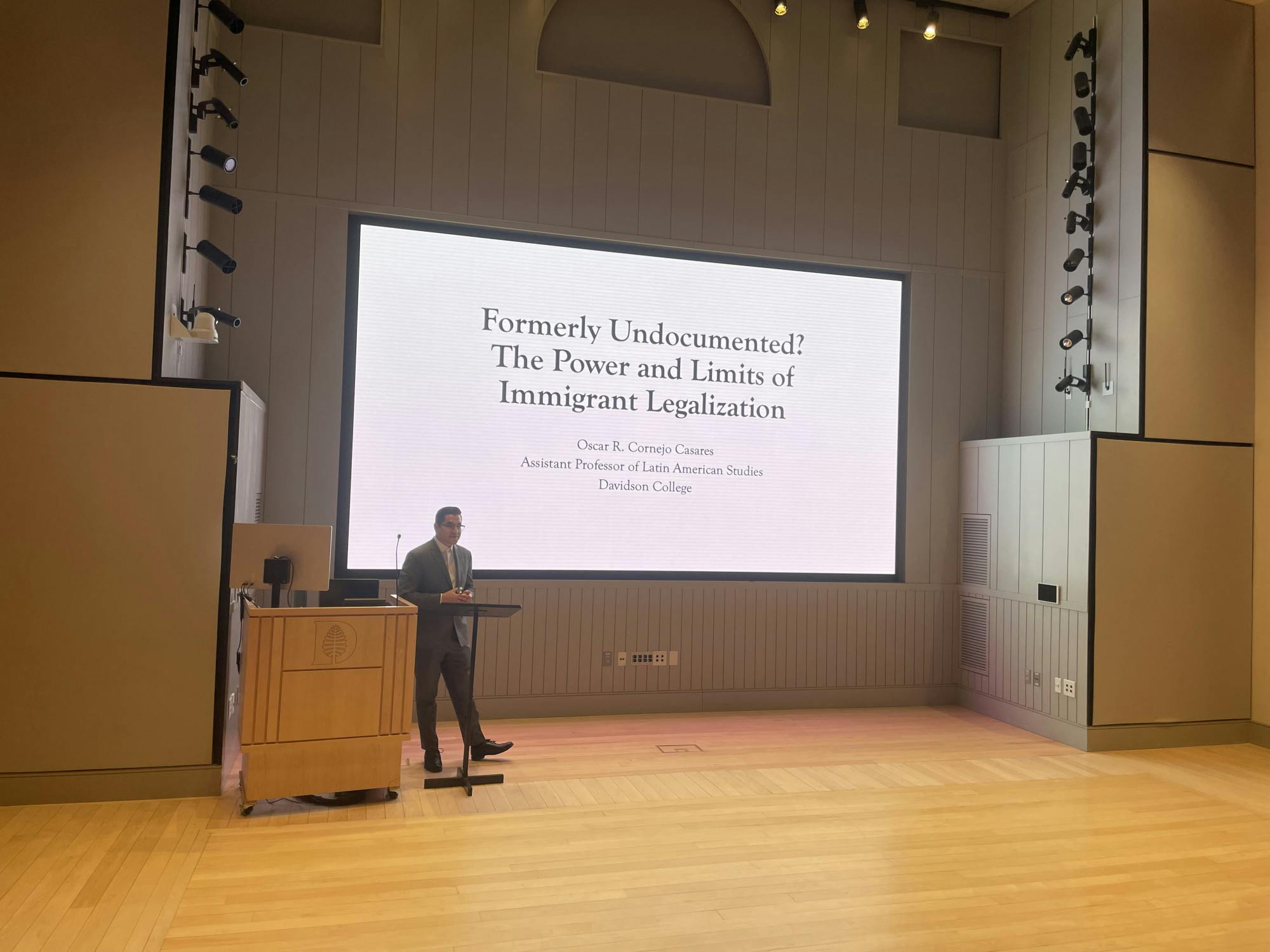
In a lecture on Jan. 22, Davidson College sociology professor Oscar Cornejo Casares ’17 spoke about the experiences of undocumented immigrants and argued that the formerly undocumented face continued social consequences after gaining legal status.
Approximately 40 community members were in attendance for the lecture, titled “Formerly Undocumented? The Power and Limits of Immigrant Legalization,” which was hosted by the sociology department along with Latin American, Latino and Caribbean studies department and the Rockefeller Center.
Cornejo Casares shared that he analyzed a subset of a dataset of 56 undocumented and formerly undocumented Latin American immigrants in the Chicago area. He found that there are two key processes associated with the “experience of illegality” that shape the “dispositions” of undocumented and formerly undocumented immigrants in the United States.
The first, which he calls the “habitus of illegality,” is the way that “socio-legal histories of exclusion” impact undocumented and formerly undocumented immigrants. According to Cornejo Casares, the “possibility of deportation” creates a constant sense of fear among undocumented immigrants.
It is the “threat, the fear, the possibility of deportation that produce the socializing and controlling effects of the law,” he said.
According to Cornejo Casares, “legalizability” is another form of state power that alters undocumented immigrants’ experience of illegality.
“As undocumented immigrants pursue the possibility of legalization, they often incorporate the state’s logic of deservingness to make themselves worthy of legalization through their actions, behaviors or mindsets,” Cornejo Casares said. “Legalizability, in turn, functions as a form of control, through a kind of hope of a desired and not yet plausible future.”
Cornejo Casares said that the second way in which “illegality” affects the livelihoods of undocumented people is through a mechanism he terms “habitus of neo-illegality.”
This phenomenon arises when once-undocumented immigrants gain legal status, and the dispositions that they’ve internalized when they were undocumented are “reconfigured.”
“The formerly undocumented remain undocumented through embodiment,” he said. “They are somehow in between the habitus of illegality, but not quite yet in the possible habitus of citizenship. They’re in this in-between.”
Cornejo Casares said that his research raises questions about belonging in American society.
“This research also allows us to have the conversation about what membership [and] belonging we might cultivate that are beyond the law, because in this instance, the law and the state [are] the problem,” he said.
In an interview after the event, Cornejo Casares said that it felt “culminating” to return to Dartmouth for the lecture, and discussed in more detail the “theoretical and practical applications” of his research.
“I think that theoretically, one of the key takeaways is about the limitations of citizenship and the reimaginations of citizenship,” he said. “I think for social work, for instance, we need to put a spotlight on the formerly undocumented as a group.”
Francisco Arias Cabanas ’28 shared that he attended the event for extra credit in his SOCY 2: “Social Problems” class, and due to firsthand familial experiences with the “psychological effects” of immigration.
Cabanas said it was “very interesting” to think about the “long-term effects” of undocumentation “from a scholarly perspective.”
Alyssa Ortega ’29 said that she also attended the event for extra credit in SOCY 2, and because the presence of Immigration and Customs Enforcement agents in her home city of Chicago piqued her interest in the topic.
“I think the thing that stood out to me the most was the [idea that] getting citizenship is the ultimate goal, but that fear [of deportation] never really goes away,” she said.
Sociology professor Janice McCabe, who helped organize the event, said in an interview before the event that she hoped the lecture would give students “a sociological and research-informed perspective on a topic that is incredibly important in our world.”
Sociology professor Sunmin Kim, who also took part in organizing the lecture, said that he hoped the talk would help students who are immigrants, or have relatives who are immigrants, feel “validated.”
“I want to get the message across to the student body that regardless of what’s happening, regardless of what the powers that be make you feel, you should feel validated and proud of that heritage or your own experience about migration,” he said.