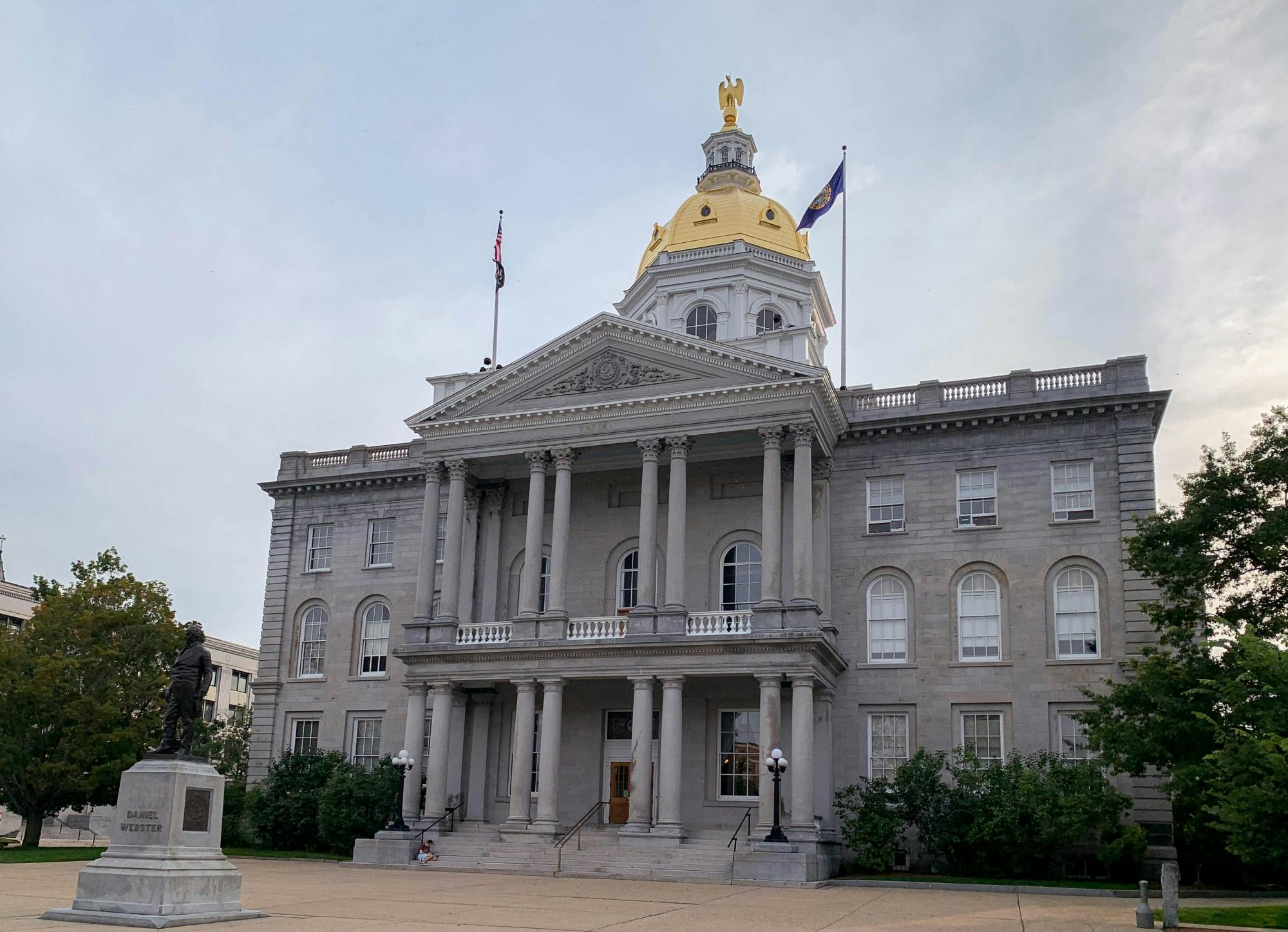
New Hampshire state legislators have proposed more than 1,140 bills in the first few weeks of the legislative year, covering issues from education policy to firearms regulation, according to the Concord Monitor.
Not all proposals have been formally introduced to the State House of Representatives or State Senate yet. However, every bill introduced will receive a full hearing, debate and vote, according to State Rep. Richard Nalevanko, R-Cheshire. This approach differs from other legislatures such as the U.S. Congress, where bills may die in committee.
“All bills, regardless of what happens in the committee process, get a full hearing,” Nalevanko said. “It’s important to note that committees cannot kill a bill.”
Among the more than 1,000 proposed bills, a handful have attracted significant attention. The Dartmouth unpacked a few of them.
H.B. 1749: Death Penalty
Democratic executive councilor Karen Liot Hill ’00 said there are “several bills” that have been proposed to reinstate the death penalty in New Hampshire. Among those bills is H.B. 1749, which would restore capital punishment for “murder offenses,” according to the bill’s text.
Hill said the death penalty was abolished statewide in 2019 after “over a decade of very hard work and a lot of public testimony opposing it.”
“When our current governor [Kelly Ayotte] was formerly the attorney general for New Hampshire, she favored the death penalty,” Hill said. “So this is a bill that I hope will be defeated, but it certainly is a bill that has to be taken seriously.”
In an email statement to The Dartmouth, State Rep. Samuel Farrington, R-Strafford, wrote that he “understands both sides” of the debate to reinstate the death penalty but ultimately opposes the measure.
“Personally, I oppose a broad death penalty because I don’t trust the government deciding who gets to die,” Farrington wrote.
H.B. 186: Legalizing Marijuana
On Jan. 7, the House passed H.B. 186 in a 208-135 vote. The bill, if signed into law, would permit adults 21 and older to possess up to two ounces of cannabis flower, and 10 grams of concentrates and cannabis products containing up to two grams of THC. It would also allow individuals to grow up to six cannabis plants at home, with no more than three mature plants.
State Sen. Donovan Fenton, D-Keene, who introduced — a similar bill legalizing marijuana in the Senate — said New Hampshire should “lead” instead of “falling behind.”
“New Hampshire’s the only state in New England that hasn’t legalized and regulated cannabis,” Fenton said. “Every single one of our neighbors has figured this out while we’re still pretending prohibition is working and people just drive to Massachusetts, Maine, Vermont, buy it legally and come right back anyway.”
Fenton noted that a 2025 executive order signed by President Donald Trump reclassified marijuana from a Schedule I to a Schedule III drug under the Controlled Substances Act, a less severe classification.
“Cannabis is no longer treated like heroin — it’s treated more like medications like Tylenol or testosterone, and that’s a huge shift,” Fenton said.
Farrington wrote that he “doesn’t expect [the bill] to become law” because several efforts from the House to legalize marijuana have failed in the Senate in the past.
“The Senate tends to be against legalization, and the governor certainly would not support it either,” Farrington wrote.
H.B. 1605: New Hampshire Intelligence Agency
H.B. 1605 would establish a “state office for intelligence and counterintelligence within the executive branch,” according to the bill’s text.
This bill proposes allocating $6 million to fund three to five analysts, two to five investigators and additional support staff, with analysts and investigators required to have military or equivalent training in intelligence and counterintelligence, according to the bill’s text. The office would also investigate threats posed by “hostile” foreign actors.
State Rep. Mike Belcher, R-Carroll, who co-sponsored the bill, wrote on X that China is “a pretty big problem.”
“Just look what they’ve gotten up to in Maine,” Belcher wrote. “We need a small office of investigators and analysts tasked with tracking these foreign threats on New Hampshire soil.”
However, Fenton opposed the bill, saying that a “state intelligence agency cuts directly against” New Hampshire’s “privacy tradition.”
“It makes no sense why the state needs its own intelligent agency,” Fenton said. “ ... We have state and local law enforcement already sharing threat information with the federal government.”
H.B. 1013: “Prohibit Games to Capture a Pig”
H.B. 1013 would prohibit “games in which the object is to capture a pig.” State Rep. Paul Berch, D-Cheshire, a co-sponsor of the bill, said the bill aims to address “animal cruelty.”
“I know in the business of some events at fairs that the supervision is not good, that animals such as pigs are pulled in inappropriate ways,” Berch said. “I think there’s better ways to do it.”
Berch noted that while there is a “long tradition of pig scrambles,” which are agriculture fairs where children chase, catch and restrain piglets in a ring, there are “better ways” to teach children about animals.
“The value in teaching kindness and gentleness to animals is a bigger value than even the value of tradition,” Berch said.
Farrington described the bill as “the silliest of the entire session.”
“Just another example of government overreach,” Farrington wrote.
H.B. 1793: “Campus Carry” Bill
If enacted, H.B. 1793 will “prohibit public colleges and universities from regulating the possession or carrying of firearms and non-lethal weapons on campus,” according to its text.
Farrington, who introduced the bill, wrote that the bill “will protect the natural right to self defense.”
“New Hampshire is a constitutional carry state, meaning that a lawful gun owner can carry in public without a permission slip from the government,” Farrington wrote. “The Supreme Court has recognized the second amendment as an individual right — Article 2A of our state constitution further protects this natural right.”
Farrington also noted the recent Brown University shooting, which occurred in a gun-free zone.
“We know that gun-free zones only create soft targets where victims have no chance of putting up a fight,” Farrington wrote.
Fenton said the bill is “absolutely horrible” and that “there’s no reason someone should have guns on any school grounds or campuses.”
“Schools are for learning, not for crossfire and education relies on trust and not fear,” Fenton said. “We’re just adding an element to the situation where it makes things more dangerous and no one’s getting protected.”
The range of bills introduced at the start of this legislative session fits a broader pattern in New Hampshire’s state legislature. While some bills have been described as “silly,” Hill said it is “fairly typical” to see bills which are “hard to believe.”
“A bill was introduced [in 2024] for New Hampshire to secede from the United States,” Hill said. “These kinds of outrageous bills have become part of the regular business.”