
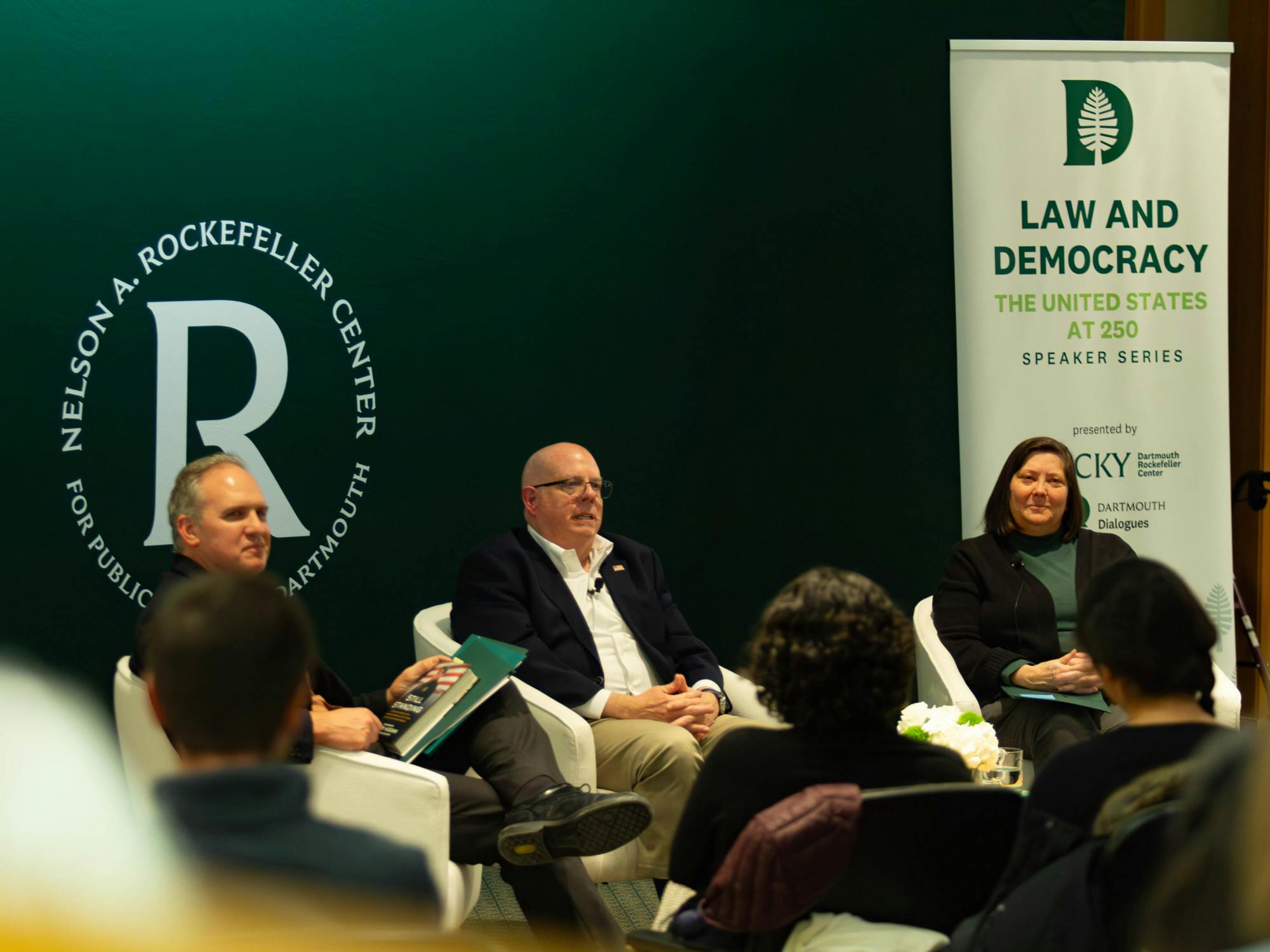
On Jan. 28, former Maryland Gov. Larry Hogan urged bipartisan cooperation and said students should “disagree agreeably” at a Rockefeller Center for Public Policy event.
Approximately 90 people attended the event in Filene Auditorium. The event — which was co-hosted by Dartmouth Dialogues — was moderated by Rockefeller Center director Jason Barabas and economics professor Patricia Anderson.
Hogan was the second Republican elected governor in the state of Maryland in 50 years, serving from 2015 to 2023. He served as chairman of the National Governors Association during the COVID-19 pandemic.
Hogan began the event by discussing his performance as governor. He said that he was “very proud of [his] administration.”
“We left it on the field and did the best job we possibly could under some challenging circumstances,” Hogan said.
Hogan noted that he was a Republican governor “in arguably the bluest state in America.”
“We actually got things done in a bipartisan common sense way,” Hogan said. “It’s something that I think is really lacking in America today.”
Audience member Eli Berkowitz-Douglas ’29 said that Governor Hogan’s emphasis on bipartisanship was “refreshing.”
“It was great to hear from Gov. Hogan because he’s a rare voice of moderation in today’s politics,” Berkowitz-Douglas said.
Hogan said that as chairman of the National Governors Association, he attended bipartisan weekly Zoom conferences during the COVID-19 pandemic to discuss states’ needs with the federal government. He said that constituents “appreciated the transparency” of the NGA during the crisis.
“I had to get the best information I could [and] make quick decisions, because people were dying and businesses were shutting,” Hogan said. “I just [tried] to get the right information, make the tough decisions, regardless of the politics, and then explain to people … here’s what we’re doing.”
Hogan also noted his efforts towards passing the 2021 Infrastructure Investment and Jobs Act, calling the state of America’s infrastructure prior to the act “an embarrassment.”
Infrastructure “was one of those issues where Republicans and Democrats were talking past each other and not coming up with any compromises,” he said. “I held an unprecedented summit at the governor’s mansion in Annapolis with Republican and Democrat governors, senators and congressmen, and I made them hammer out a compromise.”
Shifting towards present-day politics, Hogan said that politicians should stand up for their beliefs whether they’re “politically popular or not.” He said that he “greatly admired” his father — a U.S. representative from Maryland — for his “courage” in breaking with the Republican Party to support impeachment proceedings against President Richard Nixon.
“The whole Nixon administration, the whole Republican National Committee, all of his colleagues in Congress and some of his supporters and friends were very angry,” Hogan said. “But it’s the thing that he’s most remembered for now.”
Hogan also identified gerrymandering as a particularly concerning practice, referring to it as a “cancer on democracy.”
“I think that’s a big part of the problem in state legislatures and the Congress, because the politicians pick their voters instead of the voters picking their representatives,” Hogan said.
Hogan added that he supported term limits for U.S. congresspeople, and noted he did not want to run for office again. He described the Senate as a “self-obsessed retirement community.”
“They stay there until they’re in their mid 80s, and we need some younger blood down there,” Hogan said.
In an interview with The Dartmouth after the event, audience member Jacob Markman ’27 said he was very impressed with Hogan’s “focus on getting things done rather than achieving nominal victories.”


