
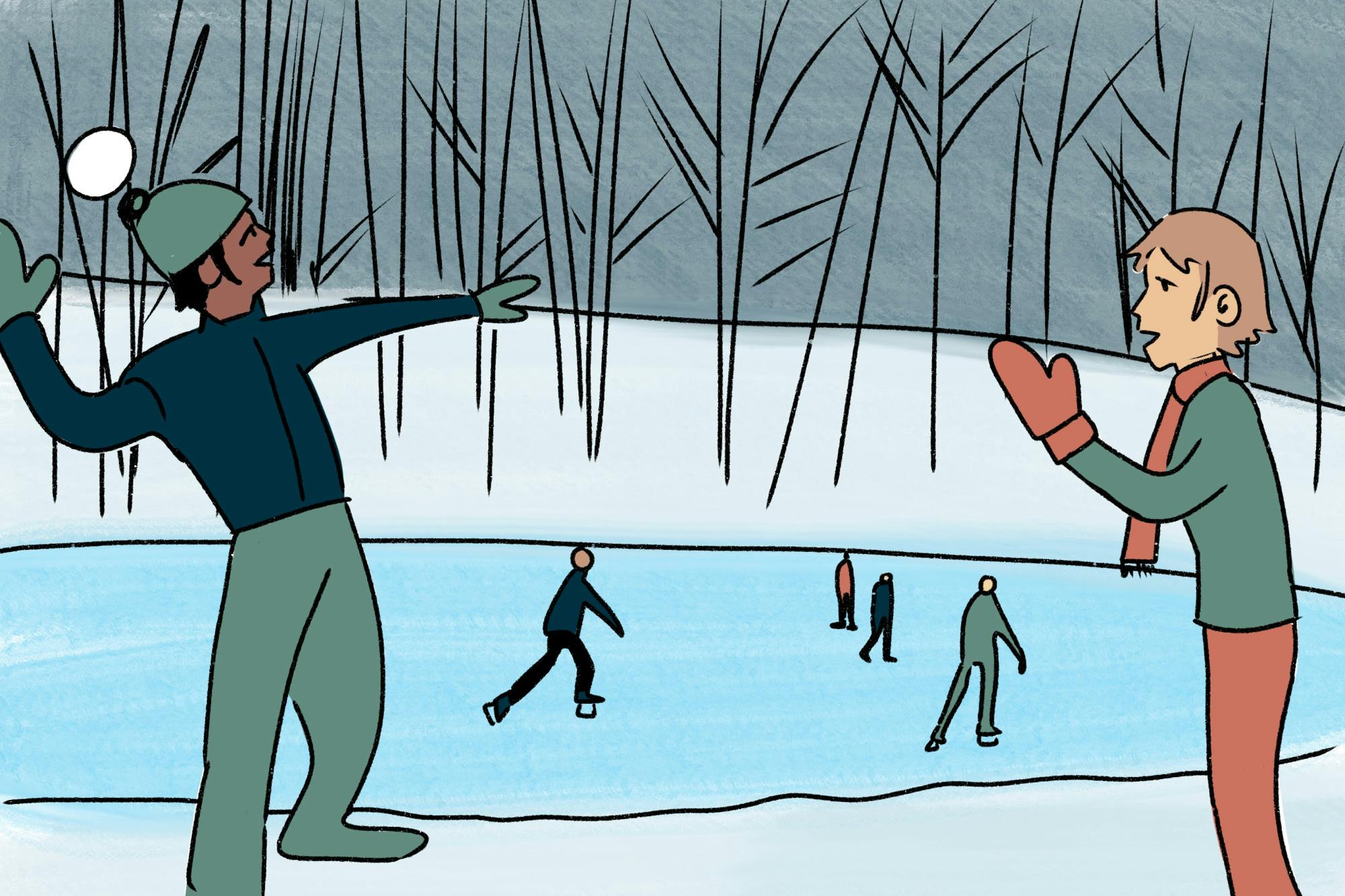
The first line of Kaveh Akbar’s poem “Wild Pear Tree” goes, “it’s been January for months in both directions.” This has been the crux of my winters at Dartmouth. It has taken me a while to get used to the New England flora of forests and short brick buildings. Many times I have found myself relieved at the sight of a slab of concrete when I travel down to Boston.
Taking root at Dartmouth pushed me to juggle acceptance and discovery. As a senior, I can look back and feel lucky to have come of age under the wide Hanover sky pierced with stars and to have made friendships that provide shelter from the cold. I rejoiced in inventing routes in a too-small town. Yet, as I’ve acclimated, I had to confront that the “nothing” here makes up for the “anywhere-ness” of a city.
This is an invitation to observe our campus closely rather than wondering about what-could-have-been-elsewhere. Winters at Dartmouth are tough. Still, many students learn to function, create and thrive in the unforgiving climate of the short winter term. A small campus can be hospitable to creating your own fun with little to no cost. Here is my week of learning to be a guest in the many corners of my campus, making my way through warm side-quests.
Monday
Microbrews happens every Monday from 8-10 p.m. in One Wheelock. With a Dartmouth ID, anyone over the age of 21 can help themselves to various beer and IPA options. The leather couches, bar seats and wooden chairs are always crowded with regulars. Alongside being a free and cozy alternative to going out for drinks, Microbrews put a lot of student musicians on my radar. This week, my expectations of the event I associated with acoustic or jazzy sets were subverted with a DJ set. Regardless, I rely on Microbrews to introduce sweet tunes to my Monday blues.
Tuesday
Rauner Special Collections Library stands tall in the front right corner of Baker’s lawn. From the outside, it appears to be part of the landscape of many administrative buildings, with sides of stone and brick perfectly aligned. I walked into the building with the goal of finding something I didn’t know existed before. Rauner reminds me of a pantry full of jams and pickles: There is comfort in knowing someone is keeping things preserved. I left my coat and bag in the lockers outside, and enjoyed a newfound lightness from the winterwear that typically cradles me. I jotted down a few boxes that caught my interest on the library website and requested them online prior to my visit.
I decided to look into the history of creative writing at Dartmouth, inspired by the recent talks organized by the English and Creative Writing Department as part of the Cleopatra Mathis Poetry and Prose Reading Series and my class, CRWT 11: “Introduction to Creative Nonfiction.” The boxes are full of folders, stacked back to back, organized by an internal logic I am not privy to. At Dartmouth in the 20th century, the creative arts were almost exclusively hosted through the Hopkins Center for the Arts in collaboration with other departments. In the files, I found internal communications, photos of invited authors and articles from The Dartmouth about the public reception of the book talks. Every year of the 1980s, the English department hosted a fundraiser through Book & Author luncheons in collaboration with the Hop. The Arts Education Services’ collaboration with the Hopkins Center brought artists, educators and students together from all over the Upper Valley, and even made news in Boston. In the archives, there was a lot of chatter from people who cared to culminate, experience and enjoy the arts at Dartmouth, regardless of the weather.
Wednesday
I took off to the Hood Museum as a little detour before the Hop resident artist and jazz pianist Jason Moran’s first recital of the week. I spent most of my time perusing the American Pop curation, trying to keep track of the layers of imagery. Eager to be a part of every show I see and every exhibition I view, I tried to find a compromise between consumption and inspiration, standing in the room.
Once I made my way to the second floor of the Hop, I found the new Jack ’53 & Mac ’11 Morris Recital Hall very easily. I walked into a room with high ceilings and windows for walls, glad that this was the site for Moran to reimagine Duke Ellington. The event, “The Music of Duke Ellington: My Heart Sings,” is a celebration of the legacy of the musician, which Jason Moran performs as an homage. I felt immense joy experiencing Ellington in the hands of another gifted musician, generously providing a peek into what it means to live through jazz.
Thursday
The jewelry studio is located at the Lower Level of the Hop, next to the ceramics studio and woodworking workshop. I made a note to look them up later. I hesitantly walked into the jewelry studio, 10 minutes earlier than my appointed slot.
The jewelry studio is a popular location frequented by students of all class years. Every slot is approximately an hour long, and the studio can host up to eight people. At times, students may not be able to find an open slot to sign up for a given week — a testament to the space’s popularity. Still, when I walked in the desks were empty, and there was no one there besides two jewelry artists, one of them a student. They let me peruse the different artifacts left behind by previous crafters: wires and beads bent and connected to make up big earrings and silver rings etched with patterns and letters. Next to them, there was a fruit bowl packed with a mix of beads in the midst of being color-sorted: the “free bowl.” Beads winked and gleamed from the large, sorted closet. Behind the desk, there were more drawers, labeled by color. Each of them is priced, almost consistently, only up to 35 cents a bead.
The jewelry studio staff handed me a bunch of copper wire and told me that if I got the hang of it, they’d give me the silver wire, since working with copper is cheaper and allows for more experimentation. I ended up with twisted, darling little earrings, barely touched by the pliers I was equipped with. I didn’t end up having to pay for the materials, as the cost tallied up to barely over a dollar. Maybe the artists thought I shouldn’t have to pay for the monstrosity I wrangled with my bare hands. I decided to come back another time with a plan.
Friday
I have been waiting to revisit the renovated Top of the Hop since my freshman year. Every Wednesday through Friday from 5-7 p.m., the bar is open for students to grab a drink, catch up or do work. Its balcony juts out towards the Baker-Berry Library, allowing for much-needed sunlight during winter days. On Fridays, the Hop Fellows host events that bring student artists in front of audiences. These events are accompanied by tables to spread the word about opportunities for funding and engagement with the arts at Dartmouth. Last Friday, the Hop Fellows hosted an intimate concert for the community, much like an NPR “Tiny Desk Concert.”
We watched three performances back-to-back for two hours, each with a slightly different set-up and genre. The night took us through original piano ballads, a dreampop performance on a high chair and a band playing originals and covers worth dancing for. I saw people chatting over the music and others mesmerized. Snow fluttered outside. I thought to myself, I am glad we are all here.


