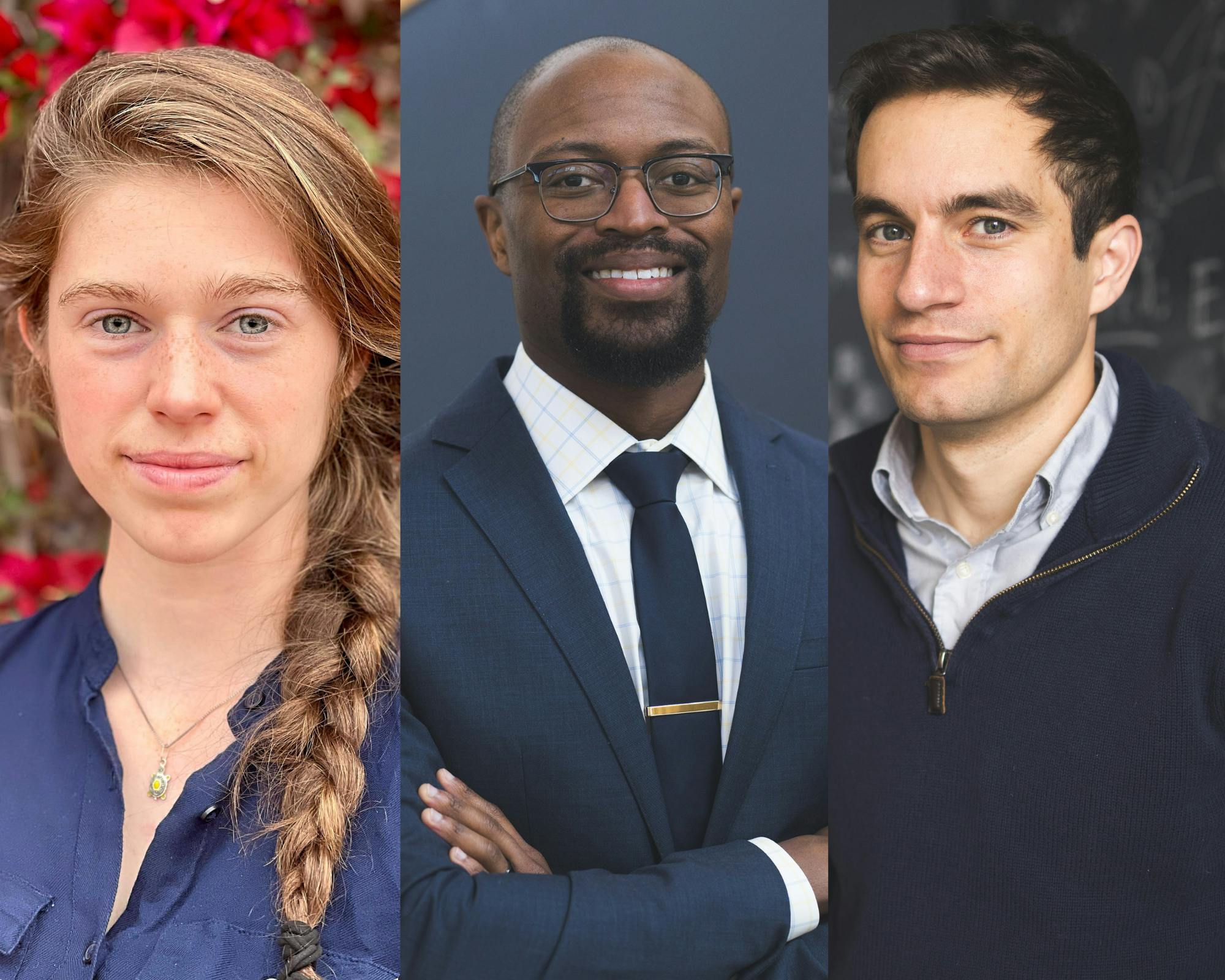
At the beginning of the 2025-26 academic year, Dartmouth brought in 30 new tenured and tenure-track scholars across disciplines, including atmospheric science, studio art, economics and East European studies. Two of the 30 new members are Dartmouth alumni.
Newly hired assistant professor of engineering Rebecca Gallivan said that Dartmouth’s interdisciplinary and collaborative approach to engineering made the College appealing to her.
“For me, the fact that the engineering department here was so interdisciplinary and so close-knit across those different focus areas was really appealing,” Gallivan said.
Gallivan also hopes to combine her passion for historic materials with art and environmental conservation in future projects.
“I would really love to build up some relation and pair with the Hood Museum of Art and be able to intertwine some of the art and science together and use our understanding of materials and their understanding of materials in art,” she said.
Similarly, new assistant professor of government professor Keidrick Roy said that he too was drawn to Dartmouth because of its “interdisciplinary” approach to education. Roy added that one of his goals in teaching is to provide students with “practical and moral tools” to be “great in their jobs and good human beings.”
“I also want them to have familiarity with what it means to think well across one or more disciplines,” he said. “I want students to understand how to think in the breaks and the gaps, regardless of the career that they choose.”
Health policy and clinical practice assistant professor Guanbo Wang, who is also a part of the cohort, said he was surprised at the abundance of cross-department collaboration at the College.
“I feel like I’m being seen by people like the department chair of medicine and the research chair,” he said. “I feel like I’m involved.”
Roy echoed Wang’s sentiment.
“I love attending events and working with colleagues and departments beyond my home department of government, such as history, philosophy and African and African American Studies,” Roy said. “Any given project I’m working on is often engaging with each of these fields.”
Bijan Mazaheri, a new assistant professor of engineering, shared that one of the reasons he came to Dartmouth was because of the equal value it puts on both research and teaching.
“I like that Dartmouth straddles the line of really cutting edge research, while also still caring about undergraduate education,” Mazaheri said. “I think it’s pretty unique in that regard.”
When describing her first term at Dartmouth, assistant history professor Tara Suri agreed.
“It’s been so clear to me how teaching and the energy around teaching feeds back into research and helps me ask and refine my own research questions,” she said. “It’s an amazing community of scholars — scholars who teach and who learn — and the students are just so exciting to work with.”
Mazaheri, whose research focuses on causal inference, has already started a new class at Dartmouth called “Principles of Causality.” Additionally, he hopes to contribute to the work of researchers focused on artificial intelligence at the College.
Beyond the balance of research and teaching, some professors found themselves shocked by the level of student engagement with unfamiliar topics.
“What has blown me away is students’ curiosity and interest in constantly learning more, digging deeper,” Suri said. “The number of students who came by to borrow a book from my office was really incredible.”
Assistant professor Cong Chen, who works on advancing the global energy transition through economics and AI in the engineering department, added that the College’s setting has a “good research and study atmosphere.”
“It is a very beautiful area and a very good school so students can actually come down and get into the details of all those research studies,” she said.
Jared Gonzalez Arce '29 is a news reporter from California majoring in history. Out of The D, Jared is in surf club and loves music.
Eliza Dorton '29 is a reporter from Washington, D.C. and is studying English and public policy. Outside the classroom, she enjoys reading and going on walks.