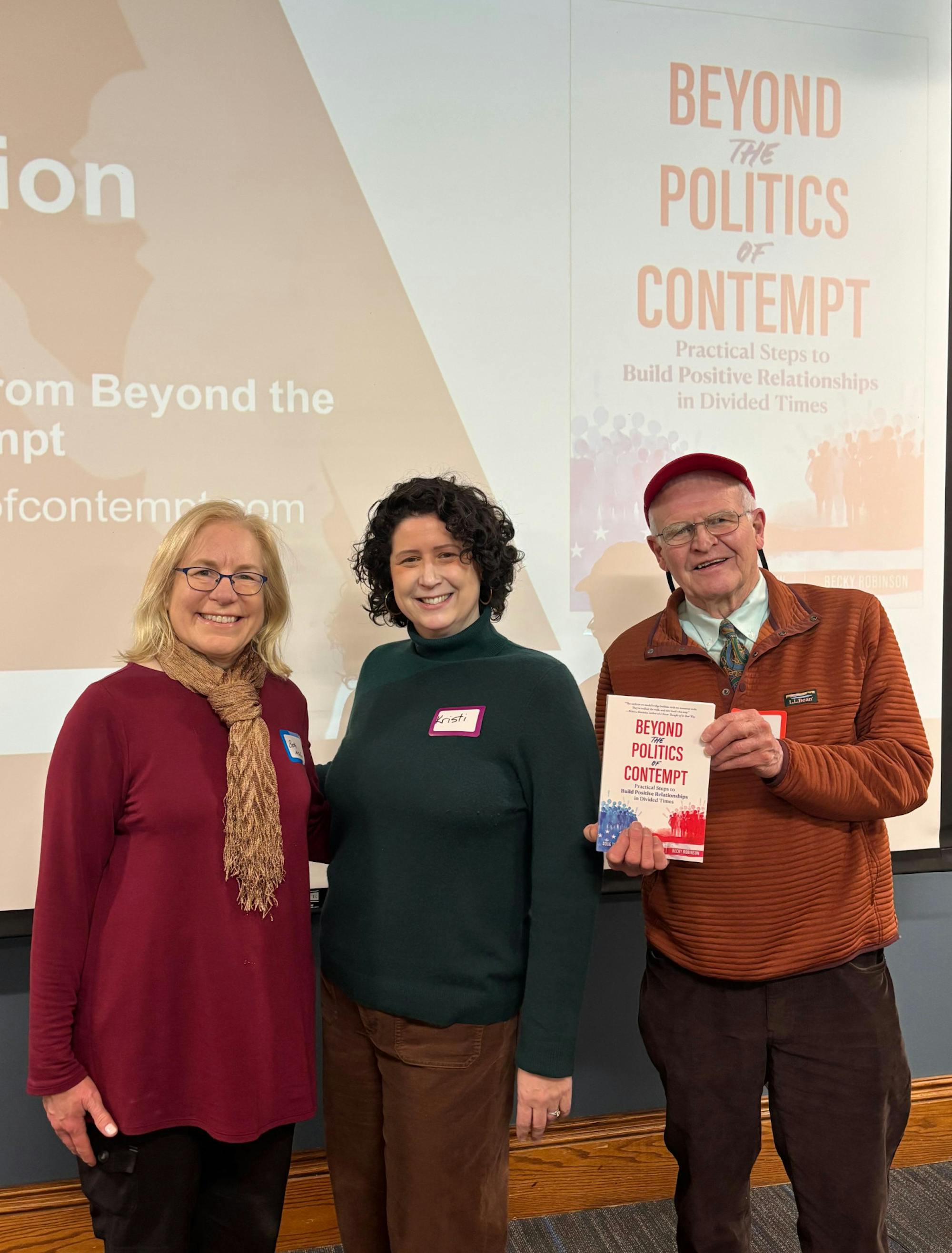
On Sunday, three students gathered in the Collis Center for Student Life for a workshop titled “Communicating Across Differences: Hopeful and Practical Steps to Build Positive Relationships in Divided Times.” The event, hosted by Dartmouth Dialogues, focused on how to engage in difficult conversations across political and social divides.
The workshop was led by Vanderbilt University Medical Center neurology and pediatrics professor Beth Malow and former N.H. Rep. Doug Teschner, co-authors of “Beyond the Politics of Contempt,” which examines political polarization in the United States while offering solutions on how to heal that division.
The event comes as Dartmouth Dialogues enters its third year on campus. The initiative was launched in January 2024 with the goal of equipping students, faculty and staff with tools for constructive engagement across differences. Dartmouth Dialogues executive director Kristi Clemens described the workshop as part of a sequence of programming with Teschner and Malow that began with a public talk in November and a workshop with faculty and staff in December.
Clemens said that small turnout is an ongoing challenge for the program.
“It’s really hard with Dartmouth students to know how to reach them or what is interesting to them,” she said.
Clemens added that Dartmouth Dialogues hopes to create a student advisory board “in the next couple of terms” to better reach students.
In an interview before the event, Malow described the book’s approach to difficult conversations as “pragmatic” rather than purely relationship-preserving.
“We feel it is okay to persuade others or at least share our point of view,” she said. “The difference is that we speak our viewpoints after we have first listened to the other person and diffused tensions.”
Malow added that the book advocates against engaging in us-versus-them behavior.
Malow said that she and Teschner support the Dartmouth Dialogues program’s emphasis on small-group, skills-based workshops.
“We agree with this approach, as the workshops help students communicate in a way that builds relationships, rather than breaks them down, while still speaking authentically,” she said. “Small group conversations also allow students to speak their minds in a way where they can be heard, rather than social media or large group settings where ideas can be misinterpreted.”
In an interview after the event, Jacob Markman ’27 said he attended the workshop to develop practical dialogue skills.
“I went to the workshop to learn more about how to engage in constructive dialogue,” Markman said. “I hoped to learn practical skills to help me navigate difficult conversations.”
Markman added that his interest was shaped by polarization in the broader political climate.
“I am quite alarmed by the level of polarization as well as hate and lack of empathy that exists across political divides,” he said. “I think much of the reason these divides exist is because we live in self-perpetuating orthodoxy where truth has become hollowed out into convenient slogans that often go unexamined.”
In an interview prior to the start of the workshop, Teschner emphasized that the listening-first approach can apply beyond interpersonal disagreements.
“The framework also applies to policy decisions and disagreements at the institutional level as well,” Teschner said. “Listening first to understand, then speaking to be understood, are effective approaches for any conversation or topic.”
Clemens encouraged students to attend Dartmouth Dialogues events even when they are unsure what to expect.
“Come to the event because you might learn something new,” Clemens said.
Isabel Menna ‘29 is a reporter from Leavenworth, Wash., is majoring in economics and is a member of the Dartmouth Ski Patrol.