
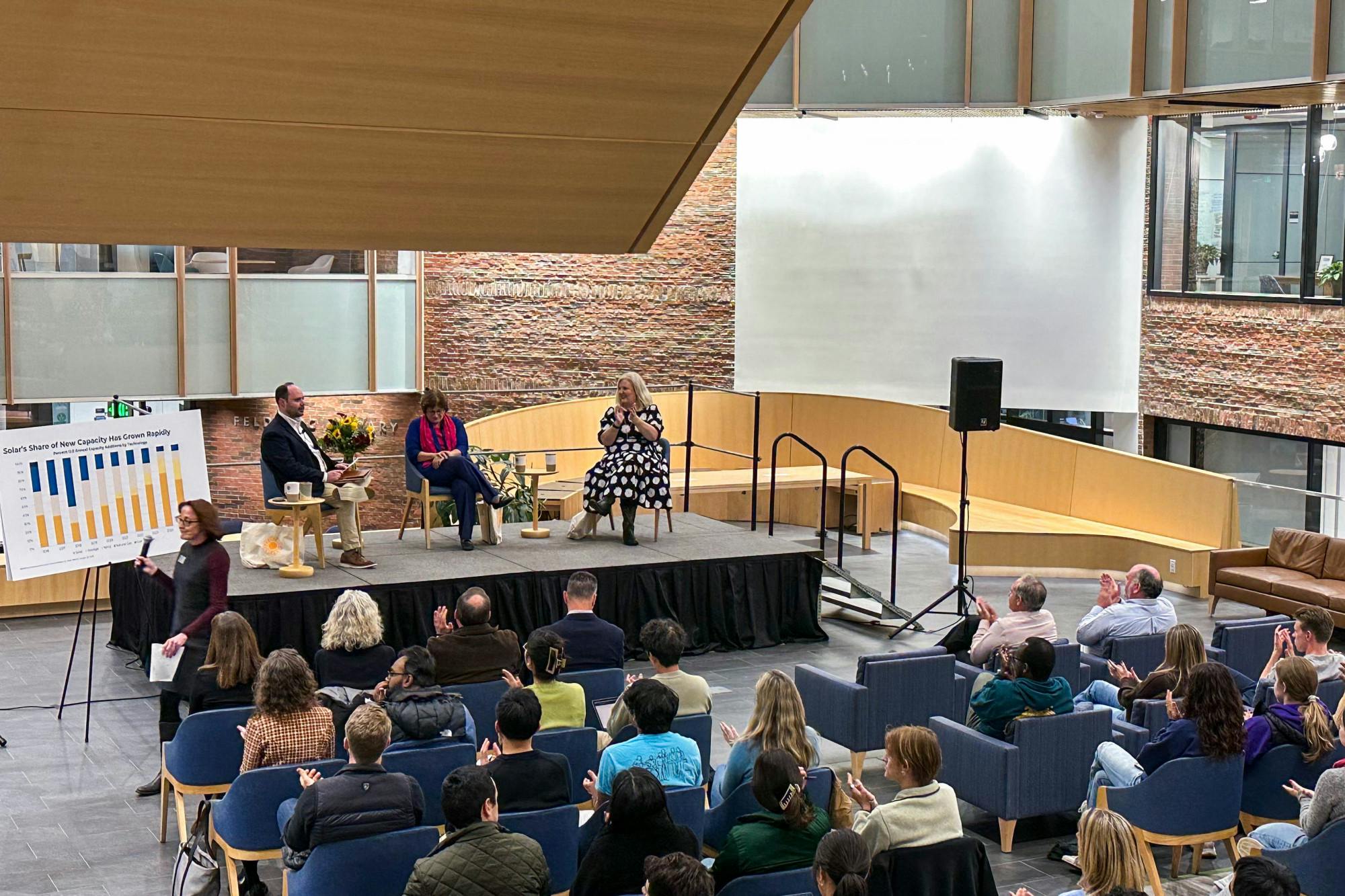
The Rockefeller Center for Public Policy hosted former Rep. Annie Kuster ’78, D-N.H., and CEO of the Solar Energy Industries Association — the national trade organization for solar and storage industries — Abigail Hopper ’93 for a conversation about energy policy. The two said President Donald Trump has discouraged the clean energy industry by denying permits and ending federal subsidies for clean energy developments.
The conversation — titled “From Capitol Hill to the Capital Markets: Charting the Clean Energy Future” — was co-hosted by the Arthur L. Irving Institute for Energy and Society and the Revers Center for Energy, Sustainability and Innovation and moderated by Revers Center director Jonathan Silverthorne ’08. Approximately 127 students, faculty and community members attended.
Hopper said the Trump administration “weaponized” the permitting process for clean energy developments. In July 2025, Trump signed an executive order ending green energy tax credits and removing federal subsidies for renewable energy. Later that month, Secretary of the Interior Doug Burgum issued a secretarial order “stopping all permitting,” Hopper said.
“Permitting decisions, which are both federal and local, are being utilized to stop project by project by project,” she said at the discussion. Almost every large-scale solar project or battery project has ended because the federal permits they need have been stopped by the U.S. Department of the Interior, according to Hopper.
Hopper announced at the event that she is stepping down as CEO of SEIA after nine years “partly because what’s happening in Washington is not normal.”
“I’m tired of pretending like it is,” she said.
Similarly, Kuster said that “one factor” in her decision to retire in January was because of her “frustration” with Trump’s “refusal to recognize the impact of climate change.”
“[Trump] has essentially conceded the future of the global superpower race to China” who “fully embraced” clean energy, she said. Kuster said the Trump administration has “stopped [energy] projects in their tracks,” including “offshore wind” and “solar energy” advancements.
Hopper said that since Trump has taken office, SEIA’s lobbying strategy has shifted from solar’s climate impacts to affordability and foreign policy.
“Since Jan. 20, I haven’t really said the word ‘climate’ at all,” Hopper said in an interview before the event. Instead their lobbying emphasizes “American energy dominance.”
Kuster said that politicians should “change their approach” to talking about climate change.
“Focusing on the polar bears was too remote for real people’s real lives,” Kuster said. “It wasn’t translating to electoral politics.”
Kuster said her interest in energy policy stems from the fact that it is a “major expense in people’s household budgets.”
“The cost of energy is very high [in New Hampshire], and so I was always looking for ways to lower the cost of energy, and things like solar and wind, new sources that can, if they’re broadly introduced, lower costs considerably,” Kuster said.
Audience member and Vermont coordinator for Citizens Climate Lobby Jennifer Durgin spoke out during the discussion about how clean energy organizations need to be “bipartisan.”
“We need to support those moderate Republicans, and we need to keep having conversations across the aisle,” Durgin said at the event.
Kuster agreed, and apologized for mentioning political parties “a number of times” during the conversation, adding that it’s “difficult” to have climate-centered conversations “without” their mention.
In an interview after the event, Durgin said Hopper and Kuster “did a really good job on focusing on the most pressing issues right now with renewable energy.”
“We drastically need permitting reform,” Durgin said.
Attendee Bill Zheng ’26 stated that the event was “very interesting.”
“It really focused on constituents, everyday people,” Zheng said.
Audience member Rae Aaron Tu’27 went to the event because she works in sustainable finance. She said it was “especially awesome to see two women” who are “really successful from different segments of society.”
“I was really curious to hear from a representative and also someone involved in the renewable space,” she said.
Eliza Dorton '29 is a reporter from Washington, D.C. and is studying English and public policy. Outside the classroom, she enjoys reading and going on walks.


