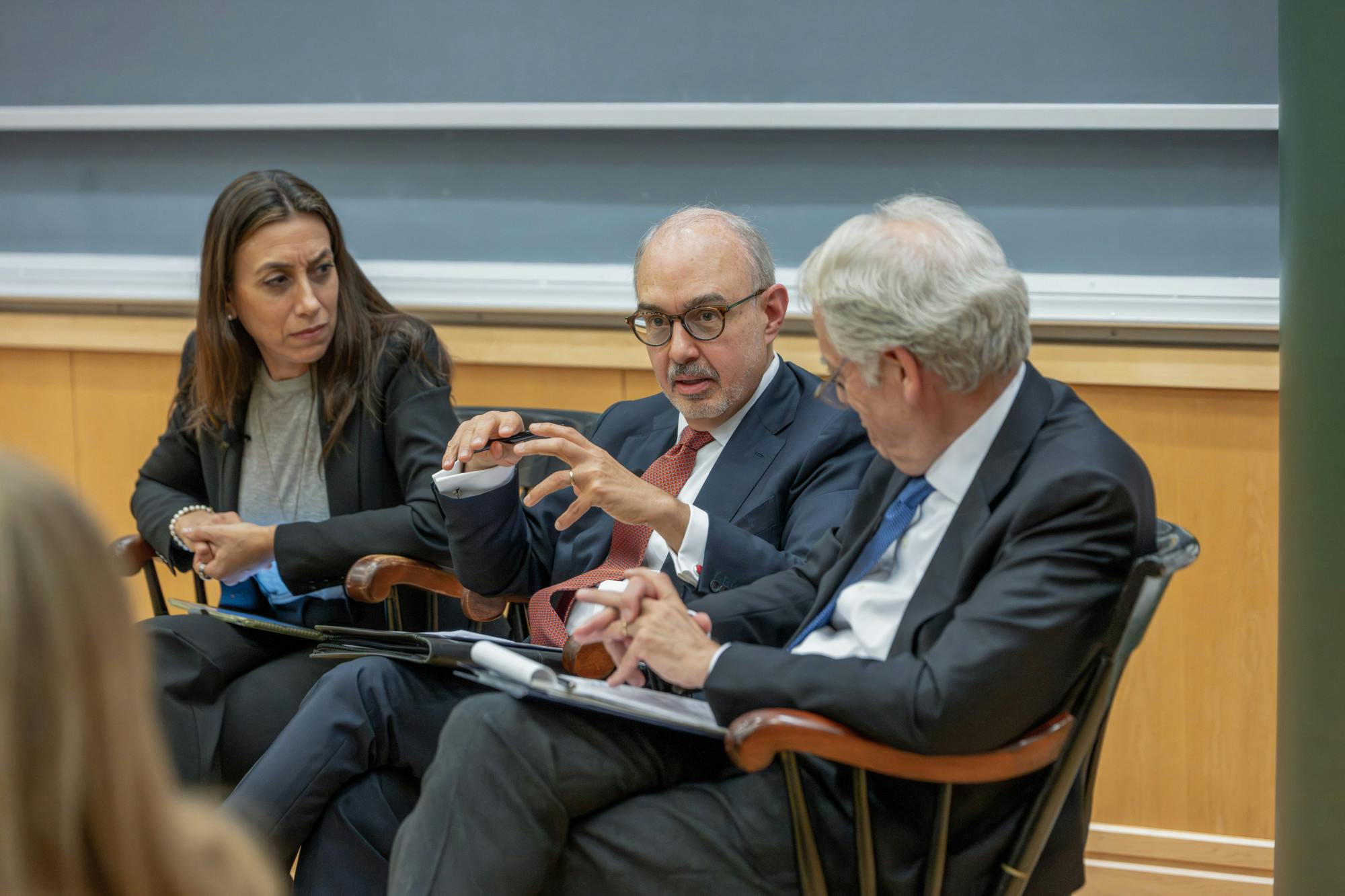
Three former ambassadors discussed the United States’s renewed interests in the Central American and the Caribbean region at a Dickey Center for International Understanding event titled “Global Crossroads: The Americas, the U.S., the UN, and a new Chapter of Diplomacy?” on Oct. 2.
The event drew around 75 in-person and 20 online attendees, according to Dickey Center events program manager Judith van Rhijn Jackson. Dickey Center director Victoria Holt moderated the discussion, which centered on improving multilateral diplomacy.
Ambassador Norberto Moretti of Brazil highlighted the “deep polarization” within the Americas and the Trump administration’s preference for “bilateral deals rather than collective efforts” as two major complications to collaboration efforts.
The UN Security Council — a “principal organ” of the UN responsible for the “maintenance of international peace and security,” according to its website — has been “effective when it comes to Latin American issues,” Moretti said, referring to its operations in Haiti and Colombia. He emphasized that the Security Council’s work would yield “better” results if the U.S. were “prone to a more collective and cooperative approach.”
U.S. Ambassador Jeffrey DeLaurentis, who served in Cuba, Colombia and at the United Nations for the U.S. for 28 years and teaches INST 80.06, “Multilateralism and U.S. Leadership,” at Dartmouth, explained that the Trump administration “has a different view” of “multilateralism and international law” from Moretti’s.
“The view from Washington seems to be that the rules-based international order is broken, or breaking,” DeLaurentis said. “It’s more about competition and scrambling for resources.”
The U.S. military has carried out 10 known strikes on boats in international waters in the Caribbean and along the Pacific Coast based on what President Donald Trump called “incredible intelligence” that drugs were being smuggled on these boats, according to the New York Times. These operations “bring bad memories to a region that is, to some extent, still traumatized by past U.S. action,” Moretti said.
“The use of force is what, I think, brings discomfort even to those countries that are aligned with the Trump administration,” he explained.
For example, Ecuador — a close U.S. partner — released a survivor of one of the attacks because it had no evidence he committed a crime, Moretti said. The decision indicates the “potential pressures of the internal domestic political opinion on how the U.S. is handling this issue,” he explained in reference to drug trafficking.
UN Department of Political Affairs director of the Americas division Laura Flores said that the U.S. has “skirted international law” by committing these attacks, citing that many human rights experts are calling the resulting casualties “extrajudicial killings.”
“We are experiencing a very challenging moment, a moment of unpredictability. And that obviously affects the interaction among member states, among the various stakeholders within the UN,” Flores said. “We just have to be nimble on our feet and adapt constantly.”
Flores also highlighted how U.S. involvement in Haiti has “transformed.”
“The multinational security support mission is now being transformed into a gang suppression force, sponsored and promoted by the United States,” Flores said. “We’re really hoping that this time around, we’re gonna be able to see things through, because ultimately, it’s a question of resources.”
Moretti said he was concerned by the Trump administration’s decisions to “withdraw from a number of entities of the [United Nations] system” and to not “pay in full” its contributions to the UN. These actions will “lead to an unbalanced organization,” such that “development and human rights” goals are “underfunded,” Moretti said.
Furthermore, the Trump administration’s advocacy for the UN to “go back to basics” — meaning that the UN should concern itself only with peace and security, and therefore not human rights or development — has “no support at all” from other UN member states, he added.
DeLaurentis pushed back on this idea, explaining that some American officials feel that the American contribution “isn’t necessarily recognized” by the other members of the international community.
“I feel obliged to say that the U.S., for decades and decades, has been an extraordinary supporter financially of all of the funds and programs,” DeLaurentis said.
Event attendee and student in DeLaurentis’s international studies class Issa Allison ’29 said he believed the ambassadors from Panama and Brazil offered a novel “global South perspective” rather than the “Western perspectives” that are “normally at events like this.”
“It really does extend our worldview,” Alison added.
Asked to give concluding remarks offering advice to young people interested in the region or in diplomacy, Flores emphasized the importance of “interconnectivity” and “spaces of collaboration.”
“The world is losing the capacity to listen and to connect,” she said. “We are all standing on our soap boxes and talking, and we need to connect more.”
Moretti, for his part, encouraged attendees to “think very hard on the relevance of the U.S. in the international system, and the relevance of the international system to the U.S.”
Will Sánchez '29 is a reporter from Portland, Ore., studying government and psychology.