
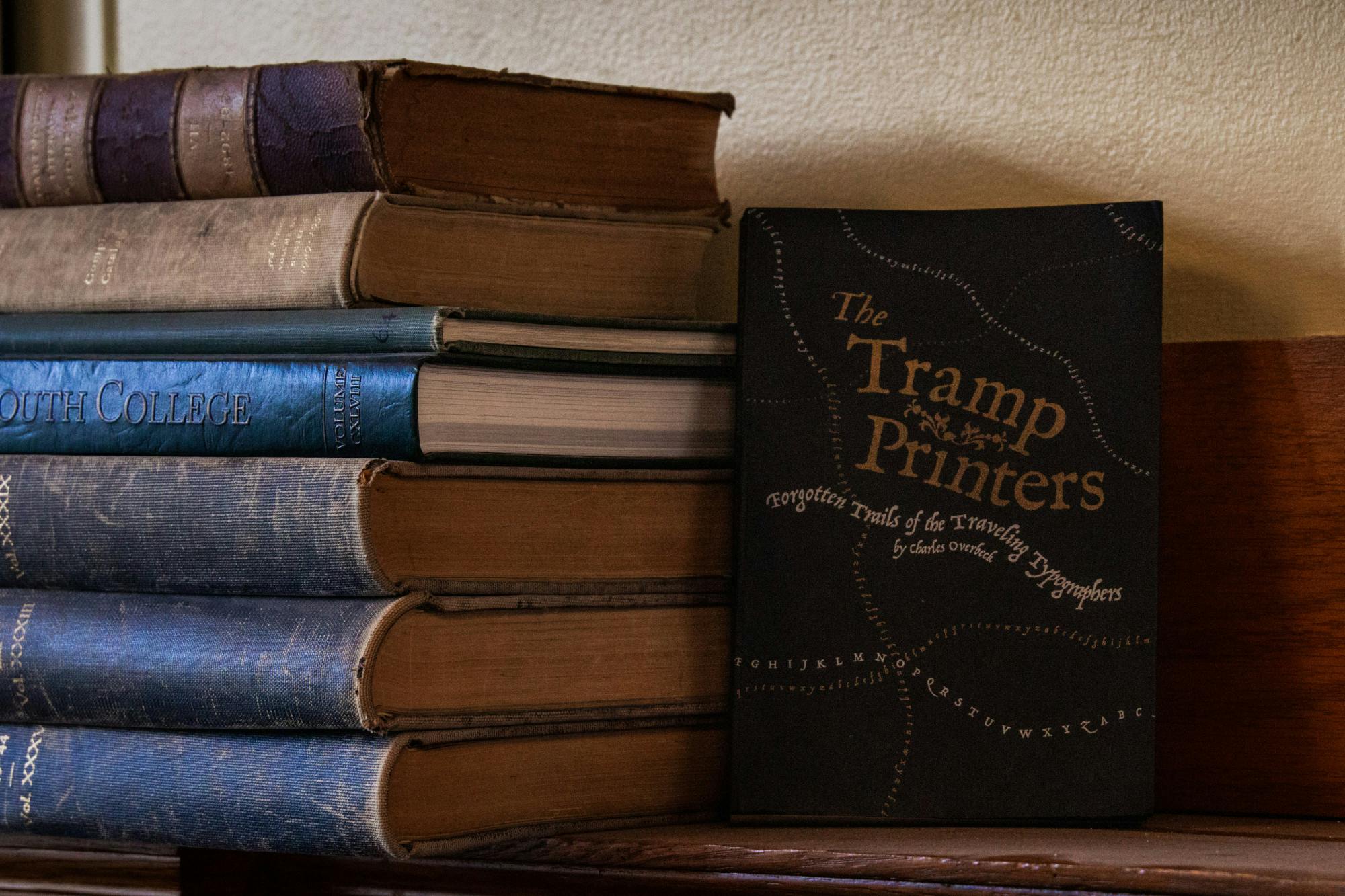
A wistful feeling I can’t quite place stirs in me at the arrival of fall: the shortening days bring thoughts of the open road, a desire to wander. The words of Isabelle Eberhardt are fitting.
“Now, more than ever do I realize that I will never be content with a sedentary life, that I will always be haunted by thoughts of a sun-drenched elsewhere,” she wrote.
Charles Overbeck, printer and co-founder of Eberhardt Press, a print shop in Portland, Oregon, working with zinesters, artists and small publishers, chose those words for the epigraph of his first book, “The Tramp Printers: Forgotten Trails of the Traveling Typographers.”
This, then, is the perfect moment to travel along the trails of those train-hopping typesetters chronicled in this brilliant, poignant book, published three years ago, which I recently had the pleasure of reading.
For more than a century, typesetters criss-crossed the continent by foot and rail, riding from newspaper to newspaper, with only a union card, their skills and a few small tools.
Contained in these beautifully set pages is the whistle of the locomotive, the feeling of hopping off an early-morning freight train and leaving town under the cover of dark, a few days later, the same way. The smell of lead, ink, hot coffee and thousands of unwashed miles; the sight of ink-stained wood floors and sawdust-floored saloons.
In the tales collected in Overbeck’s book, there is a refreshing sense of possibility, of freedom. “There is much to be said for being able to elect just how long one would work, much to be said for a walk in the sun, a ride atop a boxcar traveling through the mountains in the spring — for fresh air and freedom from boredom,” one tramp printer, Paul Fisher, wrote.
With Overbeck as your guide, you’ll meet legendary characters, hear about their antics and strange quirks, described as “on the far side of weirdness of character,” and their drinking habits, described as Olympian.
“They were trapeze artists and treasure hunters, drunkards and dreamers, irascible misfits, cunning prankers, motley poets, and devoted printers all,” Overbeck writes.
Traveling printers carried their union traveling card, which allowed them to work at any newspaper or print shop with a union contract.
“You could hit town by show-up time, work a shift, and the chairman would cash you out at the end of the shift, and issue you a new traveler, and you could be back on the road again,” tramp printer Dean Nayes wrote.
Overbeck convincingly argues of the role that printers played in the labor movement, including pushing for an eight hour day, and other fights for fair wages and better working conditions. The traveling typographers, Overbeck writes, “eschewed materialism and fought for their rights as workers for more than 100 years.”
The ground covered here was largely unknown to me, despite the fact that it belongs to a larger, ongoing story about which I care deeply.
“It is the story of people struggling against exploitation; it is the story of the inherent conflict between workers and owners; it is the story of people’s fervent belief in the power of the printed word; it is a tragic tale of lives drowned in a sea change of technology; it is the story of capitalism’s crushing triumph over trade unions, and the rise of corporate tyranny,” he writes.
He dedicates the book to the memory of the tramp printers and “in memory of everyone who ever sweated and swore over a printing press, in memory of every print shop that shut its doors forever, in memory of every printer who was thrown out a job and ended up working at a goddamned flea market, in memory of hot metal, in memory of real paper and real ink, in memory of the reek and clamor of a busy print shop.”
Today, in a landscape in which media conglomerates largely control both the means of transmission and the content being transmitted, Overbeck skillfully and convincingly links the dominance of media conglomerates to the destruction of printers’ trade unions.
“They were fighting for our futures more than a century ago, and it is up to us to carry that banner now,” he writes.
I am only scratching the surface of the cornucopia contained in Overbeck’s book.
Here are stories of first editions of newspapers being hand set within days of setting up a new town in the American West. Print shops, Overbeck writes, could have been set up under a fig tree in the Mojave desert or under a tarp in a field. Here too are heartbreaking stories of editors and printers who advocated the abolition of slavery or crusaded against political corruption being faced with deadly violence, their presses destroyed and print shops burned.
There are many delightful stories of the loveable character of tramp printers, too. Tramp printer John Edward Hicks described them as “essentially poets at heart.”
“They had in their makeup a little of the child, artless and whimsical; something of the philosopher, disillusioned and made cynical by their experiences,” Hicks wrote.
Some preferred to travel on foot, as part of a philosophy of “a leisurely and gracious manner of spending one’s life.”
Many were brilliant and exceedingly well-read. They “sprinkled knowledge and literacy” throughout the land: there were printers who could recite Shakespeare, Wilde, Chaucer and the Rubiayat, while others could read Latin or French.
They could discuss politics, art, history, literature with “such erudition that frequently the editor would be found sitting at their round-table discussions by the office stove after work hours in the dim light of a flickering coal-oil lamp.”
The last few chapters, on the end of an era, are heartbreaking, and made this book one of the most moving I have read in a long time.
Why do we print our newspaper? What do we lose when the products of our thoughts have no physical element? This book provides one of the best answers I’ve read. Print and digital are “distinctively different cognitive experiences,” Overbeck writes.
“Print is real. You can touch it, feel it, smell it, share it from hand to hand. It’s private, even intimate. And facilitates deeper thought and greater comprehension, inspiring creativity and reflection instead of manic scrolling through blips of information in an endless montage of words and images,” he writes.
Overbeck makes a very convincing argument for why this matters and gives us a beautiful tribute to an undeservedly forgotten group. When I say I much prefer reading newspapers in print to online, some people say it’s quaint. But as this book demonstrates, there is more to the story. It’s not merely nostalgia. “Whither the printer goes in this new economic order, we all follow,” he writes at one point. I hope that print will live on.
If you care about the printed words on paper, if you care about workers rights, I have the perfect book. If you want rollicking, strange and delightful stories, I also have the perfect book. As Overbeck tracks the trails of the tramp printers, he largely avoids romanticization and mythmaking; this was hard and often dangerous work. He leaves me dreaming of such a life nonetheless.
Kent Friel ‘26 is an executive editor at The Dartmouth.


