
At the northwestern corner of San Francisco, you can look out to the Pacific and see the stump of a lighthouse about a mile from land, built in the early 1900s after a steamer ship was wrecked in the fog. Now partly dismantled, Mile Rocks Lighthouse has long worked in my imagination.
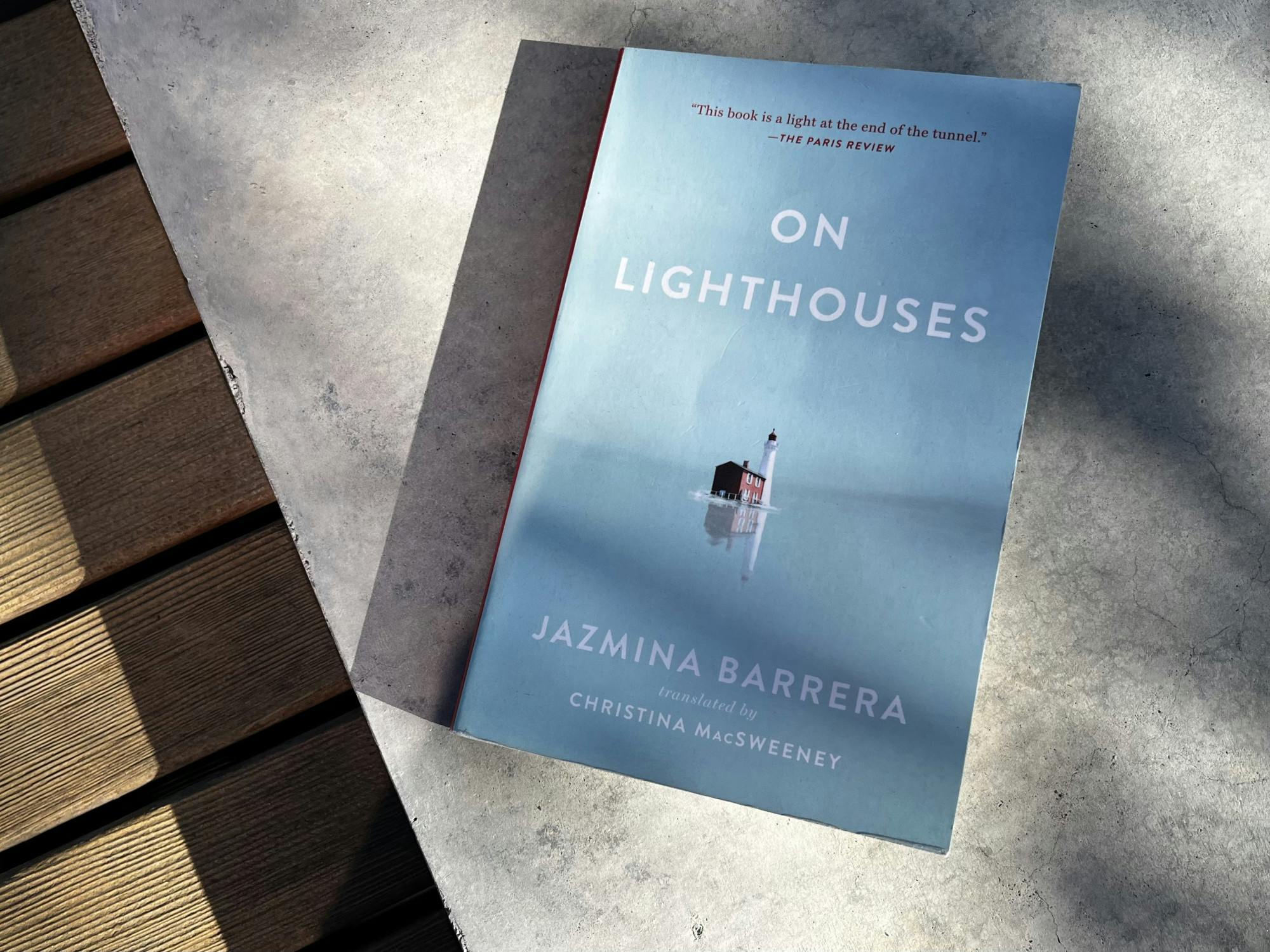
On days when the fog is so dense you can hardly see a few feet in front of you, I imagine a ship lost in the fog. Thoughts of lighthouses swathed in mist are disorienting. “In the mist, everything is a little unreal, a little remembered,” Jazmina Barrera writes in her quiet, beautiful book “On Lighthouses,” a collection of six interconnected essays which I recently finished reading.
Occasionally, I’ll discover a book, like this one, that weaves a spell over me, with a narrative voice that feels so relatable, it is magical and comforting. Barrera has written a gentle meditation on those sea-swept edifices, reflecting on solitude and lostness, nostalgia and madness.
Lighthouses, Barrera reflects, represent both a desire to escape from the world and the task of guiding and helping others.
“It’s perhaps true that I like lighthouses because I’m disoriented,” she writes. “I always feel as if I’m adrift, which is why the image of the sailor lost on the high seas is so deeply disturbing.”
Barrera is a writer from Mexico City and the author of both novels and essay collections. This book was originally published in 2017. The translation, by Christina MacSweeney, was published in 2020 in an elegant, nearly pocket-sized edition by Two Lines Press, a San Francisco-based independent publisher exclusively publishing works in translation.
Books with aqueous themes attract me immediately, splashed as they are with the sight and scent of the sea: mist-shrouded coasts, deep blue depths, the call of gulls, smell of salt. Seeing it on a display highlighting indie publishers, I bought a copy of “On Lighthouses” at Green Apple Books in San Francisco, one of my favorite bookstores.
Like the lighthouses she collects in her mind, reading experiences “can also be coveted and amassed,” Barrera writes. I read this book by the ocean, starting it after a day on the beach. My memory of being by the ocean and reading this book are fused.
The waterlogged prose in “On Lighthouses” contains lines like this:
“Water is, therefore, the image of time, and a wave crashing on the shoreline at midnight is a piece of time emerging from the water. If this is true, observing the surface of the ocean from an airplane is equivalent to witnessing the restless face of time.”
Barrera organizes each essay around a different lighthouse she visits, from Oregon to Normandy, mixing memoir and travelogue with a history of lighthouses, from ancient Celts and Mayans to nineteenth century France and present-day Mexico. Lighthouses, she explains, are everywhere in human history and literature.
“Could it be that the connection between humans and the sea is so primordial that there will always be someone to switch on … a light for ships in distress or fishermen,” she ponders.
Ray Bradbury’s story, “The Fog Horn,” which I so enjoyed years ago, is discussed here. As is, of course, Virginia Woolf’s “To the Lighthouse,” along with several other literary works that revolve around lighthouses.
As Barrera is aware, her obsession with lighthouses is not particularly unique. “The world is a cornucopia of objects for the lover of lighthouses,” she writes. Lighthouse-related imagery is everywhere.
They have been written about and reproduced innumerable times, but she soars above the kitschy and sentimental. The result, thankfully, is more bizarre and hypnotic.
“It’s difficult to talk about the topics generally associated with lighthouses: solitude, madness,” she writes. “Those of us who try have no option but to accept ourselves as quaint.”
There is more than a tinge of melancholy in these pages. Among her best passages are an exploration of the solitude of the lighthouse keeper. Lighthouse keepers sometimes go mad, and Barrera tells us a few of those stories.
Near the end, she reflects, “I avoid human company because I love it. I’m capable of feeling fond of anyone with whom I’ve spent a certain amount of time, and then it makes me very sad to be apart from them.”
She dwells on an unfinished story Edgar Allen Poe was working on right before his death. The protagonist of “The Light-House” has a thirst for solitude, “that solitude, / which is not loneliness.” A bewitching bonus is that Barrera writes a dark and haunting ending to this unfinished Poe story.
Lighthouse keepers, in their solitude, can become philosophers. She quotes a former lighthouse keeper, who says, “we used to have a lot of time on our hands, and when we read a book, we really read it.”
Kent Friel ‘26 is an executive editor at The Dartmouth.


