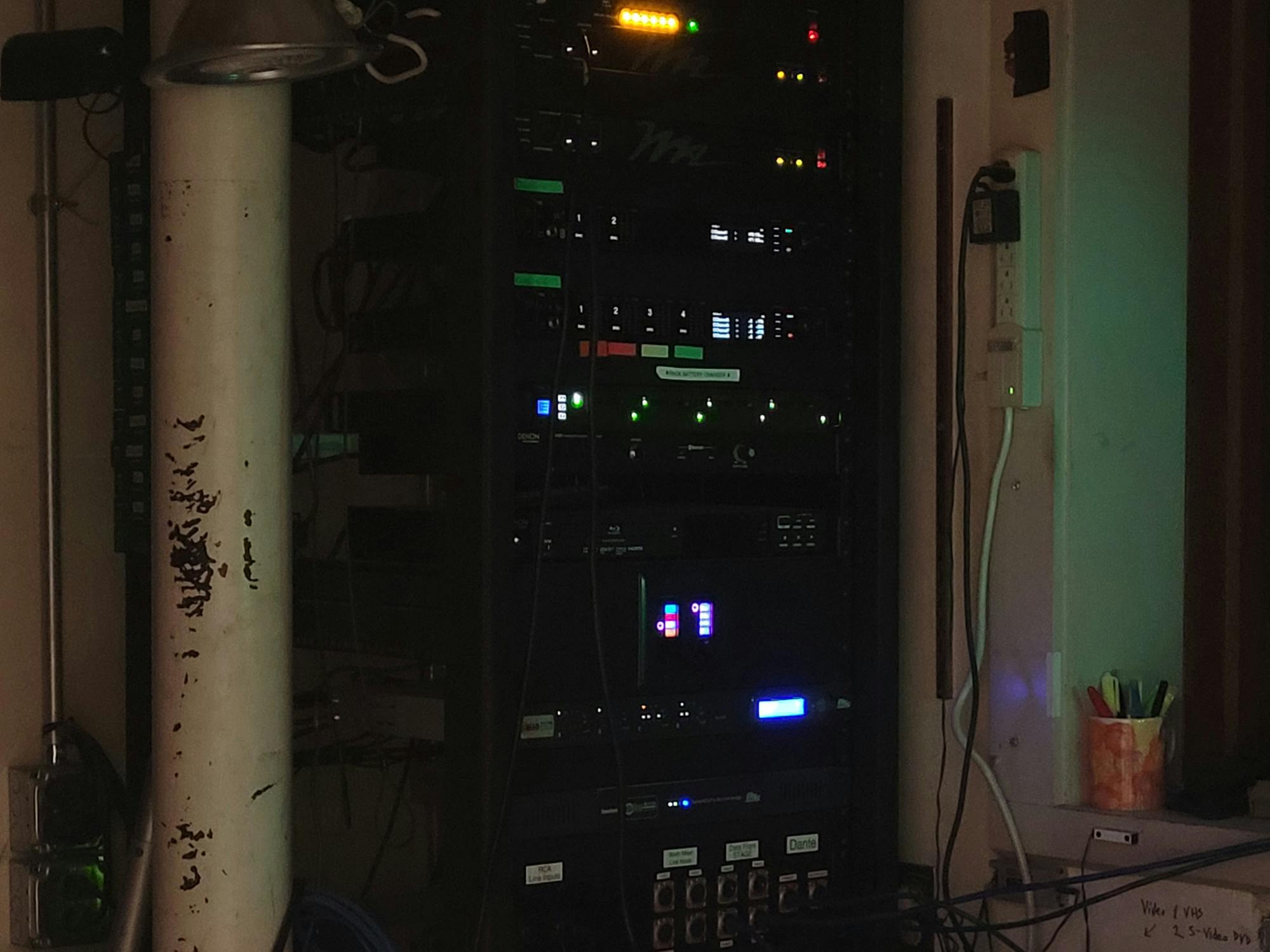
Despite a nationwide boom in data center construction, New Hampshire currently has only 10 small-scale data centers, according to the New Hampshire Bulletin. New Hampshire has no confirmed plans for additional data center development, and is one of the states with the fewest number of data centers in the country, according to Axios.
Data centers “do all of the processing for artificial intelligence,” engineering professor Anthony Rizzo explained. In 2026 alone, four tech companies — Microsoft, Meta, Amazon and Alphabet — plan to spend $670 billion on their construction. As a percentage of gross domestic product, that figure marks the second biggest capital effort in U.S. history, after the Louisiana Purchase, according to the Wall Street Journal.
“These AI demands are very computationally expensive,” Rizzo said.
Rizzo added that the data center industry is on an “exponential trajectory.”
Energy and land prices, lack of sales tax cited as reasons for limited construction
State Rep. Thomas Cormen, D-Grafton, cited the state’s high electric costs and land prices as reasons for why the state has so few data centers.
“We have high electric costs compared with the rest of the country,” Cormen said. “The price of land might have something to do with it as well. Land in New England is fairly expensive because we don’t have that much of it that isn’t already developed or forested.”
Craig McGahey, who serves as a co-managing partner at data center consultancy CloudCenters, added that New Hampshire has “a number of disadvantages” as a location for data centers. He said that because New Hampshire does not have a state sales tax, the state government cannot use sales tax exemptions to incentivize data center construction as other states have done.
“Some states were interested in luring data center operators into their economies by offering generous sales tax exemptions,” McGahey said. “If you bought $100 million worth of compute capacity, servers, racks, everything, you would be exempt from sales tax. New Hampshire doesn’t have any sales tax, so it can’t provide that benefit.”
State leaders divided on future data center construction
Data center construction has emerged as a major political issue across the country. State officials in New Hampshire are divided on the issue.
State Rep. Michael Vose, R-Rockingham, who serves as chair of the science, technology and energy committee in Concord, noted that while data centers are “energy hungry,” they bring benefits including “economic development and additional jobs.”
Vose added that he thought New Hampshire had a “good policy climate” for data center construction.
“We’re a state that encourages — to the degree that we can — entrepreneurship [and] business development,” Vose said. “We’re also close to Boston, which is a place where there are a lot of businesses that might potentially need to build a data center.”
Vose said he thought New Hampshire should “not stand in the way” of data center development. He praised Republican Gov. Kelly Ayotte for signing H.B. 672, which reduces regulations on off-grid energy providers.
“Those are the kinds of policies that open the door to innovation and create a climate where people can experiment and see what works and see what doesn’t,” Vose said.
Cormen, on the other hand, said that while he is not against data centers in general, he didn’t “think they fit well in the context of New Hampshire.” He said that because New Hampshire does not currently consume as much power as other states, energy generation for data centers would require the state to build costly infrastructure.
“The problem with [data centers] is, first of all, you need the power, and it’s got to be generated somewhere, and then it’s got to get to the data center somehow,” Cormen said. “So you're talking about probably transmission lines, which are very expensive.”
Cormen added that he does not think data centers create many jobs.
“They spend a billion dollars to build the data center and it provides under 100 jobs,” Cormen said. “You just don’t need that many people to run this thing.”
McGahey said “conversations have been held” in the governor’s office to try and develop different incentives for data center developers.
He added that in the future, the state may have a “proliferation of smaller data centers,” noting that “the world has an insatiable demand for AI compute.”
“Interest and demand will continue to grow,” McGahey said.
Eliza Dorton '29 is a reporter from Washington, D.C. and is studying English and public policy. Outside the classroom, she enjoys reading and going on walks.