
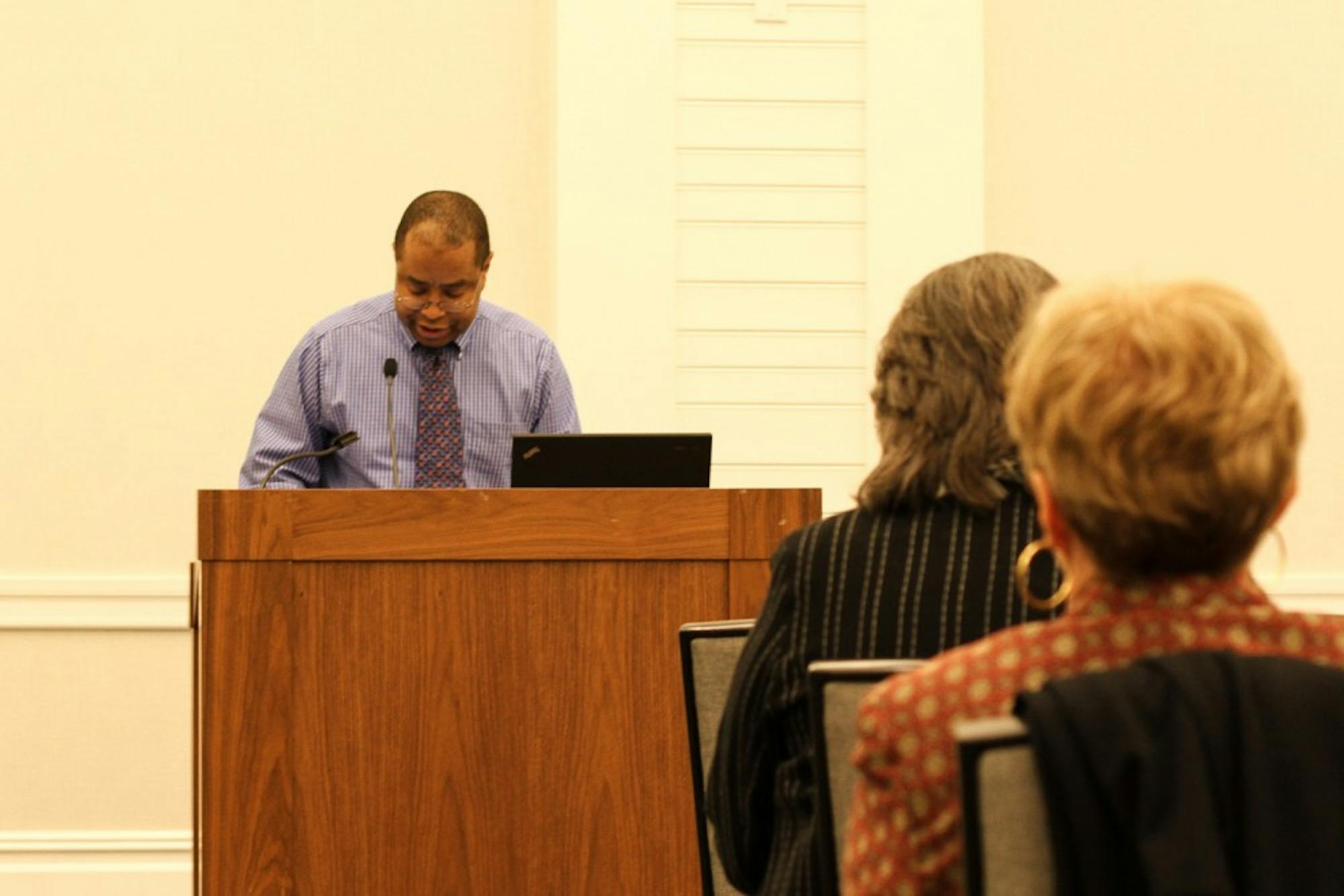
A proposal that would have allowed professors to make their past course assessments available to students was tabled at Monday’s faculty of arts and sciences meeting, after around a dozen professors raised concerns about the proposal’s implementation. Noting that it was unlikely to pass, Dean of the Faculty Michael Mastanduno suggested postponing the vote.
If the proposal is approved, starting next year faculty could opt-in to allow undergraduate students to view their peers’ online course evaluations dating back to 2006. Only students could access the site, and professors would not be able to see their colleagues’ reviews.
In April, the committee of chairs, comprising heads of the College’s arts and sciences departments, recommended the initiative’s approval.
The goal of publicizing course assessments, Mastanduno said, is to help students more efficiently select courses. Many faculty members at the meeting, however, disagreed, arguing that the main purpose of course evaluations should be to help professors improve their classes.
English professor Thomas Luxon said open course assessments could not effectively meet the different needs of students and faculty. Faculty members use the evaluations for professional development, he said, while students would use them to choose classes based on work load and teaching style. The anonymous nature of the evaluations, some professors said, would not be conducive to constructive criticism and could possibly lead to immature comments.
English professor Gretchen Holbrook Gerzina said that the pressure to publicize course evaluations among students could hurt women and minority professors, who she said tend to do less well on course evaluations.
“Professors of color would not want to opt in for course assessment release,” Gerzina said. “Or even come to Dartmouth as a result.”
Noting that professors cannot view others’ evaluations, Gerzina said, sharing reviews with students would be a “huge leap to make.”
Making evaluations available to the general public, which is not currently part of the proposal, could imply that the assessments are a reliable evaluation of professors’ job performance, chemistry professor Jane Lipson said.
For the policy to better accommodate both student and faculty needs, more discussion and deliberation is necessary, many professors at the meeting said.
Art history professor Mary Coffey said that while she generally supports the proposal, she believed some questions on the assessment required clarification, adding that she was concerned about how students would interpret them.
English and African and African American studies professor J. Martin Favor said he was concerned about how publicized course assessments could impact students and whether open evaluations would benefit their studies.
“How does this make students better?” he asked.
Classics professor Hakan Tell, who introduced the proposal at the meeting, said the consensus was that the proposal requires improvement.
“I think it was a good productive discussion,” he said. “We got a lot of input on where we should take this. The idea would be to bring it back to a committee, tune it and then bring it back again.”
The office of the registrar launched a pilot online course evaluation program in 2006, followed by a permanent system. While official course reviews are not publicized, alternate systems like the Hacker Club’s Course Picker and the Student Assembly’s course evaluation guide contain unofficial reviews submitted online.
Student Assembly surveyed students last October to assess the popularity of making course reviews public, receiving about 900 responses in total. The results, which reflected strong approval, were sent to Mastanduno.
Many of Dartmouth’s peer institutions release course evaluations, College Registrar Meredith Braz said at the meeting, and some of them use an opt-in strategy like the one in the current proposal.
Cornell University, Harvard University, Princeton University, the University of Pennsylvania and Yale University publish official course reviews. Brown University and Columbia University use sites similar to Hacker Club’s Course Picker.
At the meeting, held in the Hanover Inn, Hanlon presented an overview of the year. He discussed budget objectives, admissions yield, fundraising announcements and his academic vision for Dartmouth. Around 100 faculty members and 30 community members attended the meeting.


