
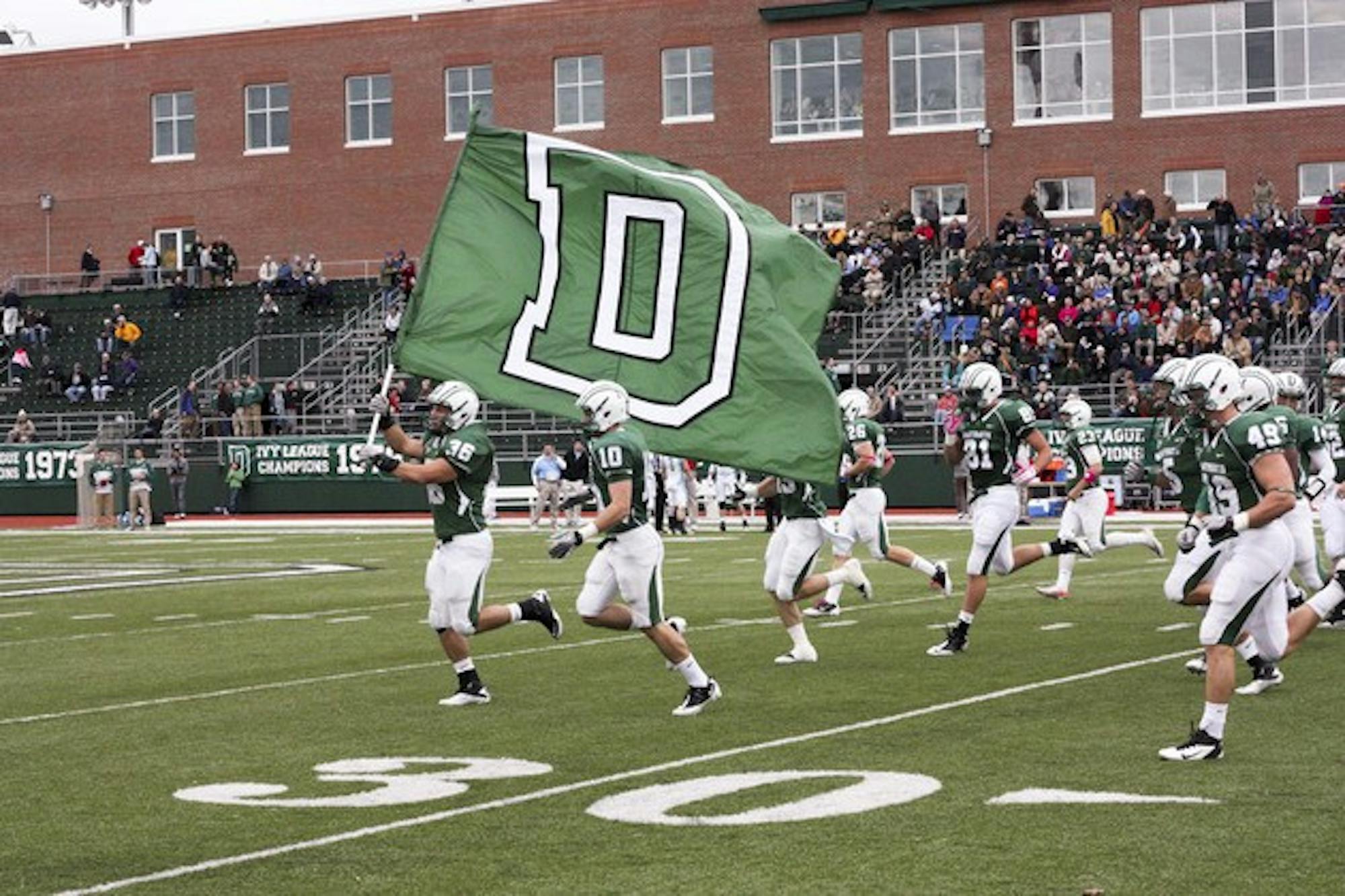
In a competitive college athletics environment, Dartmouth's sports teams, which have historically used previous success to attract recruits, have begun to adopt a more realistic and financially-reliant model over the last decade, using outside donations to improve the athletic program. Coupled with a renewed focus by the College, administrators say they believe that Dartmouth's increase in financial support for athletics could lead to an overall increase of athletic quality.
History of Competitiveness
Since the Ivy League's founding in 1956, Dartmouth sports teams have won or shared a part of 130 league titles, ranking Dartmouth sixth out of the eight Ivy League schools.
Princeton University ranks first with 406 league titles, followed by Harvard University with 353 and Cornell University with 203. Columbia University, with 87 titles, is last.
Dartmouth's historically successful teams, including football and men's cross country and women's basketball and lacrosse, have been able to build off of previous success to attract top recruits and coaches, according to players and coaches interviewed by The Dartmouth.
"A strong program attracts strong athletes," Steph Crocker '12, co-captain of the women's Nordic ski team, said.
While Dartmouth's ski team does not compete in the traditional Ivy League format, it is consistently considered one of the best ski programs in the country. The team last won the NCAA Championships in 2007.
"Dartmouth has had that kind of place in skiing, and the people who've been involved in the program have worked to create a culture," women's alpine coach and former Olympian Chip Knight said.
At least one Dartmouth graduate has participated in every Winter Olympics since the games' inception in 1924.
The Dartmouth women's hockey team, which qualified for the NCAA Tournament last year and finished fourth in the ECAC and tied for second in the Ivy League this year, gets recruits to commit to Dartmouth because of the "reputation the women's hockey team has in the outside world," according to head coach Mark Hudak.
"I think a lot of these things are tradition-based," Peter Fahey '68, a former member of the Board of Trustees and current chair of Friends of Dartmouth Basketball, said. "If you have a tradition of winning in a sport, it tends to feed on itself. In contrast, teams that have not had success, as is the case with basketball, have to work a little harder," he said.
The swimming and diving programs, which have never won an Ivy League Championship, have historically struggled to attract recruits, according to Ryan Shelley '15, a men's diver.
The small pool of available recruits has been a factor in the squash team's inability to win an Ivy League Championship, according to No. 1 squash player Chris Hanson '13.
"We've come close but haven't had that breakthrough," he said. "It's getting harder to do."
Hanson said the top two Ivy League squash recruits nearly always attend Harvard, Princeton or Yale University.
The men's and women's squash teams are currently ranked fifth and sixth, respectively, in the Ivy League.
"Inside the Ivy League, we're still a contender," Ethan Shaw '12, a cross country runner said. "Outside the Ivy League though, it seems we're seen more as an academic institution rather than an athletic powerhouse."
A lack of national media coverage has also led to a decreased national reputation, according to Stephanie Hannah, director of enforcement for the NCAA.
"In the age of TV and media, more attention is given to schools in the [Southeastern Conference] and Big 10," she said. "The media leaves the Ivy League schools behind and that chasm continues to grow."
Ivy League Executive Director Robin Harris said that due to the name recognition of Ivy League institutions, "When we have success, it makes a splash."
Harris acknowledged, however, that networks such as ESPN that focus on sports like football and basketball may hurt the athletic reputation of the Ivy League. Honing in on big-money sports may create the impression that Ivy League institutions are not athletic powerhouses because Ivy League football teams cannot advance to postseason play and Ivy League basketball generally only sends one team to the NCAA Tournament.
"I'm happy because we're getting press when appropriate," she said. "Do I wish we had more? Yes."
A Change in Thought
Dartmouth, which historically relied on sources other than fundraising to maintain athletic success, according to Deputy Director of Athletics Bob Ceplikas '78, began to see a decrease in athletic competitiveness within the Ivy League in the early 2000s.
"We've gone through a decade of mediocrity in pockets of the program, and they happen to be pockets that draw fans," Athletic Director Harry Sheehy said.
Dartmouth is currently on track to win 20 Ivy League Championships from 2006 to 2016, representing the school's lowest league title total since 1966-1976, when Dartmouth won 10 championships.
Since the league's founding, Dartmouth's most successful 10-year period occurred between 1986-1996, when Dartmouth teams won 43 championships.
These successful years also coincided with the increased development and success of female athletic programs, and as a result, an especially large group of athletically-minded alumni.
This group of alumni has recently entered the alumni age bracket that tends to see the most activity and donations, 20 to 40 years removed from graduation, according to Ceplikas.
Coupled with a purposeful renewal of athletic fundraising on behalf of the College, this alignment now means that non-institutional support has become critical to supporting traditionally successful Dartmouth teams and allowing historically poor performing sports to rise in the Ivy League ranks, Sheehy said.
Financing
In the 2011 fiscal year, the Athletics and Recreation budget totaled slightly over $18 million. The budget encompassed funding for Dartmouth's 34 athletic teams, as well as intramural sports, club sports, physical education and fitness classes, according to Sheehy.
"Our budget touches virtually every student," he said.
The College was responsible for 49 percent of the budget, or around $9 million dollars, according to Sheehy.
Dartmouth's overall fiscal budget was $740 million in 2011, meaning institutional support for Athletics and Recreation accounted for roughly 1 percent of the College's budget.
"That's a pretty good return on their investment," Ceplikas said.
"Other revenue," which includes corporate sponsorships, fitness passes and facility rentals, supported 20 percent of the Athletics and Recreation budget. Alumni donations were responsible for 16 percent, and athletic endowments supported 13 percent of the budget. Ticket sales accounted for 2 percent.
Sheehy said the College's support for athletics is higher in raw dollars than 10 or 20 years ago, but the athletics program itself has become bigger and broader.
"We knew we needed to gear up our fundraising because our costs were continuing to rise," Ceplikas said.
The relatively even split between institutional support and other revenue sources is comparable to other Ivy League institutions, according to Ceplikas.
John Engelman '68, alumni coordinator of the athletic sponsors program, said that alumni "have a very important role to play" in financing Dartmouth athletic programs.
In the 2011 fiscal year, $3.1 million was given in annual donations to Dartmouth athletics, a nearly 200 percent increase since 2000, according to figures provided by the athletics department.
"[Alumni support for athletics] won't get better without intentional action," Sheehy said.
Four employees have been hired in the last 16 months to focus on raising alumni support for athletics, according to Sheehy. Two employees in the development office work on annual giving and endowed funds, while two athletic department employees focus on affinity events, according to Sheehy.
"I feel very fortunate that we have a loyal, loving, passionate alumni body that wants to help," Sheehy said.
Between 2009-2010 and 2010-2011, annual giving to Dartmouth athletics jumped by over $500,000 to $3.1 million, in part due to the establishment of dedicated fundraisers, an area Dartmouth has historically neglected, according to Sheehy.
Out of the total $3.1 million raised, nearly $2.5 million came from Varsity Sport Friends Groups, alumni fundraising groups that focus on supporting a specific sport. Sports with a wider alumni base, like football and crew, tend to have the most successful Friends of Dartmouth Groups, according to Sheehy.
Friends of Dartmouth Football chairman Bob Downey '58 has more than tripled the group's support in recent years, according to Fahey.
This large singular focus on athletic support, however, has not always been prevalent at Dartmouth, Fahey said.
"Three or four years ago, there was a tendency for the development department to not allow unfettered solicitation of alumni support for athletics," Fahey said.
Dartmouth currently has the fewest endowed coaching positions in the Ivy League, with three positions, according to Sheehy. Cornell, by contrast, has 20 endowed coaching positions, Sheehy said.
The athletic department has also recently helped establish an alumni board for every team, he said.
Sheehy said Dartmouth had previously struggled in terms of athletic fundraising.
"We would not be where we are right now if [College President Jim Yong Kim] and the senior leadership hadn't decided we have to come out of the 19th century, which was where Dartmouth was, and say, We've got to enter the 21st century, and we got to do some of this fundraising more effectively,'" Sheehy said.
Both Fahey and Engelman applauded President Kim's and Sheehy's renewed emphasis on athletics.
Fahey said the past couple of years have shown "we can improve our performance in athletics without siphoning any adverse effects on the academic mission of the school," Fahey said.
The Athletic Office is currently aiming to raise an additional $20 million in new athletic endowment funds over the next few years, according to Ceplikas.
Team Budgets
Despite playing a large role in the overall support of the athletic system, outside donations do not affect the athletic department's individual budgeting processes for each team, Ceplikas said. Instead, each team's budget varies based on roster size, equipment and schedule obligations, according to Ceplikas.
Overall, football has the largest budget, but per athlete, football is "around the middle" when compared to other teams, according to Ceplikas. Yet it is still clear that the extra benefits of alumni support, including new facilities and improved amenities, make a large difference in the success or shortcomings of a specific athletic program in the long run, according to athletes.
Cross country, for example, has historically not received as much outside support as other more popular sports, according to multiple cross country runners, who said that the team's increased success in recent years could change that.
"As we're improving and getting more publicity, that's going to encourage the track and field alumni to want to contribute to our experience," Abbey D'Agostino '14 said.
Since 2000, $94 million has been invested in Dartmouth athletic facilities, the majority of which has come from alumni donations and external support, according to Ceplikas.
"That investment has taken us from near bottom of the league in athletic facilities well into the top half," Ceplikas said.
Dartmouth now has the largest varsity training center and recreational fitness center in the Ivy League.
"When you have things to show and it's cutting edge and it's sharp and polished, it does have an impact," head football coach Buddy Teevens '79 said. "You look at the Ivies, and they all have a good education, why would someone choose one or the other? So that's a separation point."
Ceplikas said he believes the current high level of alumni support, coupled with renewed focus by the administration, including the Dartmouth Peak Performance Program, is good news for Dartmouth athletics in the near future.
"It wouldn't surprise me at all if within the next few years people start making comparisons between our athletic program and the powerhouse reputations of the past," he said.
Staff writer Blaze Joel contributed reporting to this article.


