
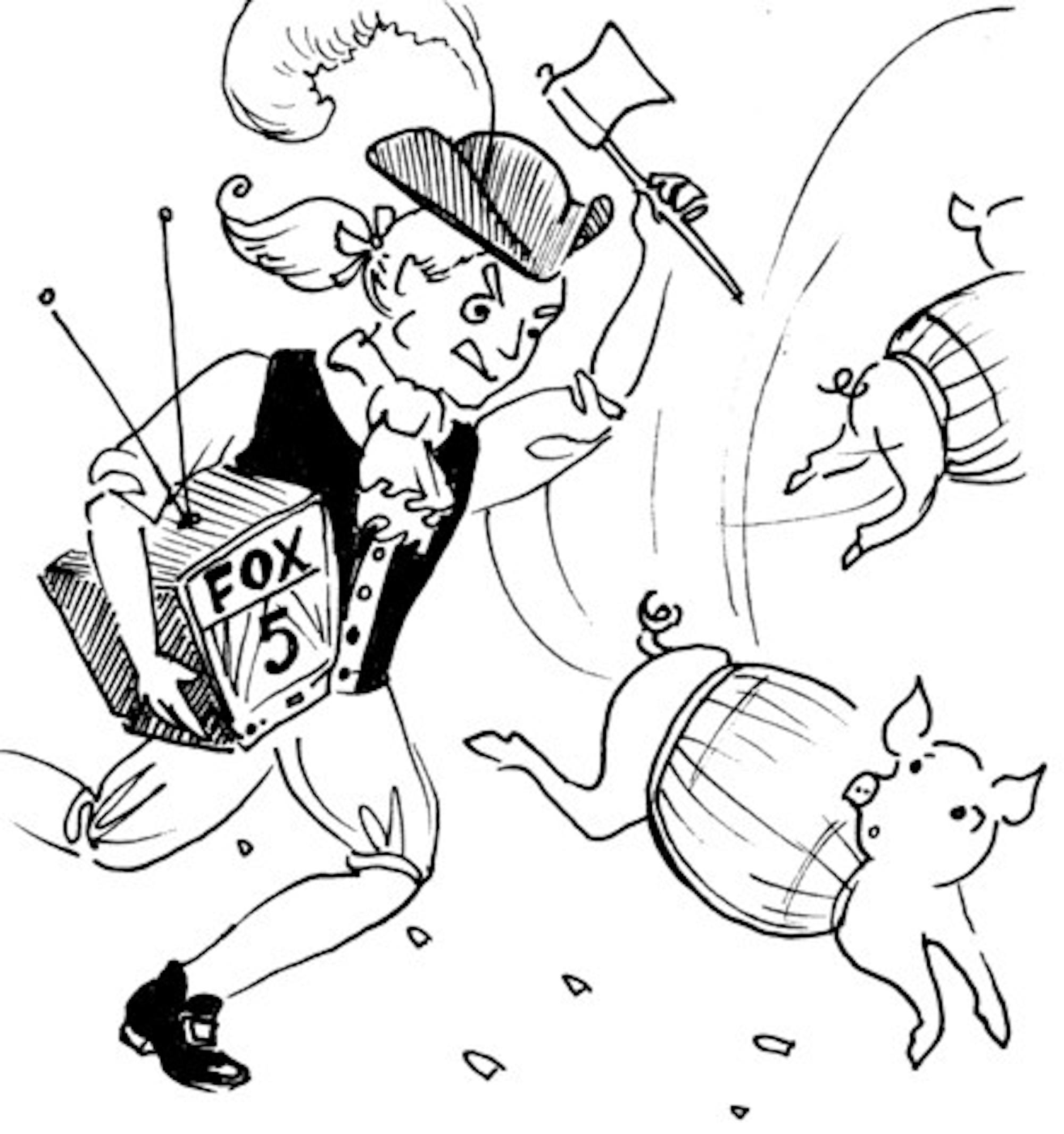
There are pleasant anecdotal encounters with Tea Partiers, such as in the recent column by Jasper Hicks '12 ("My Tea Party," April 2010), that contrast with the general craziness shown in the media. But now that this political group has been around for awhile, it is time to look past media depictions or personal encounters and decide what the Tea Party is about and whether or not we, as a generation of voters, should keep paying attention.
Recent statistical surveys have evidenced what I and many others have come to believe: one of the main underlying ideologies of the Tea Party movement is racism a last desperate pitch of middle-class white America to hold on to a version of our country that they hold dear and that no longer exists. We, young voters, need to stop taking the Tea Party seriously as a political force in our country until a time when their often vague and contradictory ideologies come together to something more than a thinly veiled racist agenda.
The University of Washington Institute for the Study of Ethnicity, Race and Sexuality recently surveyed racial attitudes of Tea Party enthusiasts. The results were disturbing, if unsurprising. Of the 18 percent of the general population who consider themselves members of the Tea Party, only 35 percent "believe Blacks to be hardworking," only 45 percent "believe Blacks are intelligent" and only 41 percent "think that Blacks are trustworthy." Numbers were similar with regards to Tea Party views on Latinos. Overall, the study suggests, as recently reported by Newsweek, that Tea Party supporters have a 25 percent higher probability of "being racially resentful" than non-Tea Party supporters.
While these survey questions could have been somewhat loaded (many might say people of all races lack the qualities listed in the survey), the numbers are significant enough to warrant distress. To look at the statistics in reverse, more than half of Tea Partiers believe black people are unintelligent and untrustworthy, and a full 65 percent of them believe blacks are not hardworking. Now maybe these numbers are not enough to convince anyone that the entire movement is predicated on racist attitudes. Obviously there are going to be some supporters who legitimately want a smaller government, decreased spending and the impeachment of President Barack Obama in the belief that he is a foreign-born Muslim socialist. But given that the movement has come in this moment rather than during the George W. Bush administration, which saw the beginning of two costly wars, expansion of executive power and the creation of an unfunded Medicare prescription drug plan, I find the official rhetoric of the Tea Party rather unconvincing. Perhaps if they called for decreased defense spending and a revoking of the Patriot Act, I'd listen.
Another interesting way to view the Tea Party movement and its relation to race was recently put forth by prominent anti-racism writer Tim Wise. In his essay "Imagine if the Tea Party was Black," he plays an "imagine" game in which the rise of the Tea Party was brought about not by middle-class whites, but black Americans. Do what he asks, and imagine. As horrible as it is, the movement in reverse would be completely different. The same people who support the Tea Party now would be up in arms against that for which they now fight, decrying how degraded the fabric of our proud nation has become. Picture Glenn Beck covering the story or the current Tea Party's reaction to a black Glenn Beck.
This, as Wise puts it, is the nature of the white racial attitude the Tea Party embodies "The ability to threaten others, to engage in violent and incendiary rhetoric without consequence, to be viewed as patriotic and normal no matter what you do and never to be feared and despised as people of color would be, if they tried to get away with half the shit [white people] do, on a daily basis."
The Tea Party phenomenon is disturbing, to say the least. Its existence and racially charged ideology detracts from the legitimacy of many conservative causes. As liberal as I am, I want a strong conservative party. I want grassroots movements of "real Americans" to march peacefully on the National Mall. But what I don't want is for us as a nation, as a generation, to take seriously a fringe group of Americans dissatisfied with the direction of racial relations and realities our country is heading towards. They are the past, we are the future.
