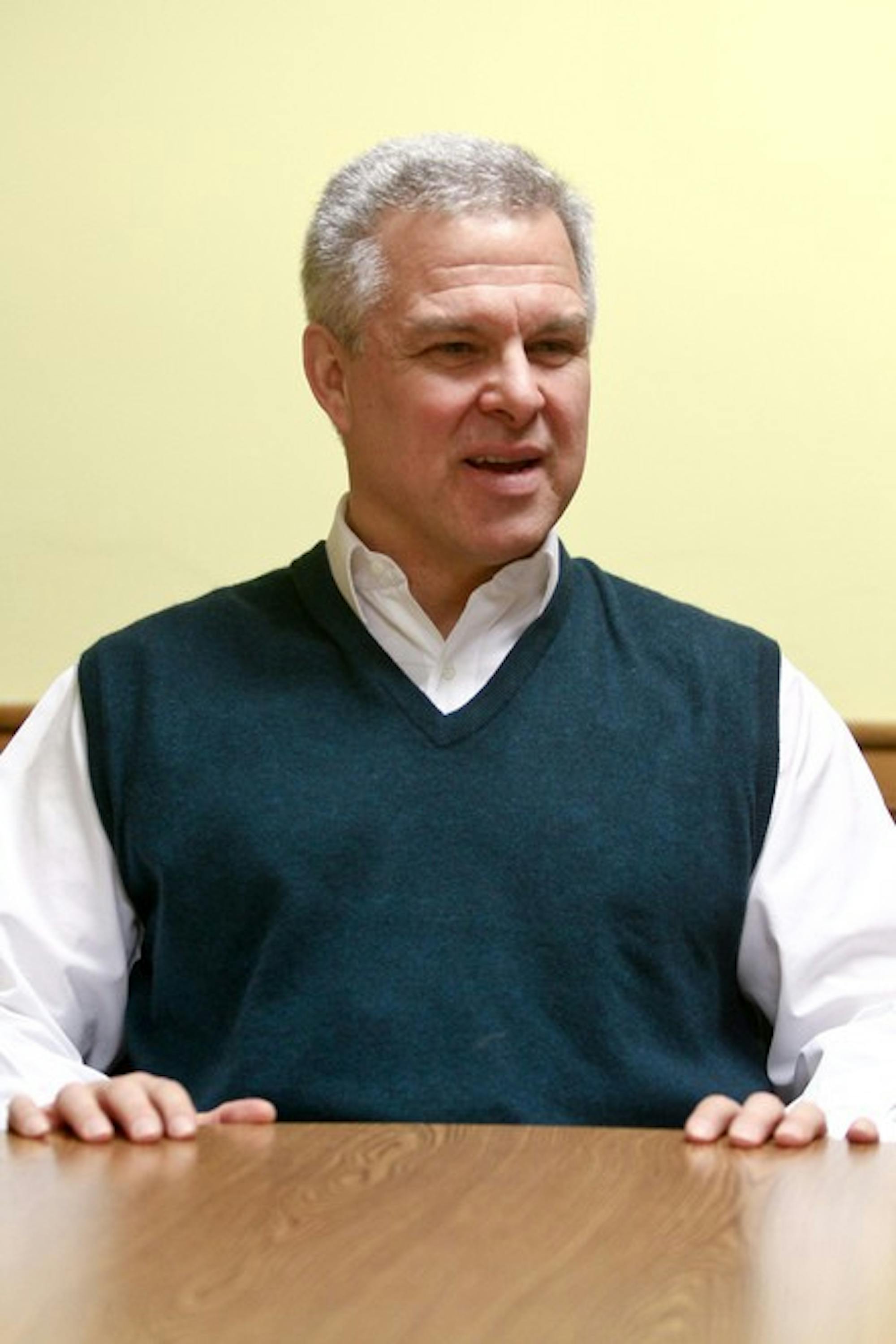
Asch said he would submit more than 800 signed petitions, adding that he had also received additional petitions that he would not submit.
Replogle said the he was "glad" to hear that Asch will officially enter the race.
"I think it's good for Dartmouth," Replogle said. "It shows our governance process works and allows all members of the alumni body to participate in the Board election."
In addition to receiving signed petitions, Asch said he also received several letters in which alumni expressed their excitement about College President Jim Yong Kim, as well as concern about the Board's management of the College in recent years.
"[There was] a great deal of upset that the Board let President Kim down in overseeing the previous administration, and as a result the finances are really out of whack," Asch said of the letters' contents.
The Board's 2007 decision to end parity between Board-selected and alumni-elected trustees was another issue discussed in the letters Asch received, he said, adding that alumni were "upset" and "wounded" by the decision.
"The idea that [the trustees] were expanding the Board to have greater diversity on the Board or because we had more alumni representation than other schools wasn't convincing," Asch said. "I think everyone sees it as what I believe it was -- as a defensive measure to stop the petitioners from achieving a higher influence on the Board."
Although he said he is a supporter of parity on the Board, Asch said he never supported the second lawsuit against the College and that it was a "mistake."
"[Judge Timothy Vaughan] made what he thought was a fair ruling and I can't disagree with that," Asch said. "I hope that lawsuits are over, but I also hope that President Kim will see that he has to unify an alumni body that's really split, and the way to unify the alumni body is to bring back parity."
The lawsuit was the second legal challenge to the Board's decision on parity, and both argued that the Board's decision violated an 1891 agreement to maintain parity, which they saw as legally binding. The first lawsuit, filed by the Association of Alumni in October 2007, was withdrawn by the Association after the alumni body elected a new executive board to the Association in June 2008. The lawsuit was dismissed with prejudice, but an independent group of alumni brought a second lawsuit in November 2008, which was dismissed in a motion for summary judgement by Vaughan on Jan. 7.
Replogle who previously said he is opposed to the lawsuit, but that he would not form official opinion on parity until after the trustee election expressed doubt that Asch is against the lawsuit.
"I am glad that [Asch] has changed his mind and now supports the end of litigation," Replogle said. "I'd like to see that on the record. Where has he come out and said it? He has had the opportunity to blog about it."
Replogle added that Asch's positions on other alumni issues suggest that Asch has indirectly supported the lawsuit.
"I am glad to hear he is now opposed to [the lawsuit] after having supported all of the petition candidates who have supported it," Replogle said.
Several alumni have raised concern that both Replogle and Morton Kondracke '60, the Council-nominated candidate for the other open spot on the Board, do not have official opinions on parity.
"[Replogle and Kondracke] need to make a clear statement one way or the other before the alumni have to vote," said Tim Dreisbach '71, a former member of the Association executive committee that filed the first lawsuit against the College.
Although he recognized that parity is a "contentious" issue among College alumni, Replogle said he thinks that "other fundamental principles of good governance" should be discussed in the upcoming election.
Replogle has said he is investigating alternative solutions to the parity issue, including an option in which one member from each graduating class would serve a four-year term on the Board.
Additionally, some alumni have expressed concern that Asch's frequent posts on the Dartblog web site are not appropriate for a potential trustee.
"[Asch] often attacks some of the highest ranking faculty and administrators at the College," former Council president Martha Beattie '76 said in an e-mail to The Dartmouth. "I know that everyone has the right to their opinion, but the bottom line is that many if not all of these people are highly admired and highly sought after by our peer institutions. Sadly, we may lose some of them because of the financial situation, but think how much sadder it would be if they left Dartmouth because someone who routinely criticizes them in the most negative manner is elected to the [Board]."
Beattie is a member of the steering committee for Replogle and Kondracke.
If he becomes a trustee, Asch said he would no longer write for Dartblog because he would be required to keep information he learns as a trustee confidential.
Asch defended the tone of many of his blog posts.
"I don't think I blog negatively," Asch said. "I tell the truth and people think I'm negative."
In response to a question about one blog post titled "The Dark Satanic Mills of the Dartmouth Bureaucracy," Asch described the phrasing as "hyperbole," "funny" and a reference to English poet William Blake's writings during the Industrial Revolution.
"I don't personally believe, and I don't think a single reader believes that I think Dartmouth is equivalent to a factory in Industrial Revolution England," Asch said. "It was just a way of being colorful and provocative."
Asch said that the "core of his campaign" will focus on his ability to evaluate whether the information that is presented to the Board by the administration is "sound," as opposed to just "valid." Asch will be able to do this, he says, because he spends time in Hanover investigating issues that affect the College.
"Only by spending enough time in Hanover can you evaluate if they are sound arguments," Asch said. "Not everyone [on the Board] has to live here, but we need to have enough on the Board who do."
Dreisbach echoed Asch's opinion that trustees need to spend more time at the College than just for Board meetings so that they can "think for themselves."
Beattie does not believe that Asch is a stronger trustee candidate because he lives in Hanover, she said.
"I don't think living in Hanover makes you any closer to the College," Beattie said. "I think that being close to the College means reading all of the news that comes out of the College, participating in club activities, hearing the faculty that come to speak, staying abreast with all of the Dartmouth news."
Several alumni expressed concern that Joe's "confrontational" manner would be a detrimental to the Board.
"I find [Asch] to be constantly combative and negative," said Jim Adler '60, a former member of the Association executive committee. "I think that those qualities would make him to be a rather poor trustee." Adler added that in his opinion, despite Asch's claims to be a "uniter," his actions show that he is "divisive."
While Beattie said that she admires Asch's passion for the College and his engagement in the Dartmouth community, she does not approve of his "mean-spirited, negative influence."
Beattie cited an instance in which Asch challenged the grammar of the leadership statement produced by the College's presidential search committee during an open forum, but provided no "constructive" commentary on the statement's substance.
Replogle echoed Beattie's concern about Asch's criticism of the College.
"I am for collaboration and [Asch] is for confrontation," Replogle said.
Although some alumni do not support the way Asch writes about the College, Dreisbach said Asch's research would be beneficial to the Board.
"Asch is very outspoken, but he does his homework and I think having that kind of fact-based independent thought would be a great addition to the Board," Dreisbach said.