
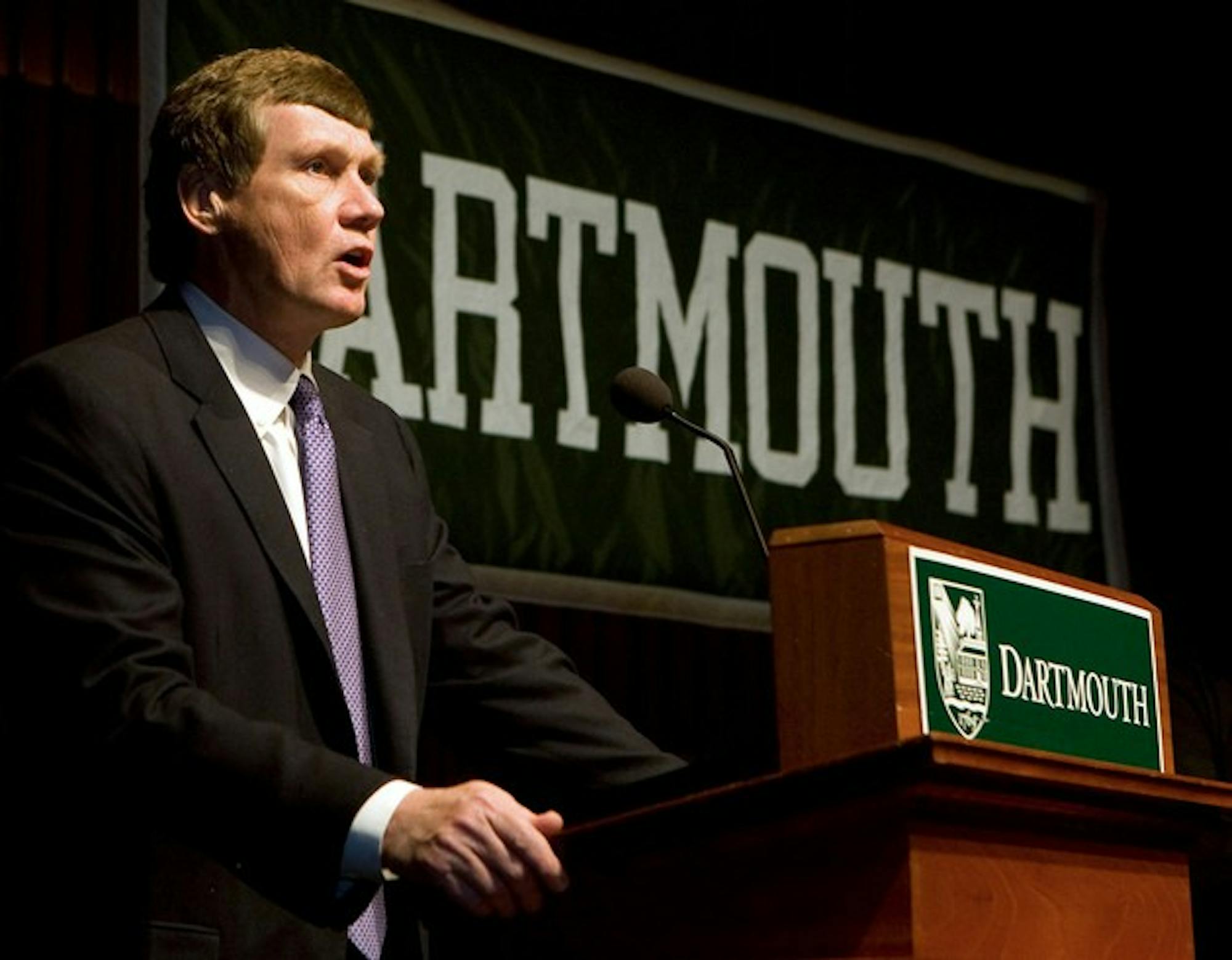
Dartmouth Board of Trustees Chairman Ed Haldeman '70 is the leading candidate for chief executive officer of Freddie Mac, the beleaguered government-sponsored loan organization, according to several media reports that cited anonymous sources. Haldeman announced June 30 he would step down as chairman of the board of directors of Putnam Investment Management.
When reached for comment by The Dartmouth on July 2, Haldeman said he would not comment until an official statement had been released.
Because Freddie Mac was placed in federal conservatorship in September 2008 as the government began to respond to the sub-prime mortgage crisis, Haldeman's appointment as CEO would require approval by the Federal Housing Finance Agency and the Treasury Department. The organization, which is formally known as the Federal Home Loan Mortgage Corporation, received an additional $6.1 billion from the Treasury Department on Wednesday.
Neither Freddie Mac nor the FHFA responded to requests for comment, and a representative from the Treasury Department told The Dartmouth she could not comment while Haldeman's selection remains "just a possibility."
If selected, Haldeman would replace John Koskinen, who has served as interim CEO since David Moffett's abrupt resignation from the company this March. Moffett served as CEO for only six months before stepping down.
Haldeman's potential move to Freddie Mac also raises the possibility of alterations to the makeup of the Board if he were to step down from the chairmanship to assume a position with Freddie Mac.
Roland Adams, director of media relations for the College, cautioned against extensive analysis of what remains a tentative report.
"It's very speculative at this stage to discuss whether Mr. Haldeman would remain or step down as Board chairman were he to be appointed CEO of Freddie Mac," Adams said in an e-mail to The Dartmouth. "Mr. Haldeman has not given the College any indication of any plans to step down as Board chairman, and he remains very much the current Board chairman."
In the event that Haldeman steps down, the current vice chair, John Donahoe '82, would become interim chairman until the Board elects a permanent replacement, Adams said in the e-mail. Donahoe is currently president and CEO of eBay, Inc.
The appointment to Freddie Mac would not be the first instance in which Haldeman has been called upon to stabilize an institution in the midst of crisis.
Haldeman served as president and director of United Asset Management Corporation from1998 to 2001. The company faced declining confidence among investors. Haldeman sought to reduce the company's investment losses by restructuring its operations, bringing UAM's 53 independent subsidiaries under greater central control, The Boston Globe reported in 1998.
During two years as CEO of Delaware Investments, following his time at UAM, Haldeman worked to reverse the Philadelphia-based financial management firm's history of negative investment returns. He returned the company to profitability, increasing its investment returns by more than $6 billion, Investment News reported in 2002.
Haldeman's approach to improving Delaware Investments garnered some criticism, however. He removed nearly half of the company's investment managers, many of them longtime employees, in favor of new advisors from outside the company, according to Investment News.
Haldeman was selected to be president and CEO of Putnam Investment Management in 2003, following a series of trading scandals that seriously damaged the company's reputation. He was elected chairman of Putnam's Board of Directors in 2007 and has been credited with furthering compliance and ethics standards at the company. He stepped down as president and CEO in June 2008, but remained as chairman.
While Haldeman succeeded in stabilizing Putnam, he could not turn around its performance. The company managed assets estimated at $370 billion in 2000, according to The Wall Street Journal, but Putnam's quarterly performance report stated that the company held $186 billion by the end of 2007, a decline of over 50 percent.
Haldeman did, however, manage to move Putnam toward a more conservative investment approach. Many of the company's previous losses had been due to investment in higher-risk stocks, a practice that Haldeman limited during his tenure, The Boston Globe reported.
Haldeman joined Dartmouth's Board of Trustees in 2004 and was elected chairman in 2007. A major contributor to the College, Haldeman and his wife gave $10 million in 2004 to support the construction of the Haldeman Center, which houses the Dickey Center for International Understanding, the Leslie Center for the Humanities and the Ethics Institute.
During his time at Dartmouth, Haldeman majored in economics, graduating summa cum laude before attending both Harvard Business School and Harvard Law School. Two of his three children, Catherine Haldeman '08 and Charlotte Haldeman '03, also attended the College.


