
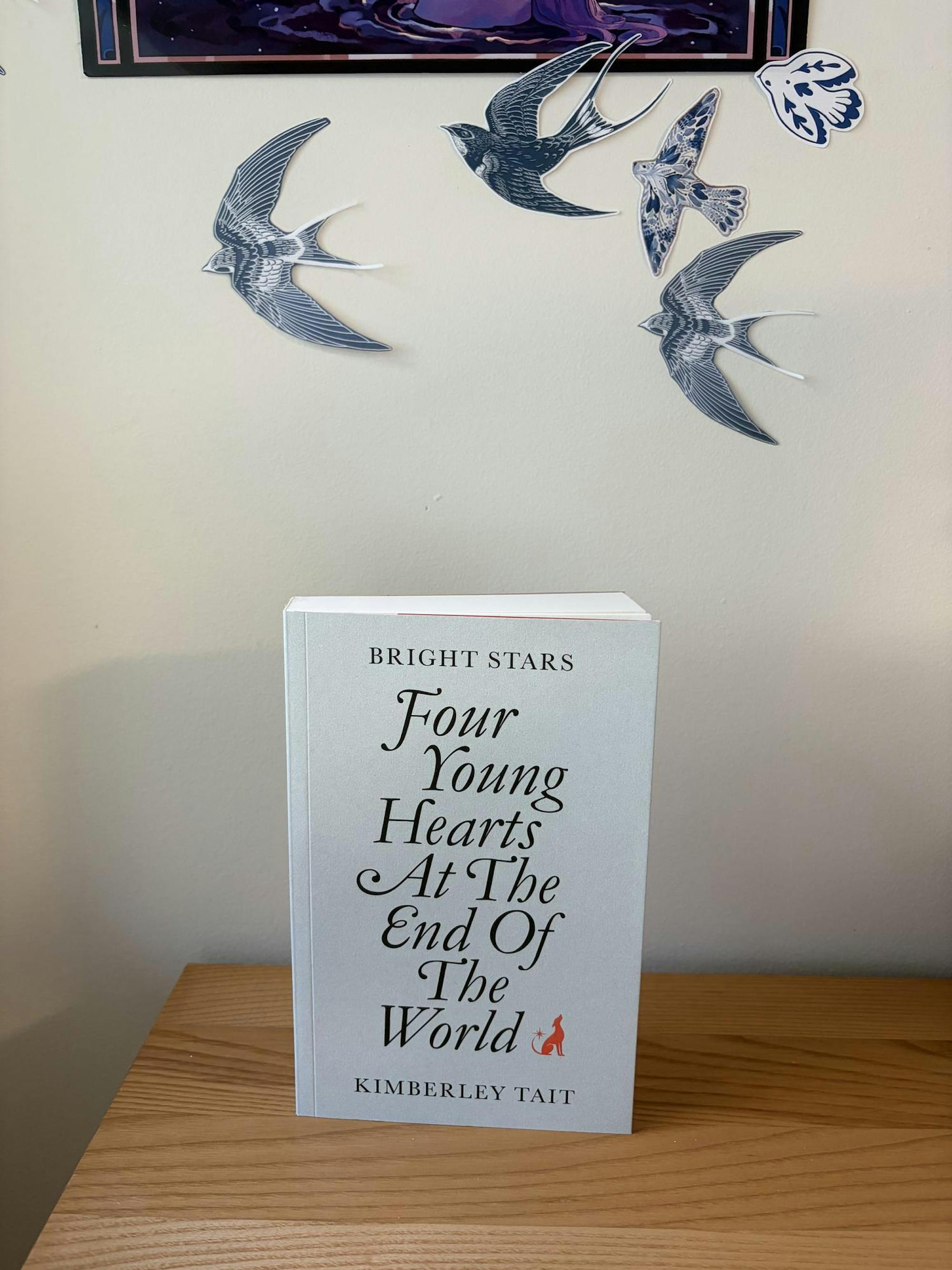
In 2017, novelist and communications consultant Kimberley Tait ’01 published her debut novel “Fake Plastic Love” about two best friends from Dartmouth charting their post-graduate life in New York City. This September, Tait published her second novel “Bright Stars” through the literary press she founded last year, Dogstar Press. Set in 2001, “Bright Stars” follows four college graduates as they enter adulthood at the bifurcating moments of the Sept. 11, 2001, attacks and the rise of the digital age. Tait, who graduated in 2001 herself, served as the lead crisis communications coordinator at the 9/11 United Services Group between 2002 and 2003, after which she worked in banking and corporate communications before becoming a current brand builder and novelist.
The Dartmouth sat down with Tait to discuss the themes and genesis of “Bright Stars” and her literary press Dogstar.
How did the idea for “Bright Stars” come about?
KT: This story was 20-plus years in the making in some kind of form. Even in my 20s, I was always working on some form of creative writing, so the idea for this novel started then. I think that my classmates and I did have a sense that we were going through a momentous time when we graduated. Of course, we did when 9/11 happened — but I think some of us also had an awareness of a larger shift at hand. And that’s what “Bright Stars” covers: the tragedy of 9/11, but also the final vanishing of offline life. A whole way of life ended then.
I really wanted to represent this generational perspective of coming of age during that time. Something one reviewer said that I agree with is that there’s so much nostalgia for the 1990s, but it’s hard to find another book that examines this period of transformation and rupture that happened in 2001 and 2002 from a cultural perspective. I was heavily influenced by F. Scott Fitzgerald, who very much wrote about his generation, and also by Caitlin Macy’s novel “The Fundamentals of Play,” actually written about Dartmouth students. I felt we really deserved a novel. That said, I ended up writing and selling “Fake Plastic Love” first, but then I returned to this novel after. Truman Capote said, “If the notion … truly belongs to you, then you can’t forget it — it will haunt you till it’s written,” and that is sort of how I felt.
What were you trying to explore in “Bright Stars”?
KT: I feel that there is this widespread nostalgia now for “the time before.” My classmates and I were what social scientists sometimes call “the last of the innocents” — we were the last not to have cellphones or computers at Dartmouth. Probably about six months ago, I started talking about being part of a new Romantic movement, capital R, parallel to the big artistic counter movement that happened after the first Industrial Revolution. I think right now, many people feel this yearning for soulfulness and the human-made. I think in this digital storm, it’s very easy to become hardened and cynical. So I hope this novel has a softening effect, to kind of serve as a reminder that even though we can’t go back to the pre-digital age, we can carry some of it forward.
One comment or review of the book that I saw complained that it doesn’t actually deal with 9/11 because it’s over in just a short chapter. But I was like, the whole point is that the 9/11 attack itself was over in three hours; it’s the aftermath that we’re still dealing with today. I wanted to explore what the tragedy meant for young people at that time, but also what it meant for society more broadly. There is also a ghost in this novel, so it is actually a ghost story, too.
What was your impetus for founding Dogstar Press?
KT: Because of how important this story was to me, I knew I needed to maintain its integrity when writing this novel, and it became impossible to do that through the mainstream system in which I published “Fake Plastic Love.” The industry has changed so much since I published that novel. There are all these commercial pressures to cater to certain audiences or even to politicize novels, and I didn’t want to change it in those ways whether stylistically or thematically. So I established what became Dogstar Press while in New Hampshire, where I moved two years ago. This novel is the first, because as the founder I could donate my work to the press.
I really developed Dogstar around the themes of beauty and sincerity. I don’t mean beauty in a superficial sense, but in the search for meaning, and also the aesthetics of language wrapped into beauty. The beauty of the book itself mattered immensely to me. I worked with a designer from Penguin Classics to design Dogstar books as a collectible series with a really beautiful tactile format that is mainly used in England — almost a combination of a soft and hard cover. We also turned the idea of a book cover on its head. The actual title is on the top, but in the middle there’s a strapline that sort of advertises the characters in the novel — “four young hearts at the end of the world.” I feel that it speaks to the point of literature, which is to immerse yourself in these characters’ lives.
I also developed this concept of a 100% human seal on every Dogstar book, verifying that the book was conceived, crafted and written without artificial intelligence. But it’s not just about AI — it’s also about the idea of not conforming to any commercial pressures in writing. I’ve also created this idea that instead of a traditional headshot, the back of our novels would include an image of something that inspired the novel. So in this case, it was a picture my freshman year roommate at Dartmouth actually took of me, which became a visual reference for me for this story. I was also inspired to bring back an old-fashioned tradition of having an “author letter” at the front of the book that explains why the author wrote it.
So this whole concept of Dogstar was many months in the making. But it was almost me just sitting and reflecting on what I think is missing from published novels today, because I think so much of the soulfulness is being drained from art in general. The impetus for the logo was also Argos, Odysseus’s dog, which is very “Vox Clamantis in Deserto” — that idea of “the voice of one crying in the wilderness” — which is how I felt about Dogstar.
This interview has been edited for length and clarity.
Avery Lin ’27 is an arts editor and writer from New York City. She studies Comparative Literature, including French and Classical Greek, at Dartmouth and also writes for Spare Rib Magazine.


