
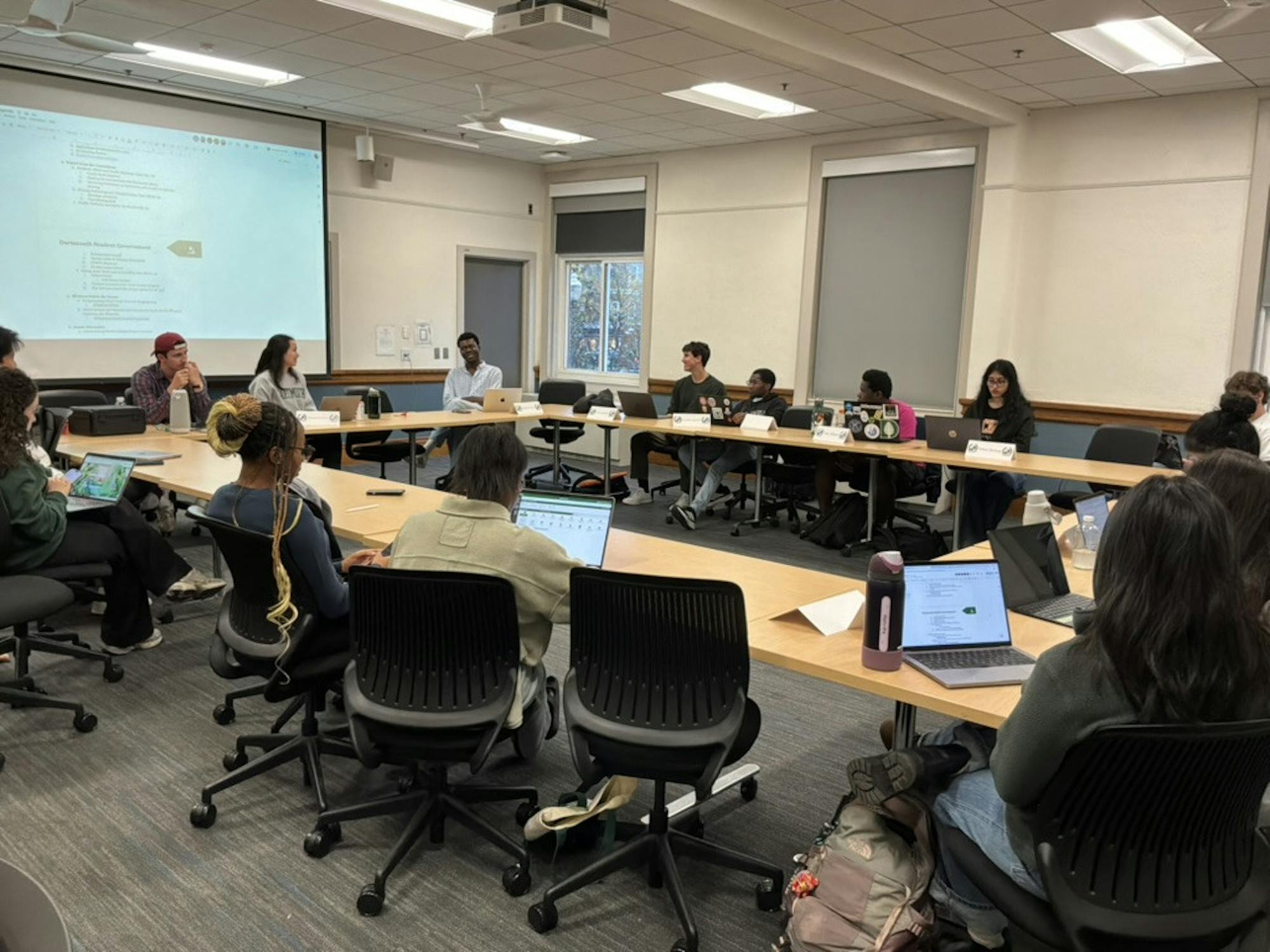
On Oct. 11, the Dartmouth Student Government met for its third weekly meeting of the fall term. Senators discussed the College’s installation of security cameras in College-owned residential spaces, voted to earmark $6,000 for the Office of Financial Aid’s Dartmouth Coach voucher program and discussed a pilot program for extending the Lewinstein Athletic Center’s hours.
The Department of Safety and Security paused the installation of cameras on the morning of Oct. 7 after students, in response to The Dartmouth’s investigation, raised concerns about privacy in Greek houses.
Student body president Ikenna Nwafor ’27 said the project has caused “outrage from different parts of campus.”
“DSG was not aware,” Nwafor said. “The IFC was not aware. The ISC was not aware. Nobody was aware. No student was aware of this.”
Safety and Security director Keiselim Montás wrote in an Oct. 8 email to campus that Safety and Security “consulted with general student leadership” about the project last year. In an email statement to The Dartmouth on behalf of Montás, who is out of office, College spokesperson Jana Barnello did not specify which student leaders were consulted. She added that Montás and senior vice president for operations and strategic initiatives Josh Keniston, who Montás reports to, could not attend the Oct. 11 DSG meeting — to which they had been invited by the Senate — “due to scheduling conflicts.”
“However, Keniston met with DSG leadership on Oct. 12, and they are working together to find the best time to speak to the full DSG,” Barnello wrote.
Student body vice president Maggie de la Fuente ’27 confirmed in a statement to The Dartmouth that she and Nwafor met with Keniston on Oct. 12 to discuss student concerns regarding the recent installation of cameras.
“We emphasized the importance of more transparent communication with students,” de la Fuente wrote. “Keniston confirmed that he and his team will be reaching out to student stakeholders this week. We also plan to invite him and Director Montás to our upcoming Senate meeting this Sunday [Oct. 18] to respond to concerns from the senate and students.”
Chief of staff Oscar Rempe-Hiam ’29 said during the Oct. 12 Senate meeting that he is “strongly against” the installation of the cameras due to privacy concerns.
“Having cameras in residential spaces like Greek houses poses a threat to general safety,” Rempe-Hiam said. “You know, day-to-day activities, walking from your room to the shower, et cetera. There’s something really wrong about being on film in that situation.”
de la Fuente, who said she lived in Chi Delta sorority during her junior fall, during the meeting that she supports cameras “in dorms and general areas,” but that the situation “gets tricky with Greek houses.”
“Every sorority is College-owned, whereas only two of the fraternities are College-owned,” de la Fuente said. “I worry that this could lead to an over policing of what happens in sorority spaces that would not carry over to the fraternities in the same way.” The two College-owned fraternity houses are Alpha Chi Alpha and Chi Heorot.
General senator Trace Ribble ’29 said he “had really similar points to bring up.”
“I understand that there are other issues here if private versus school-owned Greek houses,” Ribble said. “But I think it does say a lot that the primary victims of this surveillance are gender-inclusive Greek life spaces and sororities, rather than fraternities, where we’re seeing a lot of the harm that, in general, we’re worried about.”

At the Oct. 11 meeting, general senator Issa Allison ’29 presented a revised proposal for DSG to contribute $6,000 to help fund the Office of Financial Aid’s Dartmouth Coach voucher program. Allison previously presented a proposal for DSG to contribute up to $15,000 of its annual budget to extend the income threshold for vouchers to help students travel home for the fall-to-winter, winter-to-spring and spring-to-summer interims.
The previous proposal did not pass because of concerns about the program’s cost relative to DSG’s budget of $82,000.
The Senate passed the revised proposal with eight in favor and none opposed. South House senator and academic affairs and faculty relations committee chair Jason Zhu ’28 and general senator Samay Sahu ’27 abstained. Zhu objected to approving the proposal by unanimous consent and instead requested a roll call vote, before abstaining from that vote.
According to a statement from de la Fuente after the meeting, the Senate will be voting on the resolution again next week.
“Issa met with financial aid today and realized his proposal had some inaccurate financial estimates,” de la Fuente said. “He informed us of the issue and we will be voting on the proposal again next week so that the senate can review the resolution with corrected information.”
Zhu said he believed the vouchers were “an important program” but had concerns about DSG funding the program again in the future.
“Could we add a clause that says that Dartmouth Student Government will not be funding the entirety of this program [the income threshold extension] starting next term?” Zhu asked the Senate. “We should not be doing this over and over again.”
The revised proposal’s funding covers vouchers for the fall-to-winter interim for students with annual family incomes between $75,000 and $85,000. DSG approved funding to increase the income threshold last winter. This year’s proposal would extend the increased eligibility threshold to all three interims. Students with annual family incomes under $75,000 received vouchers before DSG partnered with the financial aid office last winter.
An estimated 95 students fall within the $75,000 to $85,000 range this term, based on figures from financial aid director G. Dino Koff, Allison said during the meeting.
Allison added that he has been told by the Office that they “wouldn’t be able to support an additional increase beyond what they’re currently supporting” without funding from DSG.
Koff did not respond to requests for comment.
Sahu said he thought the program was “important,” but that DSG should not “have to continue to pay more and more for this program for the next four years.”
“The point of subsidizing and piloting a lot of these programs is to give the data to administrators and financial aid, for them to inevitably subsidize and see the worth of these programs,” Sahu said.
Rempe-Hiam said he “would really like to see financial aid pick up some of the tab here.”
“I support passing it right now because I think it’s literally our job to just help students,” Rempe-Hiam said. “But we have to think about what it’s going to be next term and the term after that.”
At the Oct. 11 meeting, East Wheelock House senator Sahithi Medikondla ’29 spoke on behalf of South House senator and health, wellness and safety committee chair Isla Walker ’29, who was unable to attend, to announce a trial extension of the Lewinstein Athletic Center’s hours on Thursdays from 10 p.m. to midnight.
Dartmouth Athletics executive associate director for business strategy and operations J. B. Weber wrote in an email statement to The Dartmouth that Athletics will evaluate swipe-in data throughout the trial, which will run from Thursday, Oct. 15 through Thursday, Nov. 19.
“We chose Thursdays because our entry data from the past five years shows the highest volume of late-night usage on that day,” Weber wrote. “If the swipe-in data from this trial shows consistently strong late-night attendance, we will work with the DSG to discuss a longer-term plan.”
Walker, who did not previously work for the gym, will work the new Thursday shift. A previous attempt to extend the athletic center’s hours the week of Sept. 28 was delayed because no one was willing to work the 10 p.m. to 12 a.m shift, according to Walker at DSG’s Oct. 4 meeting.
“We are working on getting the gym to be open till 12 on Thursday, and this hasn’t happened yet, because [Lewinstein] is currently experiencing a student worker shortage,” Walker had said. “They can't find someone who wants to work the 10 to 12 shift.”
The Senate also voted to co-sponsor Dartmouth Civics’ nonpartisan voter education events, excluding “Rock(y) the Vote on Election Eve,” which would invite partisan student groups.
Elections for first-year senators run until 5 p.m. today. DSG also urged students to complete the faculty grading committee’s survey, which closes Oct. 23.
DSG Senate meetings occur weekly on Sundays at 4 p.m. in Collis 101 and are open to all students.
Oscar Rempe-Hiam ’29 is an opinion columnist for The Dartmouth. He was not involved in writing or editing this article.


