
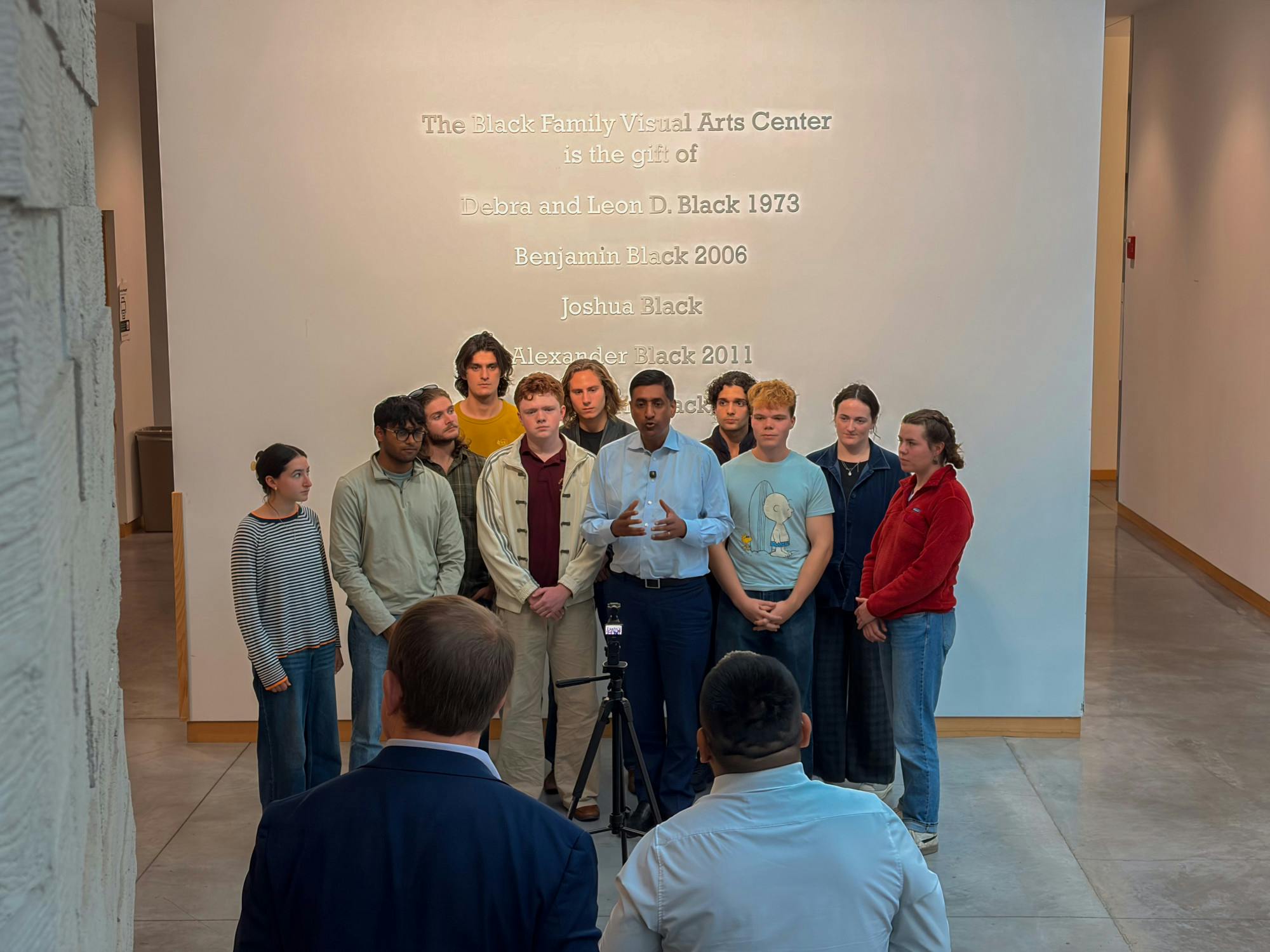
Rep. Ro Khanna, D-Calif., spoke at a private discussion on artificial intelligence at Dartmouth on Oct. 8. While on campus, Khanna also recorded a short-form Instagram video inside the Black Family Visual Arts Center alongside 10 Dartmouth students urging the College to remove the name of Leon Black ’73, a former client of convicted sex offender Jeffrey Epstein, from the building.
Khanna, whose district includes Silicon Valley, has proposed a series of legislative reforms for artificial intelligence since July, including the creation of a federal AI safety agency and a ban on “recursive” self-improving AI. He also proposed a tax on agentic AI, or autonomous AI prompted towards a goal, in an interview with NPR in August.
History professor Bethany Moreton learned Khanna “might have time for a brief stop in Hanover” and invited him to talk on campus, Harper Richardson ’27, who helped organize the event, wrote in a written statement to The Dartmouth. History professor Pamela Voekel reserved a room in Haldeman Hall for the discussion, which was closed to the press.
Richardson, a member of the Student Workers Collective at Dartmouth, said members of the union were asked by Moreton and Voekel to help coordinate the “logistics” of the event.
Khanna first called on Dartmouth to remove Black’s name from the Black Family Visual Arts Center in a video posted on Instagram on March 1, when he was on campus for a Rockefeller Center of Public Policy event.
Black has “been held in criminal contempt of Congress,” Khanna said in a follow-up interview with The Dartmouth. “He is a poster child for the Epstein files. It’s unconscionable for him still to have his name up on the building. It’s shameful.”
Black paid Epstein a sum of $158 million from 2012 to 2017. He has been sued three times for alleged rape. He has denied all allegations of wrongdoing, and the three lawsuits have since been dismissed. On Sept. 16 this year, Black was held in contempt of Congress for failing to appear at a deposition for an ongoing Congressional investigation into Epstein.
In the Oct. 8 video, Khanna said that maintaining the name of the Black Visual Arts Center “creates a culture of elite impunity” on college campuses.
“You see the consequences of elite impunity at Cornell,” Khanna said, referring to the alleged 2024 sexual assault of a female student by seven members of the Chi Phi fraternity. “There you have serious allegations of gang rape because institutions felt the rules did not apply to certain people. We need to have accountability for the Epstein class.”

A spokesperson for Black wrote in a statement to The Dartmouth that Khanna “fails to mention” in the video that Black has sued Congress for holding him in contempt and “does [not] ever acknowledge that the allegations promulgated by attorneys for victims have been dismissed in civil court.”
Cornell University did not respond to request for comment.
In April, Dartmouth’s Board of Trustees established an ad hoc naming committee to consider renaming the BVAC.. The committee has not published any decision yet. On May 29, students held a rally outside of the building, calling for the removal of Black’s name.
A College spokesperson previously told The Dartmouth that the College currently has “no financial relationship” with Black.
Trace Ribble ’29, who appeared alongside Khanna in the video, said he was “surprised in a good way” by the congressman’s attention to younger generations of Americans’ concerns.
“I’ve seen Ro multiple times in person,” Ribble said. “Each time, I’m surprised in a good way. He’s a good representation of a politician who actually listens to what young people care about and then adjusts his policy accordingly.”
In the interview with The Dartmouth, Khanna said he thinks the Democratic Party should focus on building an “economy that works for ordinary working and middle class markets” ahead of the 2026 midterm elections.
“Democrats should talk about ending the war in Iran,” Khanna said. “We should talk about taxing billionaires, fighting for Medicare for All, fighting for free college.”
He also criticized the Trump administration for underregulating the AI sector. States should “be able to regulate AI while we are waiting on federal action,” he said.
“Trump has basically been an accelerationist who doesn’t want any regulation — he needs to be defeated,” Khanna added. “This president is in the pockets of these tech billionaires.”
Khanna told the New York Times that he “planned to decide” declaring his candidacy for the 2028 presidential election in December.
“I don’t know yet,” Khanna responded to The Dartmouth when asked if he would run in 2028. “But I really might have a vision for the next New Deal. Franklin Roosevelt built the country for the Industrial Age. I believe we need to rebuild this country for the technology age.”
Tom Gerring ’30, also a student in the video, criticized the Democratic Party — including Khanna — for being “too weak” on the Trump administration. He said that Khanna’s agenda items are “not what Americans are riled up about.”
“In order for Democrats to win this November, they need to use people’s anger about Trump,”
Gerring said. “They need to be as harsh as possible as they can be with Donald Trump and his criminal allies.”
Voekel declined to comment. Moreton did not respond to a request for comment.


