
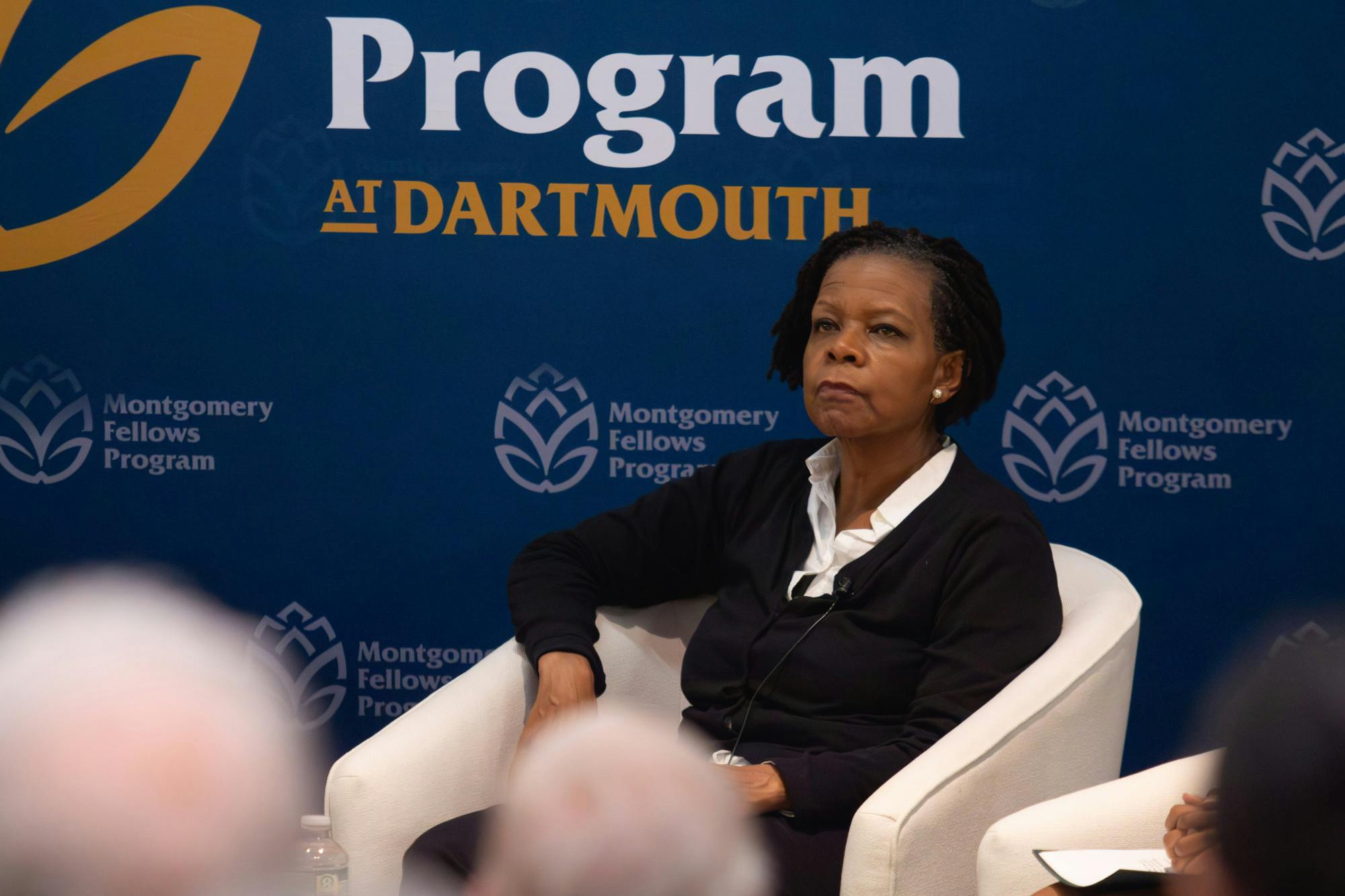
On May 14, Harvard University history and law professor and Pulitzer Prize winner Annette Gordon-Reed ’81 discussed the importance of including broader perspectives in remembering American history at an event sponsored by the Montgomery Fellows Program.
The event — moderated by African and African American studies professor Nicole Maskiell, government professor Keidrick Roy and Dartmouth chapter of National Association for the Advancement of Colored People president Ajayda Griffith ’27 — was part of the “Law and Democracy: The United States at 250” speaker series, which highlights “diverse perspectives on government, law and politics,” according to the Rockefeller Center website. 170 people attended the event in Filene Auditorium, according to Dartmouth News.
Gordon-Reed, who will serve as a Montgomery Fellow this term, spoke about the general reaction to her first book “Thomas Jefferson and Sally Hemings,” which described the relationship between the former president and Hemings, who was enslaved by the Jefferson family. She said many of her colleagues denied the sexual relationship between Jefferson and Hemings, which is now widely accepted among historians as a result of Gordon-Reed’s work.
“Usually when you have [people who are oppressed], you pay attention to victims,” Gordon-Reed said. “What do they say? How was their world constructed? What happened to them? And here, everybody that I was writing about, all [historians] cared about was what Jefferson’s white family was saying.”
After finishing her manuscript, Gordon-Reed said she sent it to colleagues who “said that the story wasn’t true” to “hear from people if [she] was wrong.” She added that she believes it is “really important” for people with “a different viewpoint” to “test your ideas, test your theories.”
Gordon-Reed also shared her experiences as an African American woman growing up in Conroe, Texas, in the 1960s. She recalled a story of a Black man in Conroe who had an affair with a white woman and was shot by the white woman’s husband in a courthouse “in front of everybody.” The husband was acquitted quickly thereafter.
Gordon-Reed also described her experience growing up in a school system that remained segregated after the practice was deemed unconstitutional by Brown v. Board of Education in 1954. She described how “white people were supposed to choose white schools, and Black people were supposed to be free to choose Black schools,” but her parents chose to enroll her in a white school, making her the only Black student at the school.
She said she continued to face “hostility” during her time at Dartmouth, both as an African American student and as a woman. Gordon-Reed explained how her dorm in North Massachusetts Hall, a single-sex residence hall at the time, was a “target” for anti-coeducation sentiment on campus.
“A determined group of men really did not want us here,” Gordon-Reed said. “They used to come to North Mass outside and chant at night. Tell us to ‘go away, go away.’”
Gordon-Reed said, however, that Dartmouth was the “perfect place” for her because of the “adventure[s]” that she had through the College. She discussed her involvement on the debate team and with the Afro-American Society magazine Black Praxis. She also described the study abroad program in France she participated in during her sophomore fall and her internship in a public defender’s office in New Jersey, both experiences she said she “wouldn’t have been able to do” had she not gone to Dartmouth.
Throughout the talk, Gordon-Reed spoke about her love for reading and her literary influences, which include James Baldwin, W.E.B. DuBois and Toni Morrison. She shared memories of reading in the Tower Room in Baker-Berry Library and enjoying afternoon tea in Sanborn Library.
Reading “opens the world up to you in different ways,” she said. “You see things, encounter ideas and thoughts that you wouldn’t ordinarily in your own life. And so that gets you a good perspective on the human condition.”
Gordon-Reed encouraged Black students to persevere through “moments of retrenchment,” or “going forward and going back,” between periods of inequality and progress.
“We are in a moment now of retrenchment,” she said. “You have to keep the ball rolling. Don’t give up … It’s a battle for human rights, and that’s always a good thing. Be confident in that.”
In an interview after the event, attendee and historical fiction writer Nancy Heffernan, said she appreciated how Gordon-Reed described herself as a writer as well as a historian.
“She likes to be a writer, and she likes fiction, too,” Heffernan said.
Attendee Linda Wilkinson said that she was “grateful” to the College for “sharing its riches with the community” through these events.
“This is a tremendous privilege for us,” she said. “I think we benefit from these ideas and the chance to exchange them.”
Attendee Carol DuBois, who said she heard Gordon-Reed speak before in Boston, said she got a “better sense” of who Gordon-Reed “is and how she thinks.”
“I really love the fact that she talks so much about how people’s stories are important, and that history is in the stories,” DuBois said.


