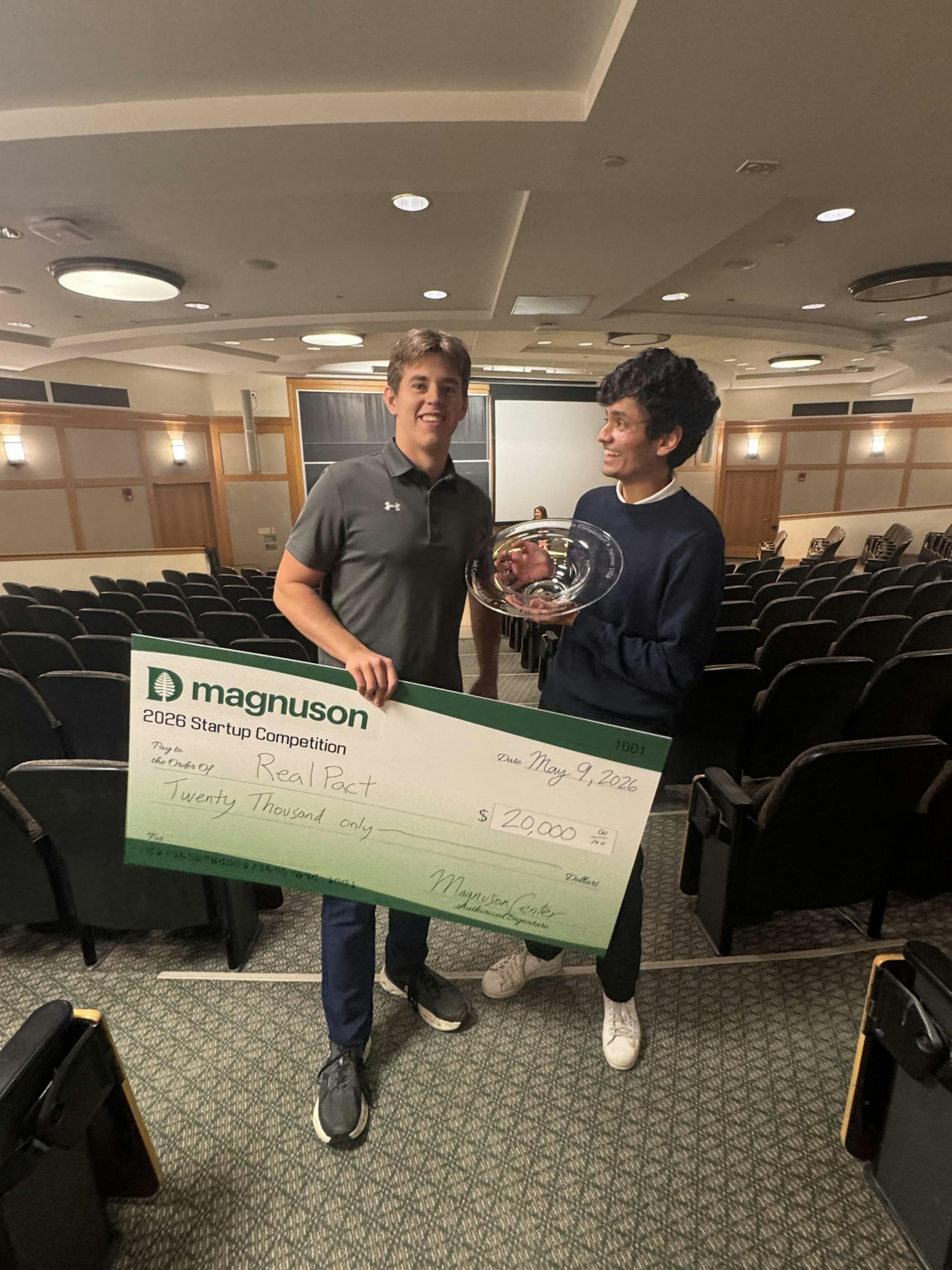
On May 9, Erik Peterson ’27 and Ranvir Deshmukh ’26 won the 2026 Magnuson Startup Competition with their real-estate startup RealPact, an artificial intelligence tool for real estate brokers that can “handle the operational work behind every [real estate] deal,” according to its website. The competition — hosted by the Magnuson Center for Entrepreneurship — evaluates startups for metrics such as their “strength of team,” “problem definition” and “quality of solution.” The winning startup receives a grand prize of $20,000.
RealPact has raised $500,000 from venture capital firm Y-Combinator and has received other funding from venture capital funds, pitch competitions and angel investors. The Dartmouth spoke to Deshmukh and Peterson about RealPact, their future plans and their advice for other students interested in entrepreneurship.
What is RealPact?
EP: In a nutshell, we automate real estate contracts for realtors. We do this by gathering city, county and state-level documents, parsing them and then putting them into realtor’s contracts.
RD: The deed, the property records, the tax records, the tax map and all this information that’s required for a transaction to be complete — we fetch that information, cross-reference it across different sources including portals at the state, county and city level, and then use our models to auto-fill the contracts.
Why did you start RealPact?
RD: The problem in real estate was prominent because the software is very old and obsolete. It’s very dated. So we thought we could build this automation tool, given the rise of AI. We started building RealPact out in November.
EP: We realized that we need to go down into a specific niche, so that’s why we talked to different people in industries like law, real estate, energy and biotech. Real estate was the one where the people really seemed to have a big pain point.
Why do you think RealPact stood out in the Magnuson Startup Competition?
EP: I would say that we have the most tangible traction. A lot of the other ideas are really good, but a lot of them are just ideas. We are selling to actual realtors and brokerages. We have people on RealPact using it.
RD: We went to Four Seasons Sotheby’s — a real estate firm — and sat with them for two hours to discuss their entire workflow and how broken the workflow is. We’ve been working with them to build out this entire product.
What does the future of RealPact look like?
EP: More short term, what we’re looking to do is to bridge the different stakeholders in the transaction process together. The realtors, loan officers, real estate attorneys, title companies — all of them played their own part with helping somebody buy or sell a home. And right now there’s not really a great platform that brings them all together. So that’s where we aim to be in the next few years.
How do you plan to use the $20,000 you won?
RD: We’re going full-time working on RealPact after graduation. The award will be used as a runway for us to work on the product while also getting traction. Once we have that traction, we can raise follow-on amounts showing this traction to investors. We have already raised funding from a venture capital fund called LeapYear, and we are raising a bigger round of investment right now of around $700,000.
EP: More specifically, we’re building out our own AI agents. That costs money. We’re trying to get SOC-2 compliance — which is something for enterprise customers to verify that all their data stays with us. That’s another large expense.
What advice would you give to other Dartmouth students interested in entrepreneurship?
EP: For me, I would say by far the best piece of advice I could give is just start building something. It doesn’t necessarily have to be something that is the next million dollar idea, but if you can figure out what people want and you just start moving forward, that’s the best thing that you can do. There’s way too many people that just like talking about making a startup, and they don’t actually do anything.
This interview has been edited for clarity and length.