
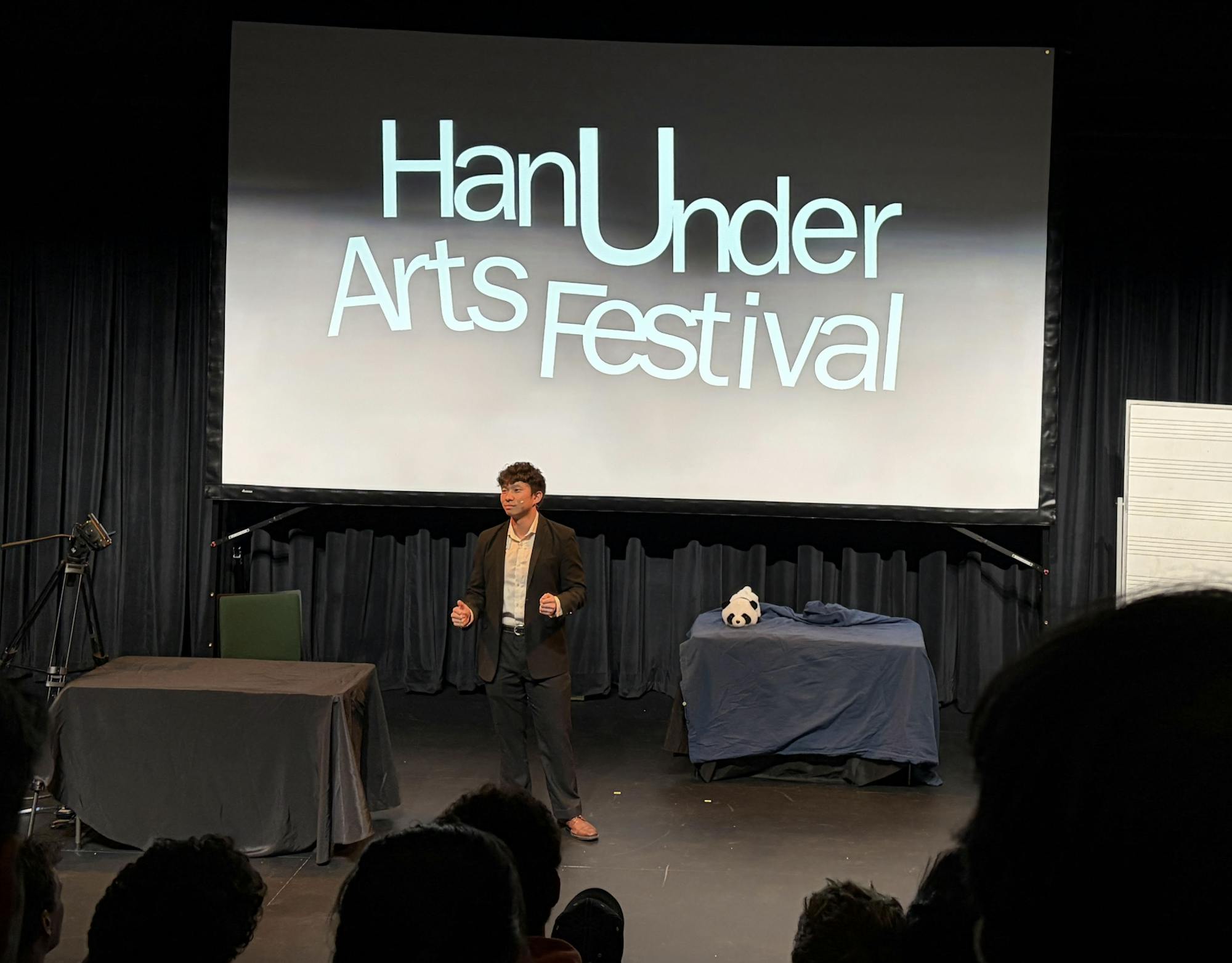
The Hopkins Center for the Arts hosted the third annual HanUnder Arts Festival from April 23 to 25. The festival is a three-day, student-run celebration of student art. Day one showcased the variety of arts at Dartmouth, spanning practices of music, visual arts and writing. The second day centered on music and dance, including performances from singer-songwriters, DJs, drag artists, rock bands and more. On day three, the festival featured sonic art, film and theater.
The festival closed with tributes to Won Jang ’26, Kate Ginger ’27 and Enzo La Hoz Calassara ’27, three Dartmouth students who have died since summer 2024.
The Dartmouth surveyed nine student artists — Ava Rosenbaum ’26, Axel Schulz ’28, Bill Zheng ’26, Ellie Alloway ’26, Jessi Calidonio ’26, Nate Lopez ’29, Olivia Koo ’26, Scipio Han ’29 and Shakeb Arsalan ’26 — about their performances at the festival, their creative process and the festival’s impact on their time at Dartmouth.
In one sentence, describe the art you presented at HanUnder.
Ava Rosenbaum: A piano trio performance by the Armenian composer Arno Babadjanian.
Axel Schulz: An impressionistic music video for an original song by Frankie Severino ’27.
Bill Zheng: A stage magic performance consisting of card tricks, mentalism and storytelling.
Ellie Alloway: I read a section from my upcoming novel, “An Englishman’s Guide to the Occult.”
Jessi Calidonio: A short film about four friends on a night out where everything goes wrong in Miami.
Nate Lopez: I performed “Cabaret” from the musical “Cabaret” in full drag.
Olivia Koo: Songwriting.
Scipio Han: For my performance, I presented a selection of classical piano compositions from the late romantic and impressionist era by the composers Chopin, Rachmaninoff and Debussy.
Shakeb Arsalan: An excerpt from a semi-feature film.
What was the most fun part of developing your piece?
AR: Collaborating with other passionate musicians and unpacking the musical intricacies.
AS: Experimenting with practical effects like DIY camera lenses!
BZ: Coming up with tricks and ways to present those tricks in a digestible way to a stage audience.
EA: I’ve been writing since I was a child, and I’ve done other readings in the past, but I particularly enjoyed the collegial atmosphere of HanUnder.
JC: The most fun was working with actors and seeing the characters come to life.
NL: I really enjoyed developing my costume and the arch of my performance, making it a statement piece to the audience.
OK: It was a nice culmination of the work I’ve done here in songwriting.
SA: I worked with other Hop Fellows and figured out that I had a 10-minute showcase slot, so I had to creatively approach my piece with a new perspective and abridge it accordingly.
SH: On top of hearing the music come together as I was working on it and picking through all the details during practice, I found writing a programme note to be a worthwhile exercise. It allowed me to reflect, in words, on the music I was playing, oftentimes reminding or informing me of ideas to implement in my interpretation of the music.
What was the biggest challenge you faced?
AR: Performing an intimate piece in a more public space.
AS: Editing was very challenging. There was a lot of footage to choose from and no real limits to guide me.
BZ: Not having enough time to prep just because I was swamped with other priorities. Also not knowing enough other magicians to bounce ideas off of. I only have one friend who also does magic.
EA: Writer’s block, without question. That blank page staring back at you is no joke.
JC: The biggest challenge I faced was filming while the restaurant was running.
NL: It was hard to decide what elements and points in the song I wanted to speak directly to the audience and to decide what I wanted the audience to take from the performance.
SA: Balancing putting together HanUnder and getting my finished cut in time. I was simultaneously also editing the HanUnder festival film and the In Memoriam for Kate, Won and Enzo, so I was only able to get my final submission in on the day of the screening.
SH: As a musician, polishing technique, muscle memory and building the endurance to perform for over 30 minutes straight is a baseline challenge, but conveying each piece in the program as a coherent story from start to finish was ultimately the largest challenge. I was playing a background setting, which took some pressure off of me in terms of making “small mistakes.”
Describe your experience at HanUnder in three words.
AS: Unexpected, rewarding, welcoming.
BZ: Electric, fulfilling, proud.
EA: Illuminating, awe-inspiring, pride.
JC: Rewarding, welcoming and flexible.
NL: Expansive, freeing, desperate.
OK: Fun, fulfilling, enlightening.
SA: It’s my baby.
SH: Creative, collaborative, artful.
Please share the most memorable part of your time at HanUnder.
AR: The collective silence after we finished performing, as if time had paused.
AS: Very cool to have people watching your project!
BZ: Seeing the audience’s reactions to my tricks and my friends supporting me.
EA: While I was performing, I saw at one point every set of eyes were on me, and as a storyteller that was very thrilling — that my story was really reaching the audience.
JC: The most memorable part was seeing people laughing. That made all the sleepless nights of editing worth it.
NL: I enjoyed collaborating with different queer artists.
OK: Being able to share my music with my friends.
SA: I found the tribute to Kate, Won and Enzo during the closing ceremony of HanUnder to be the most moving. I showed a festival film during this moment that incorporated an In Memoriam section for them alongside other performers remembering Kate, Won and Enzo. Through the course of these performances, I was moved to tears and so were the many others that had filled in the atrium of the Hop around a community sculpture that was built during the course of HanUnder. In that moment, I truly felt connected to my friends and peers alike.
SH: Holistically, the most memorable part of HanUnder was getting to see the campus come together to appreciate the arts. It felt gratifying to know that I could be a part of making music that friends could appreciate and enjoy, and that I could also see other friends perform their art forms, creating a memorable exchange that reminds us of the joys of life.
How has HanUnder contributed to your experience as an artist at Dartmouth?
AS: It made me feel like a real artist.
BZ: It gave me a stage to perform an art form that is not mainstream and showcase my art to my friends in such a fulfilling way, which I never would have gotten the chance to if it weren’t for HanUnder. It’s such a great initiative. It should get more funding for even more artists, especially in non-traditional art forms.
EA: It has given me the ability to share my art while broadening my own experience with others’ art.
NL: It has allowed me to interact in new spaces and develop relationships with audiences.
SA: HanUnder is the single biggest thing that I have done during my time here. I won’t ever be able to recall Dartmouth without thinking of HanUnder. I also feel especially attached to HanUnder since I named it.
SH: Being at HanUnder has pushed me to continue expanding my pianistic repertoire. As a musician, having any performance opportunity is valuable and a chance to grow. It is, after all, the whole reason why musicianship exists: to tell convincing stories through sound that everyone can enjoy in their own way. I will definitely continue to look into opportunities like HanUnder to continue performing and expanding my horizons as a musician.
These responses have been edited for clarity and length.


