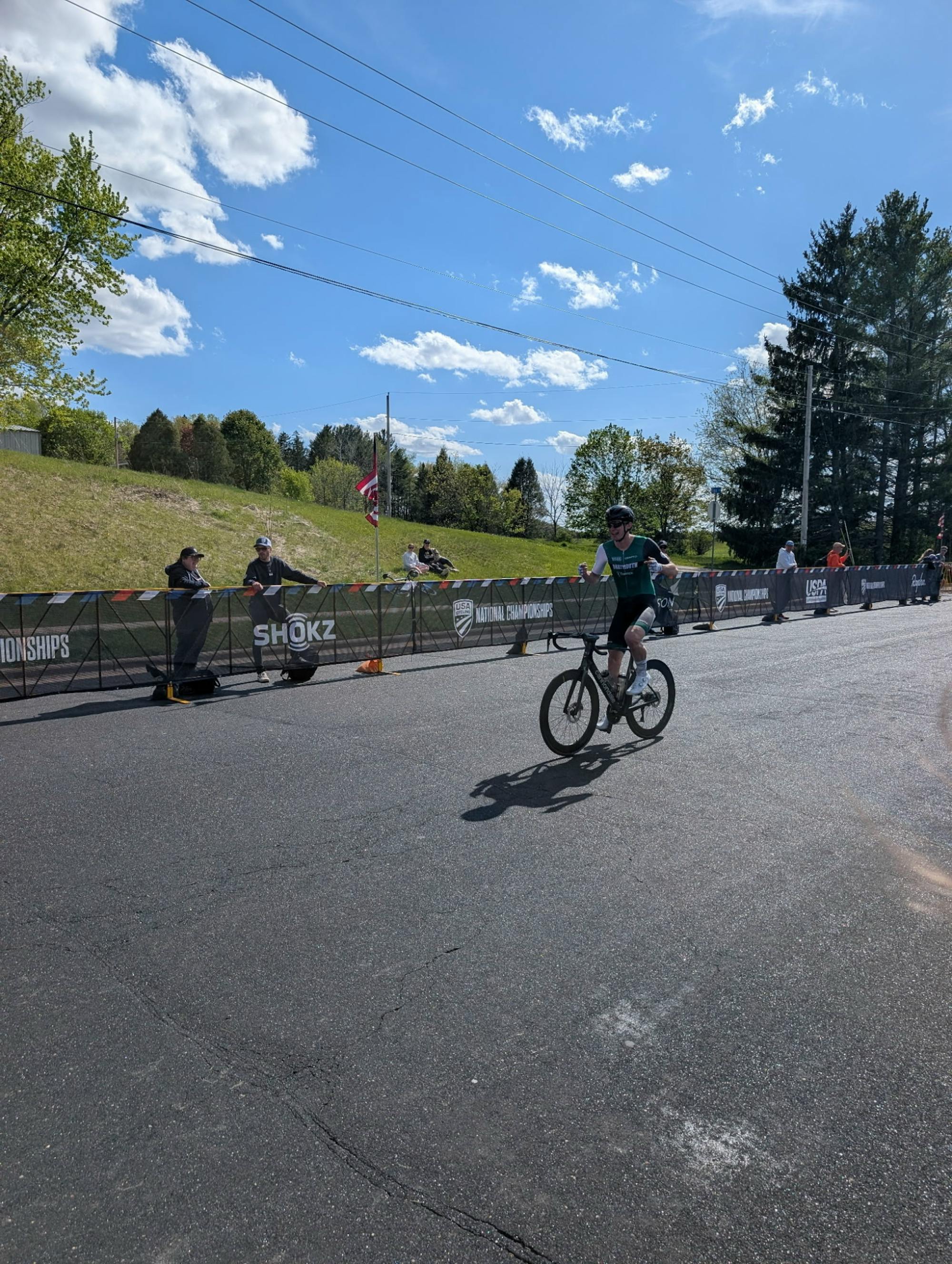
On May 9, Ben Hinchliffe ’27 won the road race at the USA Cycling Collegiate Road Race National Championships in Waterloo, Wis. Hinchliffe completed the 86-mile race with a time of 3:21:22, over two minutes ahead of his closest competitor. The next day, Hinchliffe placed 19th in the men’s club criterium, a high-speed circuit race where competitors complete as many laps as possible in 80 minutes.
The men’s team time trial, which consisted of Hincliffe, Nolan Holmes ’25 Th’26, Matthew Marotto ’28 and Divik Verma ’26, placed third in the men’s club team time trial with a total time of 49:01.28. Isabelle Jensen ’29 placed fifth in the women’s club criterium. The Dartmouth Cycling Team races nearly every weekend during the collegiate cycling season, beginning this year on March 15 and ending on May 10.
Hinchliffe is no stranger to the podium. Over the summer, Hinchliffe competed independently in the Green Mountain Stage Race, an annual race in Vermont, and placed 11th with a total time of 2:58:34 in the Men’s Pro/1/2 category. Outside of the cycling team, Hinchliffe was the 2024 winner of the men’s Olympic distance race, which consisted of a 1-mile swim, 24-mile bike and 6.2-mile run, at the USA Triathlon Collegiate Club National Championship. He also races professionally for Jamison Racing, an elite-racing team based in New York.
The Dartmouth sat down with Hinchliffe to discuss his cycling and triathlon journey.
How did you get involved with triathlon and cycling?
BH: I’ve been riding a bike as long as I can remember and I did track [and field]. I did a bit of bike racing at my club between seven and nine. I was racing track for a couple of years and I drifted into other things. I got into rowing in eighth grade, and did that pretty seriously through COVID-19 and we were training on the rowing machine.
In the spring in the United Kingdom, I was unhappy being in my garage and rowing [on the machine]. I decided to do something different — ride my bike. I wanted to do a charity fundraiser to motivate me. I decided to do a half Ironman, but I replaced swimming with rowing. I raised about £2,000 for food banks and Hope and Homes for Children [a charity to help bring separated children back to their families]. I particularly enjoyed running and cycling. I decided to try triathlon and I did that in junior and senior year of high school exclusively. I was getting good results.
I came to Dartmouth and got involved with the Dartmouth Triathlon Team. I won nationals in my freshman year. Sophomore year, I was fully focused on nationals. I didn’t win and it was a little bit disappointing. One of my friends on the cycling team said, “Why don’t you just come to a race?” I was like, “Sure, this sounds fun.” It was so much fun. I just kept rolling out the next weekend, and the next, and then I upgraded through cycling categories [which are determined by points based on race results]. After the third weekend, I qualified cycling nationals that year. I went to nationals and I got 14th.
I decided to just do more cycling because the racing is easier: I can go to races easily and I could race more often. There’s not really a collegiate triathlon season because the collegiate season for the Northeast Conference for triathlon is in August, when most schools get back.
What is your training schedule?
BH: I shoot for between 16 to 18 hours a week. I was pretty locked in, especially during the winter term. I used the indoor bike and went Nordic skiing twice a week. The 16 hours is a mix of intensity and easy riding. It’s half bike, a quarter swimming and a quarter running.
I lifted in the fall and the beginning of the winter. I like to phase that out as I go towards the racing season. I like to sleep enough as well. When I’m in a proper training week, I’ll be burning about 5,000 calories a day. Trying to get that quantity can sometimes be difficult, so ice cream and desserts are encouraged.
What are any rituals or preparations you do for race day?
BH: I used to have a pair of socks for each race. I make sure I look at the things I need to do before a race and tick those off. The further you go through the season, the more you get used to the process because it’s pretty much the same each time — hydrating, fueling and that stuff. I try not to get too superstitious about it. Bike racing is different because it’s so much more dynamic. You have to deal with people around you. You have to respond to things rather than executing a plan to perfection.
The main thing the night before is eating a lot of carbs, making sure you’re properly hydrated and preloading some electrolytes as well. Before the race, I get some caffeine — I use it as a boost.
What’s your favorite memory from nationals?
BH: I love traveling with the cycling team because it’s always a good laugh — beyond good racing. We flew out on Wednesday and we had a total disaster with our Vrbo. Vrbo still had the house on their website, but the person who owned it had sold it a year ago and delisted it. We got there and had nowhere to stay. We had a fun hour and a half in a parking lot of a Piggly Wiggly in middle of nowhere, Wisconsin, on the phone with Vrbo customer service figuring that out. In hindsight, that’s a funny memory.
After the race and Saturday, we went to former Cycling Team president Amélie Bradley ’25’s place— she now lives in Madison with Megan Liu ’25 who was on the cycling team. We went to dinner at theirs afterwards and we had a nice time catching up.
What are some challenges club teams face compared to varsity teams?
BH: There’s the funding stuff. We’re lucky that Dartmouth Club Sports does a good job — they pay for our cars and gas when we drive places for races. We also have sponsors and donors who support the team. When you race for Dartmouth, you don’t have to pay for race entry and the hotel. It’s pretty much free, which is huge, because cycling can be an expensive sport.
I was the road season coordinator this year, so it was my job to find race weekends. That’s not an insignificant amount of work between cars, places to stay, registration and travel. If you’re a varsity athlete, you can at least do work on the bus, but if you’re one of the people driving, then you’re not doing that.
What are your future cycling plans?
BH: I am going home to the U.K. this summer and I’m hoping to go to races there and in Belgium. I’m going to come back for the Green Mountain Stage Race on Labor Day weekend with Jamison Racing. My goal for this season and next year is nationals again.
Would you want to pursue professional cycling?
BH: If the opportunity was given to me, I would take it, even if I raced for a mid-level team for a few years and started working later. You’re young once, and I’m a believer in delaying sitting behind a desk for as long as you can. That would be something to think about, but I need to get more results for that to become a possibility.
This interview has been edited for clarity and length.