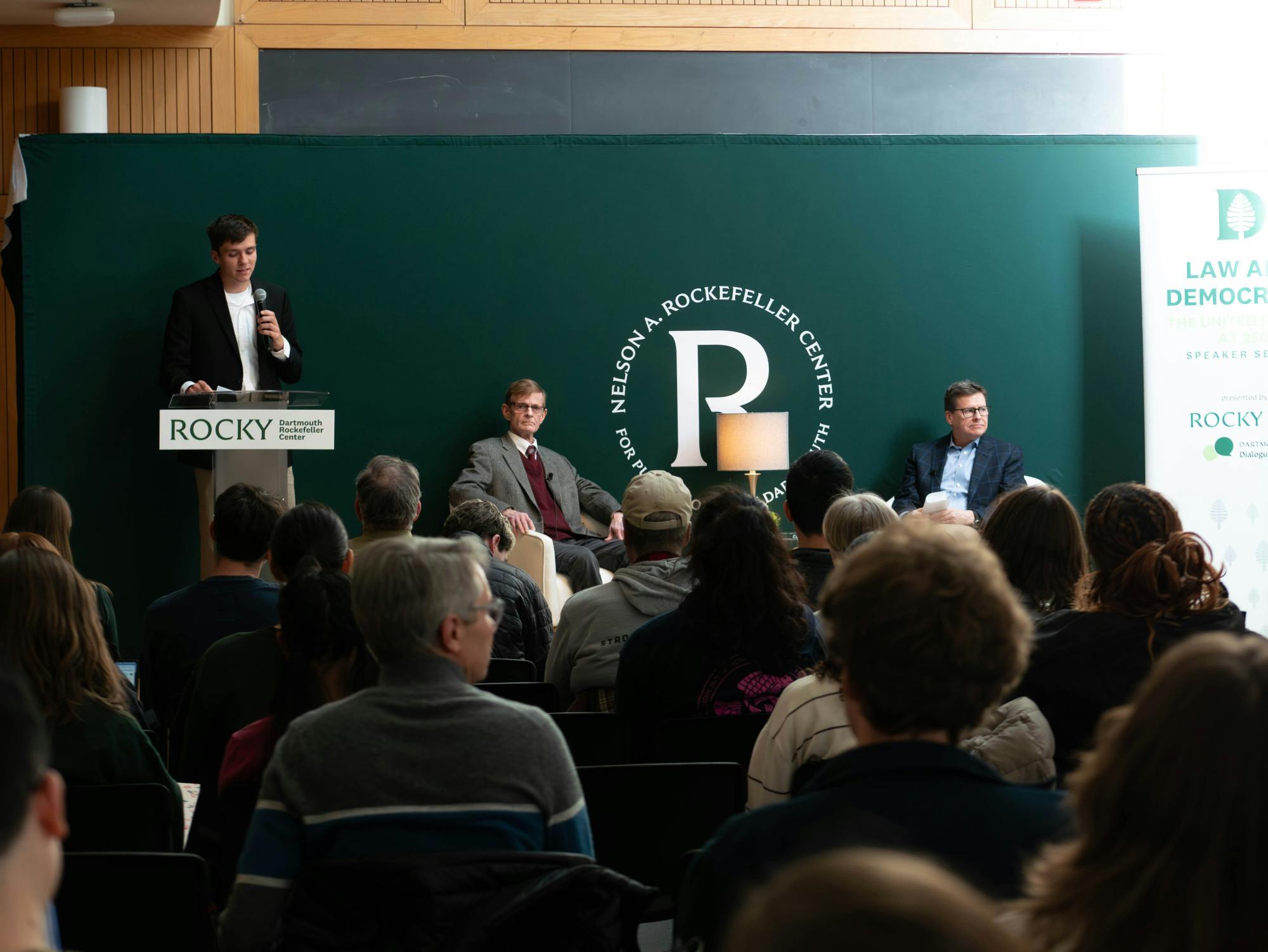
On April 7, the Rockefeller Center for Public Policy hosted Concord Coalition — a fiscal responsibility advocacy non-profit — senior advisor Robert Bixby for a conversation about the federal deficit. The event, moderated by Tuck School of Business professor Charles Wheelan ’88, was a part of the Rockefeller Center’s ongoing “Law and Democracy” speaker series, which has featured numerous public policy leaders and legal scholars since it began in fall 2025.
A federal deficit occurs when the federal government collects less in revenue than it spends in expenditures each year. To finance expenditures that exceed revenue, the U.S. Treasury sells securities such as bonds, increasing the national debt, which stands at over $38 trillion at the time of publication.
The deficit is a lot like “termites in the basement,” Wheelan said. “A dumpster fire, you’ve got to rush out with your fire procedure. With termites, the floor is going to collapse, but maybe not today.”
An American sovereign debt crisis could lead to a financial crash, spiraling inflation and substantial cuts to welfare programs, according to fiscal responsibility advocacy group Committee for a Responsible Federal Budget.

In response to Wheelan’s termite analogy, Bixby said he thinks there are “signs” that the deficit will collapse, such as a rise in sales of U.S. Treasuries after a “hiccup in the economy” due to the Trump administration’s “Liberation Day” tariffs in April 2025.
“Usually, there’s a flight to safety when there’s some sort of perceived crisis, and U.S. Treasury bonds are considered quite safe,” Bixby said. “The fact that they weren’t [on Liberation Day] got people wondering whether the rest of the world is kind of reassessing how much money they really want to lend us.”
Bixby, formerly the Virginia Court of Appeals’ chief staff attorney, volunteered for the 1992 presidential campaign of former Massachusetts senator Paul Tsongas ’62. Tsongas campaigned on fiscal conservatism and targeting the national deficit, but ultimately lost the Democratic primary to former President Bill Clinton.
Soon after, Tsongas joined forces with then-New Hampshire senator Warren Rudman to start the Concord Coalition, Bixby said in an interview with The Dartmouth.
“I said I’d like to be involved with it, so I gave up my legal career and joined the Concord Coalition,” Bixby said.
During the event, Bixby and Wheelan discussed the magnitude of the current federal deficit and the consequences of leaving it unattended.
“When Halloween comes along, I invite [my students] to choose the costume of their choice from something that has to do with the course, and a number of students come dressed as the federal debt because they can’t imagine anything scarier,” Wheelan said.
Bixby explained that the problem is not “where the debt is right now” or “any particular level of debt,” but rather “ the trajectory that the debt is on” that is cause for concern.
“The debt is on what everybody in Washington agrees is an unsustainable track,” Bixby said. “On autopilot, the federal budget rises faster than revenues.”
“The interest costs that the government has to spend are getting huge, over a trillion dollars last year,” Bixby said. “It’s about the same as we spend on Medicare. That increasingly is going to put pressure on other policies.”
Bixby and Wheelan both proposed cutting entitlements and raising taxes as possible solutions to the debt crisis.

N.H. State Rep. Terry Spahr, D-Grafton, asked Bixby why the “Founding Founders” had not included a mechanism for balancing the budget and how to implement one now.
“Our state has a balanced budget requirement, and 40 other states have some sort of requirement to balance their budgets,” Spahr added.
Bixby responded with a quote from Abraham Lincoln.
“‘Without public sentiment on your side, nothing is possible. With it, anything is possible,’” Bixby said. “We have to do a better job of bringing the public along, and then enacting mechanisms that will ensure trust.”
Bristol Casperson ’29, who attended the event, said she thought not enough people are aware of the deficit crisis.
The event was “certainly the first time I have ever thought about it very deeply,” Casperson said. “I was kind of googling like a madman [at the event], trying to find solutions of my own.”