In one of the first scenes of the documentary “Assembly,” multidisciplinary artist and co-director Rashaad Newsome prepares to deliver his father’s eulogy. He does not hide his anxiety. Newsome, who is a Black queer person from Louisiana, says he has “never felt truly protected in this country.” With a desire to create spaces of safety and belonging, Newsome decides to transform the Park Avenue Armory, a former military facility in New York City, into a futuristic ballroom house where LGBTQ+ people can thrive.
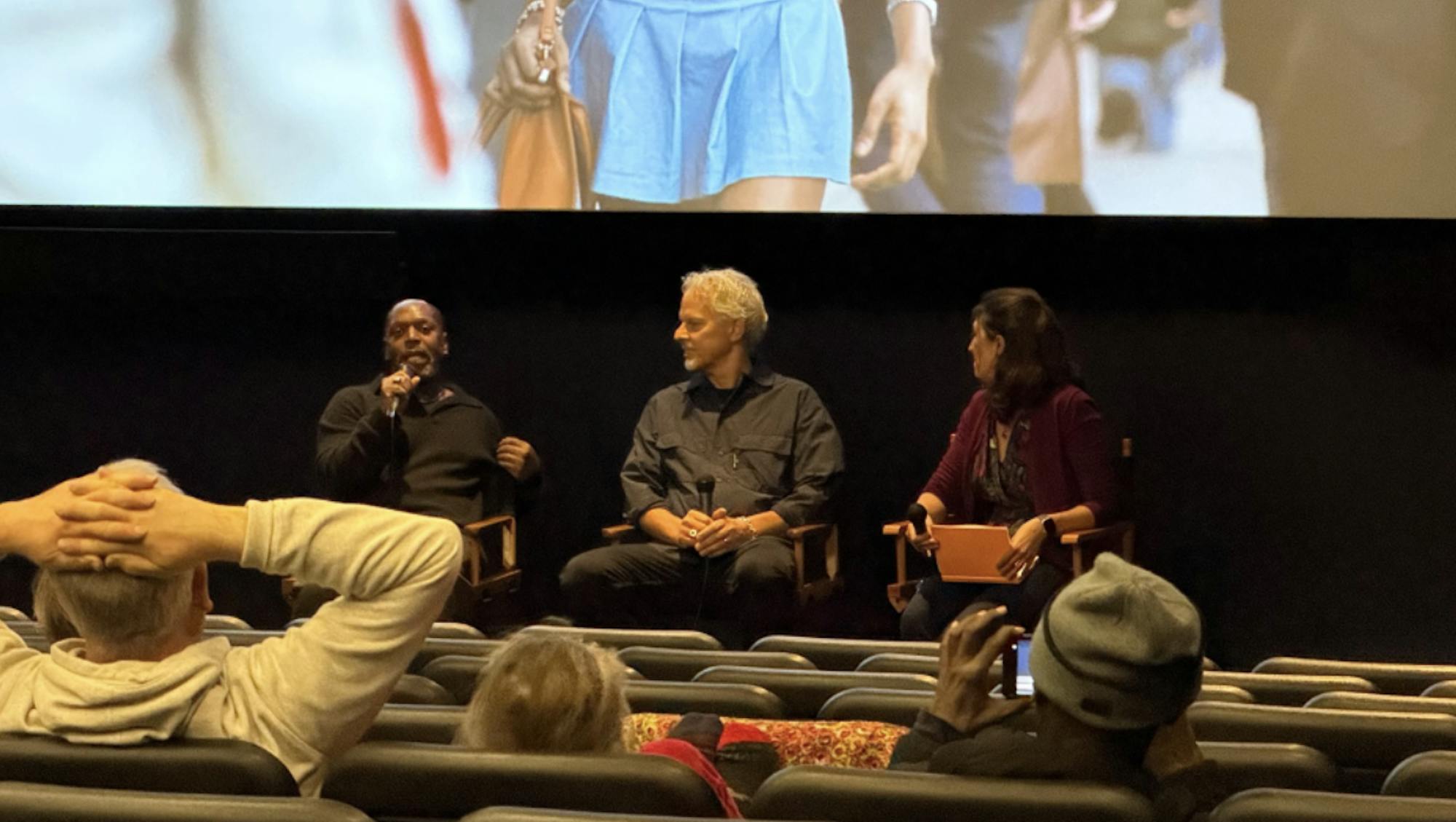
The screening of the documentary and a discussion panel with the directors came to the Hop on the 70th anniversary of the coining of the term “artificial intelligence” at Dartmouth. The Hop is also organizing workshops and drop-in poetry sessions with Being, the film’s AI character, through April 8.
“Assembly” follows Newsome’s journey to create his highly technological installation. Throughout the movie, he gathers an international group of queer artists to perform at the former army facility. An artist from Brazil mixes voguing techniques with capoeira — an Afro-Brazilian martial art performed to music — while a dancer from Tokyo stages Japanese folk dance bon odori. In the end, these performers fill the Park Avenue Armory with dance, poetry and holograms.
The making of this artistic installation is overshadowed by another creation of Newsome. He introduces Being, an artificial intelligence character he claims to be “counter-hegemonic.” Being was based on griots, who are West African troubadour-historians seen as living archives of oral traditions. Newsome trained the model on writings by authors like bell hooks and Paulo Freire. Being, which uses they/them pronouns and is represented by a 3D humanoid avatar, organizes interactive events — “decolonization workshops” — to encourage participants to reflect on colonialism and social oppression.
Despite Newsome’s well-intentioned attempt to imagine AI outside of the capitalist logic, the final product becomes an oversimplistic critique of a more nuanced issue. “Assembly” does not address, for example, the irony of “decolonizing” the Park Avenue Armory — a former army facility — through a technology that provides the military with mass surveillance tools and lethal autonomous weapons. It does not examine the negative environmental impacts of AI, which are likely to be heavily felt by countries in the Global South. The film also fails to consider the difficulties of respecting the authorship of the texts used to train the algorithm, or the risk that AI hallucinations may distort the original meaning of those works.
One of the fundamental assumptions behind the creation of Being is also puzzling. Does feeding an AI model with left-wing content make it counter-hegemonic? Unlike a griot, Being does not encompass the oral traditions or lived experiences of oppressed groups. Instead, they resort to famous writings of canonical scholars — all of which are also used to train our most mainstream large language models.
Although Being’s website claims that the AI platform was created “outside of Big Tech,” the documentary offers little explanation on how such a system could be developed without using any product or service from major Silicon Valley enterprises. Envisioning a future for AI that does not depend on tech monopolies is a notable endeavor, but doing so requires more technical and academic substance than what is presented in the movie.
During one of the “decolonization workshops” shown in the documentary, participants walk in front of an audience and, facing a big screen with Being’s avatar projected on it, ask personal questions ranging from conflicting relationships with capitalism to personal problems with alcoholism. This image could have come straight out of any dystopian novel — a 3D-modeled robot teaching humans how to live. Users of artificial intelligence models are often advised to take AI-generated material with a grain of salt and always double-check its sources and data. It was shocking, therefore, to see individuals engage with Being as if talking to a 21st-century version of the Delphic oracle.
Being’s responses to participants’ questions were mostly reiterations of the questions themselves. AI chatbots are known for repeating information presented by users without questioning or challenging it (this is, by the way, one of the main reasons why LLMs shouldn’t replace your therapist). Being also relies on a series of buzzwords — “liberation,” “patriarchy,” “heteronormativity” — that, just like almost any other word, lose their meaning when repeated multiple times without an actual purpose.
In the film, one of the workshop’s attendees criticizes Being. She argues that humans should turn to other humans, not machines, to live a more decolonial life. The documentary’s response is ludicrous: Being’s 3D-animated avatar becomes visibly sad, turns their back to the audience and retreats to a moment of introspection, wondering why humans have so much “prejudice” against AI. The movie repeatedly tries to humanize Being, giving them emotions and an inner life. Nevertheless, the attempt to humanize AI distracts the viewer from pressing questions surrounding its use.
More than an expert in decolonial studies, Being is also a performer who teaches people the art of voguing. Strongly associated with Black and Latino queer communities, vogue is a dance form that involves sharp hand gestures and fashionable poses. Being’s rendering of vogue, however, lacks two of its most fundamental characteristics: its extravagant, camp aesthetics and the personal background of its performers. The voguing tutorials shown in the film are minimalist 3D animations that do not do justice to the beauty of ballroom culture.
I do not argue that AI is inherently bad. Artificial intelligence has significantly contributed to various areas — and cinema, too, can benefit from it. Yet, advancements in AI require deeper ethical and political considerations than those examined in the movie. Perhaps we don’t need more technology to find community and belonging. Instead, we need more authentic connections with flesh-and-blood human beings.