Notifications flash mid-lecture. Laptops line every classroom table. Even breaks between classes often dissolve into scrolling.
Still, in the margins of campus life, different scenes unfold: a group lingering on a trail to study lichen, a student reading on the bus instead of refreshing Instagram or pencils scribbling across sudoku puzzles. In the communal spaces of some clubs, disconnection becomes intentional.
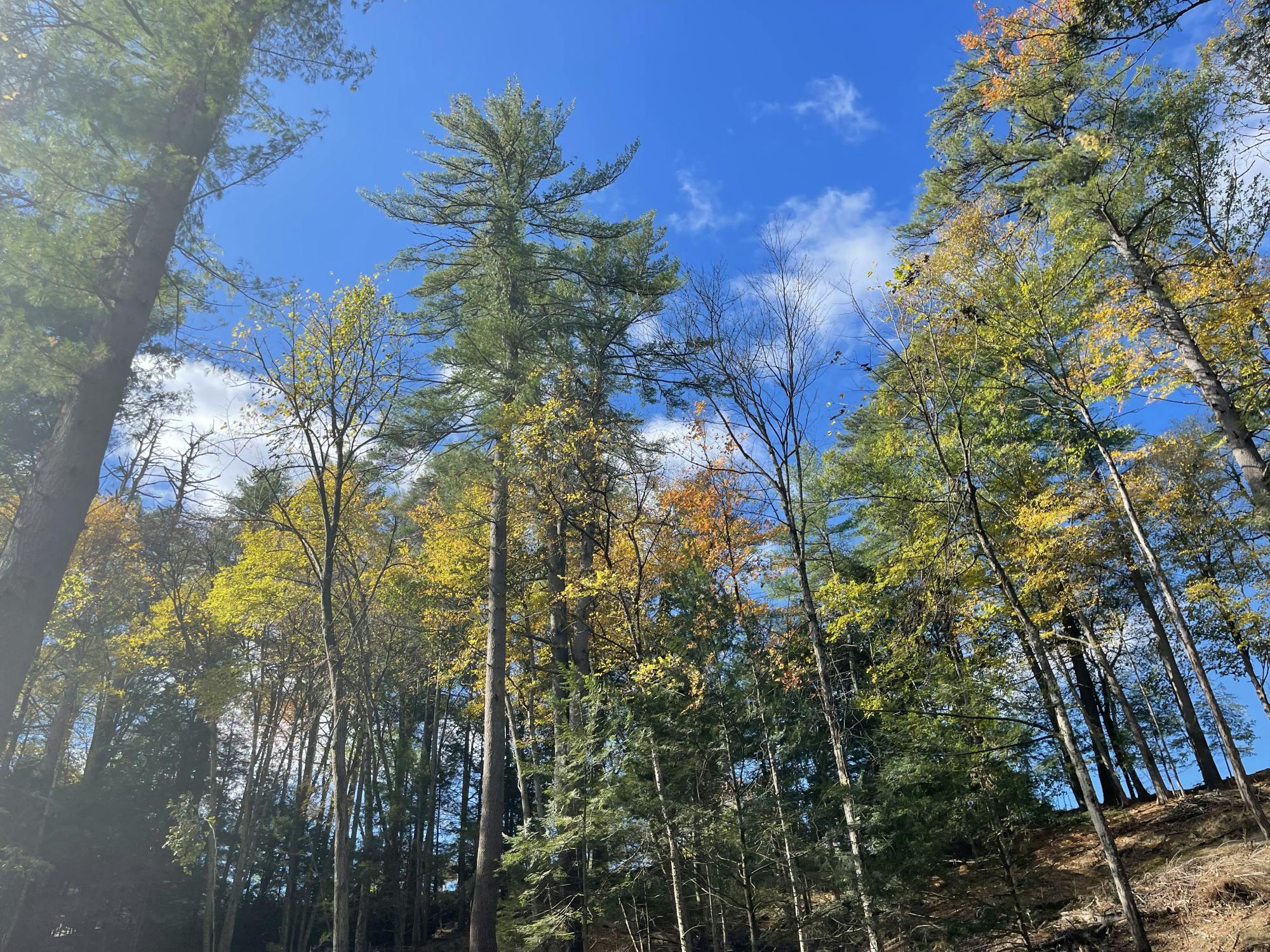
For leaders of Flora and Fauna, disconnecting often begins with slowing down. The club, a sub-organization of the Dartmouth Outing Club, focuses less on athletically intense activities and more on mindful engagement with natural spaces. Flora and Fauna co-chair Anagh Shukla ’28 said that rather than hiking to log miles or reach the highest possible peak, members look to identify fungi, watch birds or study tree species.
“We stress ... being mindful outdoors, and we’re pointing things out.,” she said. “We hike slowly [and encourage] people to take it all in and be really appreciative.”
With roughly 20 active members, the club maintains a small, tight-knit feel. Weekly meetings may include planning trips or identifying species, but the most powerful moments come in time spent outdoors. On break trips, including recent visits to Joshua Tree National Park and the redwoods, leaders intentionally foster environments where students unplug.
“You’re just more immersed in something that’s real,” Shukla said. “We’re better able to appreciate the planet and what it has to offer for you. And I do think that somewhere, even subconsciously, that evokes a need and a desire to protect and to conserve, which is ultimately the goal of a club like this.”
Even local trips follow this philosophy. Members drive to the Maine coast to see puffins each spring and visit the Canadian border to spot snow geese and snowy owls before finals in the winter.
However, The club’s approach doesn’t frame technology as the enemy. Planning happens over GroupMe. Logistics require spreadsheets. But in the woods, phones recede into backpacks, replaced by binoculars and conversation around a campfire.
“The overarching environment that leaders try to foster is to disconnect from devices,” Shukla said.
While Flora and Fauna disconnects through immersion in the outdoors, Book Club does so through immersion in story.
Amirahimaan Kalonji ’28, the founder of book club, has been an avid reader since childhood. But during her first year at Dartmouth, she found that the pace of the term made it difficult to maintain that relationship.
“I started a book club because I wanted to create a space in which everybody bonds over the same books,” Kalonji said. “With the way that the term ebbs and flows, it’s hard to get everyone to read the same thing and do something at the same time.”
The book club itself is still in its early stages, having recently held its first interest meeting on Feb. 1. The vision was simple, a low-pressure space where students can gather around a shared love for reading. For Kalonji, this inspires disconnecting, even outside of meetings.
“I used to just doom scroll on the way to work because the amount of time feels so short that I’m not gonna do anything in that time anyway,” Kalonji said. “But I’ve been reading in that time instead, and I found that it’s made the bus ride so much more relaxing.”
Part of that shift comes from engaging with “physical” copies of books.
“I like the feeling of holding a physical book in your hands, flipping through the pages, and the smell of the fresh pages when you get a new book,” Kalonji said. “I like how physical books carry over memories, like when you buy a used book and you see the previous person’s annotations in the book or when books look worn down I feel like it adds character to them.”
Screens, however, can change that experience entirely, making reading feel like just another academic task, Kalonji said.
“The only literature that I’ll read on a screen is if it’s connected to a class, and at that point, my brain has already made the mental association of the reading with stress,” Kalonji said. Reading on a screen “takes away the joy from it.”
Also opposed to screens in favor of print, Sudoku Society offers yet another version of this offline recalibration. Paper puzzles are spread across tables in Kemeny Hall classrooms, and members solve individually, collaboratively or in friendly head-to-head competitions.
Although disconnecting from technology is not the club’s primary goal, co-president Annabelle Coles ’27 said Sudoku Society naturally creates space to “tap into a different part of my brain that I don’t otherwise [get to] and [allows for] not being distracted by media.”
While technology plays a minor role, like putting on a Spotify playlist in the background and printing puzzles sourced online, it acts as a supplementary material instead of the central avenue for club activities. One beloved tradition involves projecting the easy daily puzzle from The New York Times and solving it collectively, with members calling out numbers to solve the grid together. Still, the club’s identity is firmly rooted in paper.
“Being able to see it in front of you and physically complete is a really nice feeling compared to a little ding that you get on any site,” Coles said.
For some members, the interface also fundamentally changes the solving process itself.
“There’s absolutely a difference [with paper versus online sudoku],” Coles said. “I personally can’t do sudoku online. I really don’t like it. I have to see it all on paper to be able to do it.”
Across forests, novels and number grids, these clubs share a common philosophy: Disconnection doesn’t require total rejection of technology. Instead, it can mean choosing when to set it aside. In doing so, students are not escaping technology, but reshaping how they integrate it into their everyday lives.