
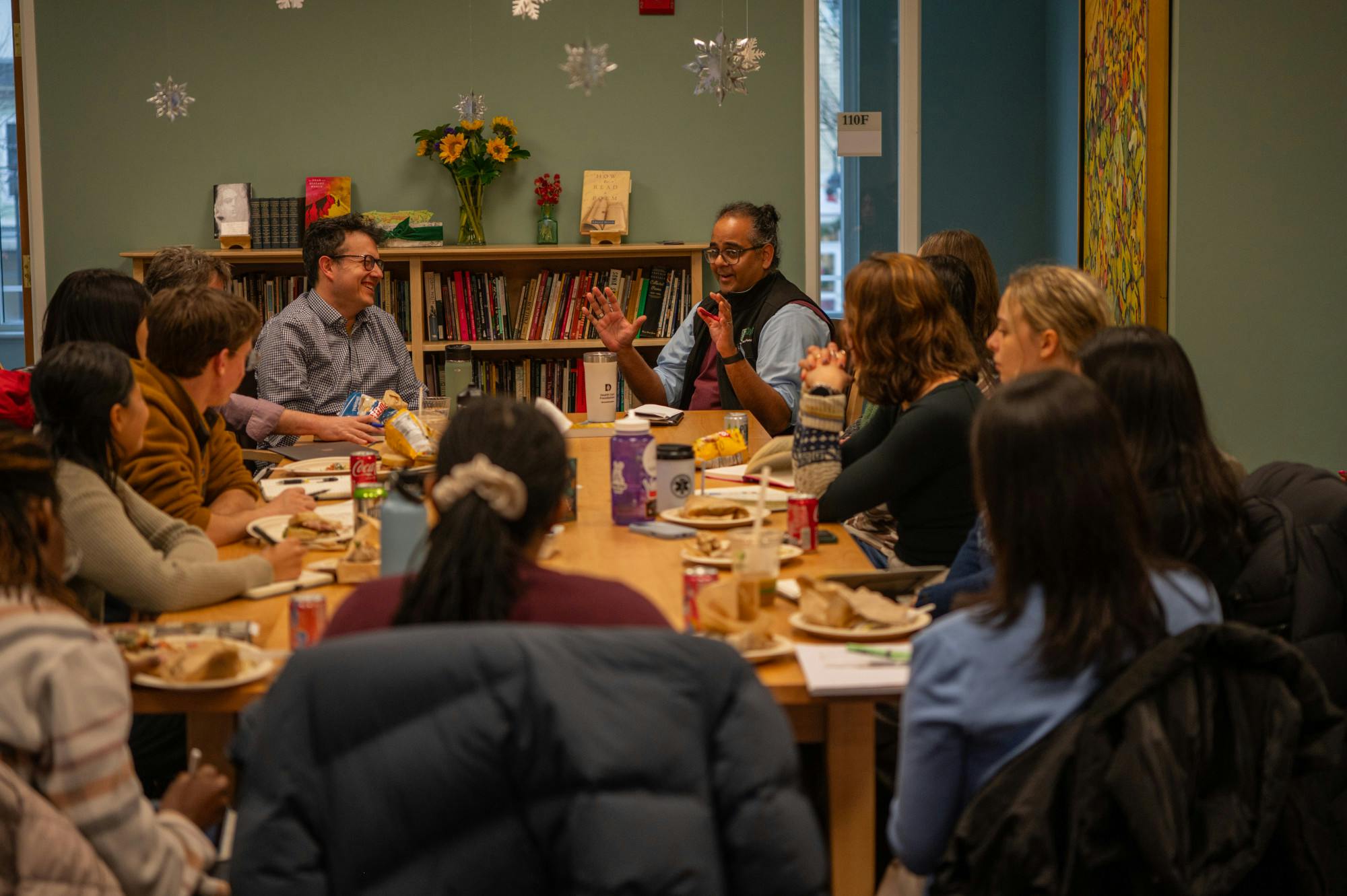
Although the Literary Arts Bridge, tucked away in downtown Hanover, only officially opened in November, students are embracing the colorful offices as a hub for creative writing.
The Bridge, located at 7 Lebanon St., hosts talks with visiting writers and gives students interested in literature a space to create, according to one of the space’s founders and professor of English and creative writing Alexander Chee.
Kate Pressgrove ’29, who has frequented the space after discovering it this year, called it a “hidden gem.”
“Having a designated space to practice what we love has been really beneficial to the creative writing community,” Pressgrove said. “It’s been a huge part of my love for writing.”
Literary Arts Bridge intern Scott Sorensen ’26 echoed this sentiment, saying the space provides much-needed support for student writers.
“As somebody who loves the English department but tends toward the creative side rather than the analytical side, I’ve never really had a home at Dartmouth,” Sorensen said.
Chee said the creation of the Bridge was a collaboration between the College and the English department. Both wanted to “create an open space for collaboration on different creative writing-related events,” he said. Chee noted that the initiative is still evolving as faculty and students continue to shape what the space can offer.
Chee said his idea for the Literary Arts Bridge emerged in part from what he saw as a communication gap on campus for writing events.
“A few years ago, I realized there were so many interesting writing events on campus that even as a creative writing professor, I wouldn’t know about until a day or two before because of the lack of promotion,” he said.
Accordingly, the Bridge has hosted a variety of events to connect students with the broader literary world. In particular, Chee highlighted the “publishing talk series” which hosts publishing industry professionals to help students navigate the practical side of writing careers.
“We have great conversations with the visitor about their career path and how they became who they are,” Chee added.
The Bridge has also hosted conversations and readings with acclaimed authors Andrew Leland, Laura van den Berg and author and translator Daisy Rockwell.
The Bridge also organizes more informal events such as “Lit Submit” parties, where professors with professional backgrounds in writing offer tips and assistance for students submitting their writing for publication.
Chee said these initiatives are part of a larger effort to support students pursuing careers in the humanities.
“Leading the FSP to London, I noticed there was an overwhelming sense of enthusiasm among students for knowledge about careers in the humanities,” Chee said. “I want to show students that there are lots of literary careers that are durable and give them hope that there is a job there at the end.”
Intern Alicia Williams ’28 said it was a “privilege” to interact with visitors.
Beyond professional development, the space aims to cultivate a sense of community among writers on campus, according to Sorensen. Sorensen emphasized his appreciation for a welcoming campus space devoted to creative writing.
“To have somewhere like that on campus is incredible,” Sorensen said. “We are a very inclusive space — you can just walk in, take a snack, sit down and work. You don’t even have to be working on poetry to be there.”
This philosophy inspired Sorensen to start “Reading the Green,” a weekly student-written newsletter published by the Bridge, in January. In addition to highlighting literary happenings at Dartmouth and in the larger Hanover community, the newsletter features students’ reflections on their current reading material, according to the Bridge’s website.
Reflecting the Bridge’s commitment to open and thoughtful dialogue, a recent newsletter featured friendly literary debate when another student involved with the program, Abi Cavallo ’24, gently pushed back on Sorensen’s interpretation of a poem by Sharon Olds.
Upcoming events at the Bridge include visits from Dartmouth alumni such as poetry and fiction author Victoria Redel ’80 and translator and editor Samantha Schnee ’92.
Williams, who is in charge of the Bridge’s social media and campus emails, said she hopes to continue expanding awareness of the Bridge.
She emphasized how meaningful the Bridge has been to her experience as a writer at Dartmouth so far.
“Writing is what I want to do with my life,” Williams said. “I feel like I finally have a sense of community and a network that offers me a chance at a brighter future as an author.”


