This week, elections will be held for campus-wide student leadership positions, including for DSG president and vice president, house senators and class council.
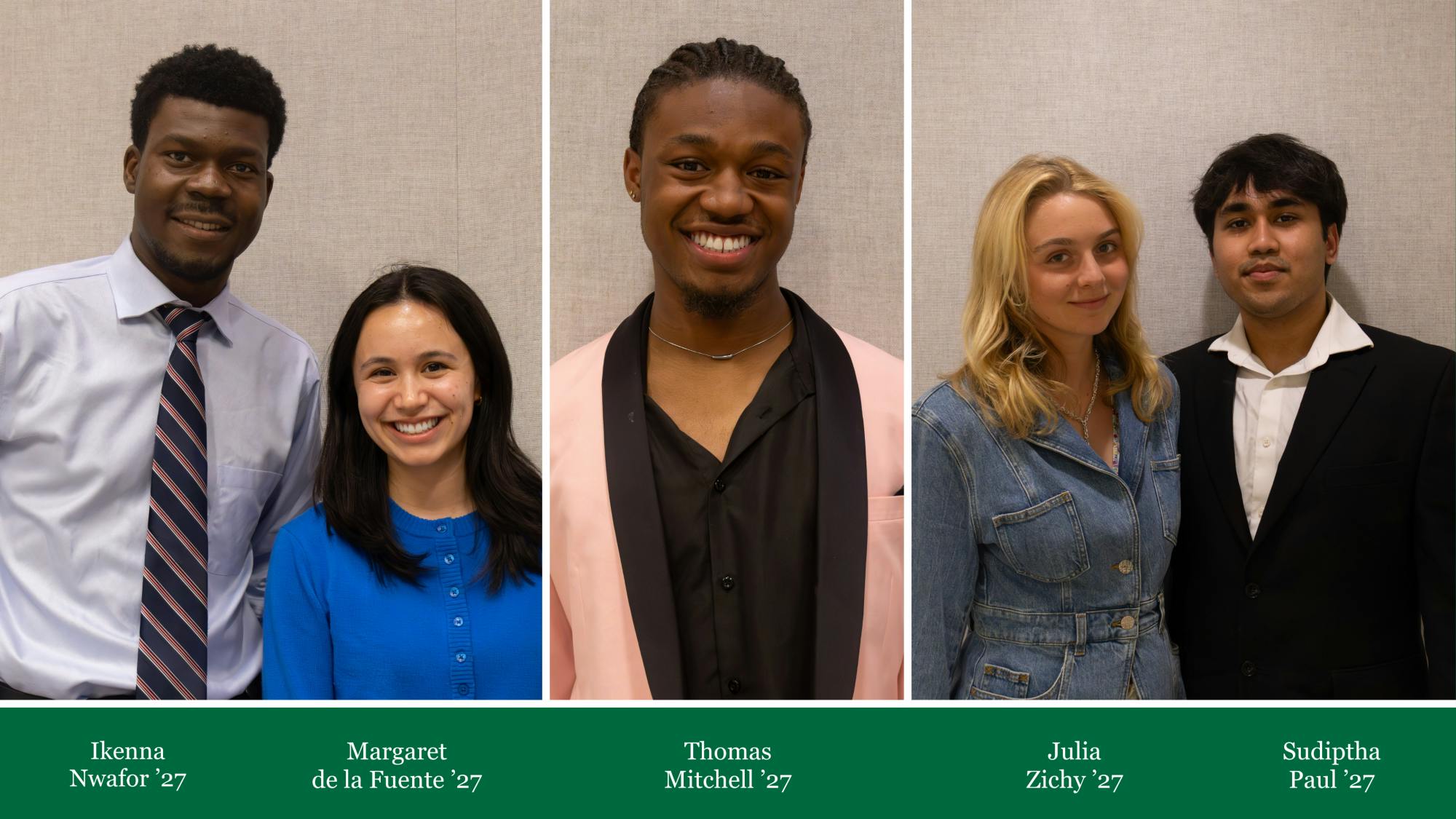
Voting for all positions will open at 5:00 p.m. today and close at 5:00 p.m. on Tuesday, according to Elections Planning and Advisory Committee chair Meghan Goyal ’26. The Dartmouth sat down with the two candidates for president — Ikenna Nwafor ’27 and Sud Paul ’27 — and three candidates for vice president — Margaret "Maggie" de la Fuente ’27, Thomas Mitchell ’27 and Julia Zichy ’27 — to discuss their platforms. Nwafor and de la Fuente are running on a ticket together, as are Paul and Zichy. Mitchell does not have a campaign partner.
Why are you running for office?
Margaret "Maggie" de la Fuente ’27, candidate for DSG vice president: I asked myself, ‘What is the greatest impact that I feel I could have during my senior year?’ I think that revamping DSG and doing as much as possible to get movement on the issues students care about would be incredibly meaningful. As someone who has watched DSG through The Dartmouth and stayed up to date on what DSG is doing, it feels very detached from the issues that students care about. I’m ready to hopefully bridge that divide in the next year.
Thomas Mitchell ’27, candidate for DSG vice president: Both the presidents were already running with their vice presidents, so I was like, ‘Okay, I’ll just run by myself.’ I thought being the face of DSG was maybe a little too much for me. I’ve always been the supporter type, and I think that’s what the vice president does.
Ikenna Nwafor ’27, candidate for DSG president: DSG over the last year has not necessarily pulled its full weight in actually advocating for students. I believe that we can create powerful, effective change with all of the connections and experiences that we have across campus. DSG has become very detached from the campus population and the problems of students. Maggie and I have that passion, that zeal, for dedicating ourselves to saying, ‘How can we actually work towards a tangible improvement to student life across campus?’ To do that, we have to build and work and use our relationships to come in as partners.
Sud Paul ’27, candidate for DSG president: I left Dartmouth about a year and a half ago due to a medical injury. I came back, and at the time, I was still a DSG senator. I’m running for president because I decided I can’t keep complaining about the things that I believe are so flawed about Dartmouth. Instead, I should really try to change the things that I think make Dartmouth so inaccessible. I decided to put so much time into DSG to work with campus partners, whether it was with the financial aid office to increase the Dartmouth Coach vouchers or with the ITC to expand WiFi access downtown and at the Dartmouth Outing Club House or with the William Jewett Tucker Center to create the sick care package delivery program. Julia and I are running together because we love the work we do.
Julia Zichy ’27, candidate for DSG vice president: I entered DSG wanting to change the way Dartmouth Dining works and the ingredients that are put into our food. DSG is not at the same place now that it was my freshman spring. We are in a collaborative era. We get projects done, and we have developed enough close relationships with administrators that the college administration trusts us, and we trust them. This upcoming year, I knew that I almost had to run, because I couldn’t trust any other set of hands. I know the potential that we can take in this next year, because we have senators that are so devoted to putting their best foot forward, and that’s what I want to do.
For students who don’t believe that DSG meaningfully impacts their lives, why do you think that is and how would you change that?
MDLF: I think that DSG has done a lot in the past to improve student life, but it hasn’t felt that way for the past few years. Looking back at Jessica Chiriboga ’24, she got free laundry done. Looking back at David Milman ’23, he got Late Night [dining at the Class of 1953 Commons after 9:30 p.m.] done. We want to be delivering on the same types of issues and we want to make sure we’re doing things that are felt across the student body, not just impacting one specific group or our own personal agendas. We’re here to listen to others and represent everyone. We would be elected by the entire student body and we would be able to represent the entire student body.
TM: I think it is because sometimes students don’t even know who is on the DSG board. I didn’t realize I had so many friends who were on the DSG until I looked at the website and I was like, ‘Oh, my gosh, why don’t I know this information?’ Also, no one reads all the emails that DSG sends out. They’ll skim or skip through stuff. So when students think of DSG, they think it’s useless.
IN: Much of DSG’s work is done in closed rooms with administrators: discussing drafts, negotiating and going back and forth. We’re going to communicate more of what we are doing — not just the end result, but also the process of it. We are speaking with new resources, and asking for input and feedback. I’ll be on the ground doing things.
SP: For generations now, DSG candidates have lied or put forth campaign promises that are just not feasible whatsoever. For example, every single year that I’ve been at Dartmouth, students have said, ‘Collis on weekends’ as a campaign promise. In reality, having Collis open on the weekends is not feasible for a few reasons. Julia and I want to be very transparent about what is possible right now. We want to actually make long-term change while being here in the short term. This year, Julia and I have been able to really work and see great outcomes for students. .
JZ: There has been a lack of transparency in the past between DSG and the student body, and that’s something I plan on focusing on next year whether I’m vice president or not. On our platform, we mentioned creating a direct chat line between students and their representative in DSG. A big part of our agenda next year is to create a very stable relationship between student government and the students. Students don’t actually know that a lot of changes on campus come from DSG. Sud, for example, expanded the WiFi drastically to Pine Park and to other regions, even to the Dartmouth Outing Club’s house. Obviously, people are enjoying that amenity, but they don’t know it came from DSG.
What existing DSG policy or program is most in need of replacement or reform, and what would you do about it?
MDLF: Looking at some recent DSG outcomes, like banning seed oils from the A9 station at the ’53 Commons, I think that is not the use of time that the student body wants to be seeing from the student government. There’s no evidence that seed oil negatively impacts your health. It’s not obviously the better health policy.
TM: I would say increasing the income cap for eligibility for the Dartmouth Coach bus voucher. I think increasing it to $95,000 might be a bit of a stretch, but we should increase it from $85,000 to $90,000.
IN: Definitely restructuring the committees and slimming down the executives board. The committees right now are just overloaded. How can we restructure the student life committee, which I’ve chaired twice, to be more focused and narrowly tailored? That will make us more efficient.
SP: The student issue survey. As the person who ran the student issue survey this year, there needs to be a lot of reform when it comes to budgeting. This year, the student issue survey cost almost $13,000. I really want to work on ensuring that we’re thinking about every single item in the budget properly to think, ‘Is this really impacting as many students as possible?’ The student issues survey gives us a lot of amazing data on what students are thinking across campus. But if we go person-to-person and ask them questions instead, it would be far less expensive and we could actually talk to students face-to-face.
JZ: I will be pushing for reducing computer use during DSG meetings. I find that a lot of people around me are not really paying attention to the subject matter at hand, and are texting each other or doing homework. If every single person in that room besides the community members are elected representatives, they need to be representing the students, and they need to be present in the moment.
If elected, what’s one specific change students would notice by the end of fall term?
MDLF: Only being able to eat at ’53 Commons on Saturday mornings and being required to use a swipe every weekend morning is a problem. We want to be advocating for other dining locations to be open earlier so that there’s a grab-and-go option or a DBA option as well, especially as we see Russo Cafe opening next year.
TM: Engagement with DSG. Obviously initiatives and getting things changed on campus is really important, but that can only happen if students know who’s working for them and their timeline and schedule.
IN: Definitely one of our core goals is extending gym hours to midnight. That will be there by the end of fall term. I think people will also see a DSG that is involved in their daily lives, that goes back to them for feedback a lot in person and communicates with them more and more. It’s going to be more focused on living learning communities — they’re going to have those resources that they need.
SP: I think Julia and I will be able to successfully advocate for year-round leave term housing. At the moment, it is only available in the winter and summer. By working with the Office of Residential Life, we’re going to actually be able to advocate for students to access leave-term housing. This will benefit a lot of students, especially international students who might not be able to go back home.
JZ: Students will be able to see a change in the timetable. A big policy Sud and I are going to push for is being able to see either the syllabus for the class you are electing, or at the very least, the week in the term in which you will be examined, whether that is a midterm, a final or a big paper.
What actions do you plan to take in office that might be unpopular, but that you believe are necessary?
MDLF: We realize that in our role that not everyone is always going to be happy with us, but what we can say is we’re always going to be communicating the logic behind our decision making.
TM: While not being mean, I’ll be stern and firm about my opinions and my thoughts. I think everyone contributing is really, really important. If I see someone talking over someone else, I’ll address it and not just let it slide, because I feel like if you let it slide, then it’s going to build up with something more than it needs to be.
IN: For a long time, people in DSG have gotten to be executives as participation trophies. I am going to focus on people that are actually qualified who want to do this work.
SP: I think removing the printing cap is something that could end up being unpopular, but I do think it is vital for a specific set of campus. Some students might believe that we are going to end up printing a lot more, but in reality people will hopefully see that the printing cap being removed will not only alleviate the stress of students who believe that it is an extra burden on them but also possibly prevent students who might think they need to spend all of the amount they receive to maximize the dollar efficiency that they got.
JZ: As someone that was on an F1-visa for almost a decade, I find it really important for international students to be guaranteed a career advisor from the moment they step on campus until the moment they step off.
The interview has been edited for clarity and length.
Jeremiah Rayban is a reporter and editor for The Dartmouth from Wilmington, Del., majoring in economics. Outside of The D, he enjoys reading, art and trivia.