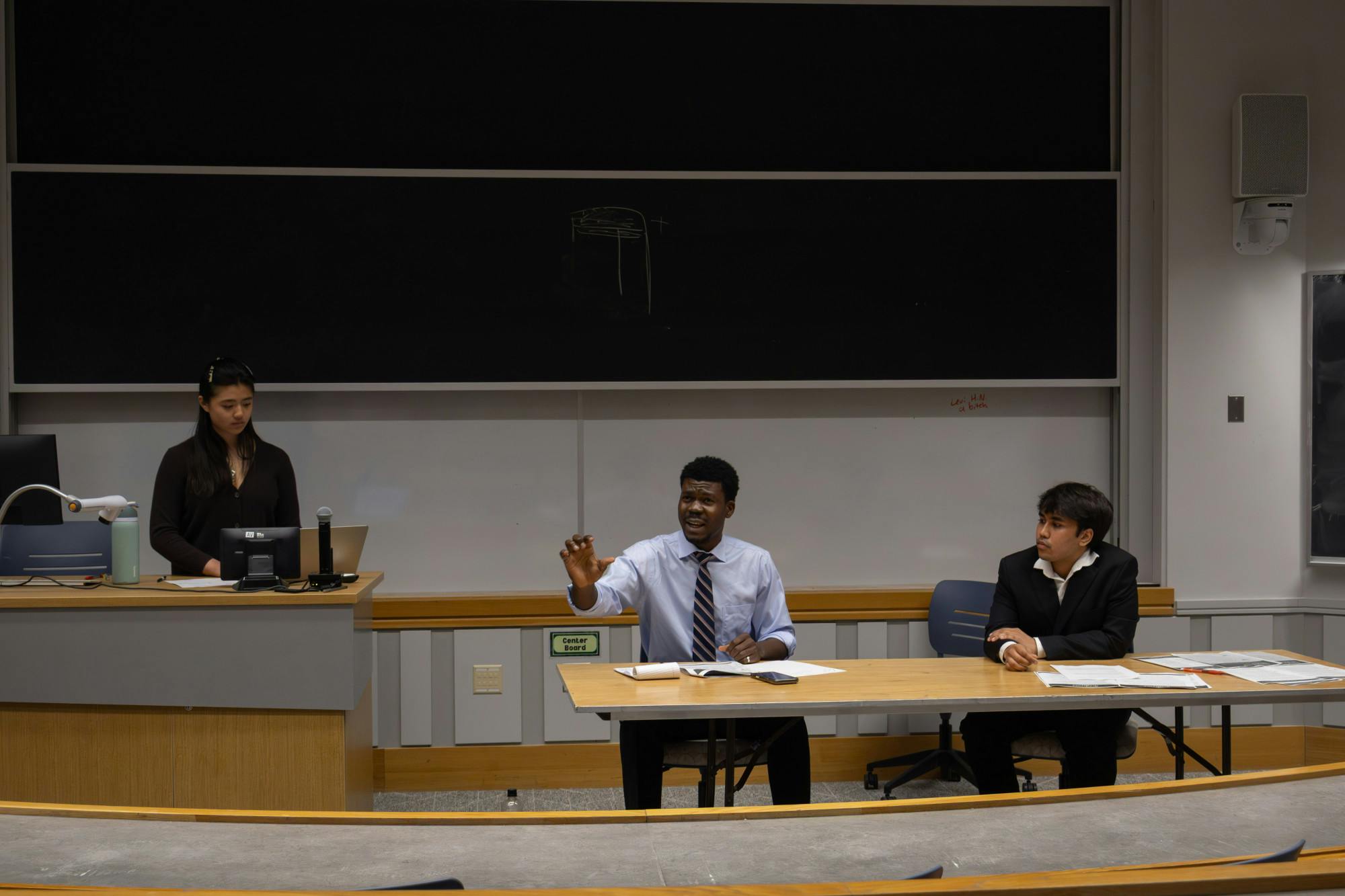
On April 26, student body president candidates Ikenna Nwafor ’27 and Sudiptha Paul ’27 and student body vice president candidates Maggie de la Fuente ’27, Thomas Mitchell ’27 and Julia Zichy ’27 spoke about Dartmouth Dining, health and wellness, transportation and Dartmouth Student Government transparency in a debate hosted by the Elections Planning and Advisory Committee.
Paul and Zichy are running together on one ticket, while Nwafor and de la Fuente are running on the other. Mitchell is running on his own. About 45 students attended the debate, which was moderated by The Dartmouth’s editor-in-chief Annabelle Zhang ’27.
Nwafor, who has served as a DSG Allen House senator for the past three years, said he hopes that DSG can do “bigger things” that “affec[t] all students across campus” under his administration, such as expanding weekend dining options, increasing termly wellness days and expanding gym hours.
Paul, who has served as East Wheelock senator for two years, stated that he plans to improve financial aid accessibility, increase access to technology and expand availability of health and wellness options around campus.
“[Zichy and I] are running on what we’ve done because we know what we’ve done has actually meant something to this campus,” Paul said.
The vice president candidates also shared their platforms. De la Fuente, who has not served in DSG before, said she plans to expand weekend dining options, increase gym hours and improve campus transportation.
“I care about the Dartmouth community, and I want to see progress in DSG because I feel like in the past year, DSG has become distant from what students actually want,” de la Fuente said.
Mitchell hopes to use his involvement in campus organizations and employment with Dartmouth dining to lead with “confidence and love by being [students’] best friend.”
Zichy, who has been involved with DSG for two years and currently serves as a general senator, hopes to improve student health and wellness, specifically by continuing her efforts to decrease seed oil use in Dartmouth Dining to accommodate students with “inflammatory and autoimmune diseases.”
“During my time in DSG, I really learned to not only appreciate all the different student groups we have on campus,” Zichy said.
Zhang asked the candidates to explain an issue of disagreement between them.
Paul said Dartmouth Dining director Jon Poldzik explained to him that Dartmouth Dining simply does not have the “feasibility, capability or funding” to open Collis Cafe on the weekends without compromising food quality and student jobs. Paul instead proposed expanding weekend food offerings at the Class of 1953 Commons to include a “possible smoothie bar or bagel station.”
According to Nwafor, whose platform includes opening Collis Cafe on weekends, members of the Board of Trustees have told him it is feasible to open Collis Cafe on weekends.
“One of us wants to bend down to [Dartmouth Dining] and say, ‘Oh, yeah for sure, because [Jon Poldzik] said it doesn’t work out, we shouldn’t do it,’” Nwafor said. “One of us actually tells them, ‘No, we think this is possible.’”
Mitchell, who is a Dartmouth Dining student worker, also hopes to expand weekend food offerings at the ’53 Commons, adding that opening Collis Cafe on weekends is “not going to happen” due to Dartmouth Dining workers’ capacity.
“The problem is we’re not thinking about the [Dartmouth Dining] workers themselves and the people who run the establishment,” Mitchell said. “... Asking them to work even more when they have lives and they have children is kind of insane.”

The vice president candidates discussed their plans to expand transportation services and gym hours.
Zichy said she believes all students “should be entitled to” bring personal vehicles to campus. Currently, first-year students are not allowed to have personal vehicles on campus. Additionally, starting in fall 2026, sophomores will also not be allowed to bring their personal vehicles.
“Cars are very important for students,” Zichy said. “They allow us to explore outside of this little microcosm of Hanover, N.H. They allow us to get to … where we’re from and they allow us to access certain medical resources if need be.”
Mitchell said he wants to increase student access to transportation by expanding the Campus Connector routes, which currently run between Summit on Juniper and Sachem Village, to campus.
“Having a new bus or campus connector route will help students who live off campus or have classes in the Life Sciences Center,” Mitchell said.
De la Fuente said she plans to extend gym hours to midnight. The Lewinstein Athletic Center currently closes at 10 p.m., which does not work with students’ “busy schedules,” de la Fuente said.
“Our days are filled up with classes [and] extracurriculars, and we just need more time to be able to take care of our well-being,” de la Fuente said.
All candidates said they want to increase DSG transparency with the student body. Paul plans to send weekly emails with DSG updates, open a physical mailbox for students to submit concerns and establish a phone number for students to share their opinions.
“We are people who do things, and we’re going to continue to increase transparency by having this direct line of contact, by having these focus groups and by having these continued surveys as well,” Paul said.
Nwafor said he plans to hold office hours and focus groups with students to understand their concerns and advocate for student needs.
“I am here for the students, and my main role is to advocate for students in those rooms, whether they are happy with it or not,” Nwafor said.
Anfisa Kryvtsun ’27, who attended the debate, noted that she was “impressed” by Nwafor’s commentary on the allocation of funding at Dartmouth, as students “don’t really know how the structure of fund allocation works.”
“Ikenna brought up some points that were not on his platform, particularly one of his points about whether funds are being allocated by directors of particular institutions or the Board of Trustees, and how that flows,” Kryvtsun said. “...We don’t really talk about it a lot, and I think that’s a conversation worth having.”
Kryvtsun added that she thought the debate was “narrowly constrained” to dining and wished that academics, freedom of speech and Greek life initiatives were also discussed.
“I thought [the debate] could have been a little more all-encompassing about some of the other themes,” Kryvtsun said. “It seemed like it was very dining-focused, which was I guess a reflection of what people care about.”
Isla Walker ’29, a general senator, said that while the debate was “helpful in clarifying where everyone stood,” it did not change her choice to support the Paul-Zichy ticket.
“I’ve seen how hard Sud and Julia have worked,” Walker said, “They’ve been leaders throughout my entire first year here. I was never imagining any other ballot besides them.”
Issa Allison ’29, a North Park senator, said he believes the next student body president and vice president should have prior DSG experience, but he was “disappointed” that “only one candidate had that experience” in the vice presidential race.
“The presidential debate was as interesting and as I expected it to be, with both candidates bringing their wealth of experience to the table,” Allison said.
Voting for all positions will open at 5:00 p.m. today and close at 5:00 p.m. on Tuesday, according to Elections Planning and Advisory Committee chair Meghan Goyal ’26.
Annabelle Zhang ’27 is the editor-in-chief of The Dartmouth. She was not involved with writing or editing this article.
Kailyn Holty ’29 is a news reporter from Redwood City, Calif., and is majoring in economics and quantitative social science.