
Andrew Leland is the author of “The Country of the Blind: A Memoir at the End of Sight,” a Pulitzer Prize finalist that explores Leland’s gradual loss of sight. Leland, who has eye disease retinitis pigmentosa, said he is now left with “tunnel vision,” so seeing is like looking through a “toilet paper tube.”
I attended his artist talk at Dartmouth’s new Literary Arts Bridge. He discussed everything ranging from his resistance to using an auditory screen reader — that reads text aloud — to the evolution of his writing process.
Leland was initially resistant to changing the way he read because his loss of sight came gradually. He didn’t want to stop reading visually, he explained in his talk. He kept “blowing the text up bigger and bigger.” But even with the auditory screen reader, he realized that only the story matters.
“All that text disappears, and I’m just reading Kafka,” he said.
Leland said the switch to an auditory reader warranted a reorganization of his drafting processes, too.
“I’ve gone, particularly in the last few years, on a really wild journey into the bowels of my computer, trying to create a workflow where I have control over my textual universe,” he said. “Part of my experience of becoming a screen reader user, and a magnification user, has been like an estrangement from my own text, my own ability to edit that text.”
This reminded me of conversations about method we have been having in one of my creative writing classes. Novelist Peter Manseau, for example, our guest speaker that week, told us that he has a full-on writing shed, a designated space devoted to focusing on his craft. I also recently read “A Room of One’s Own” by Virginia Woolf, which argues that if only Shakespeare’s sister had her own space, she could have been just as successful a writer. These writers underscore the importance of place and practice to creating a coherent text.
I, on the other hand, only have Google Docs, Canvas, library printers and midnight deadlines. I learned that everyone’s writing methods can widely vary, yet still work. The unsophistication of a tiny dorm room desk is just as effective as a writing retreat.
Of course, I asked Leland for tips on daily writing practices, too.
“If you plug away at something for an hour a day for a month, it’s remarkable,” he said. “It’s a little bit like exercise … like you run seven miles every Sunday versus running two miles every day. You’re going to be in much better shape with the two miles every day plan. I think writing is the same way … you just touch the document every day, stay in it, even when you’re not writing.”
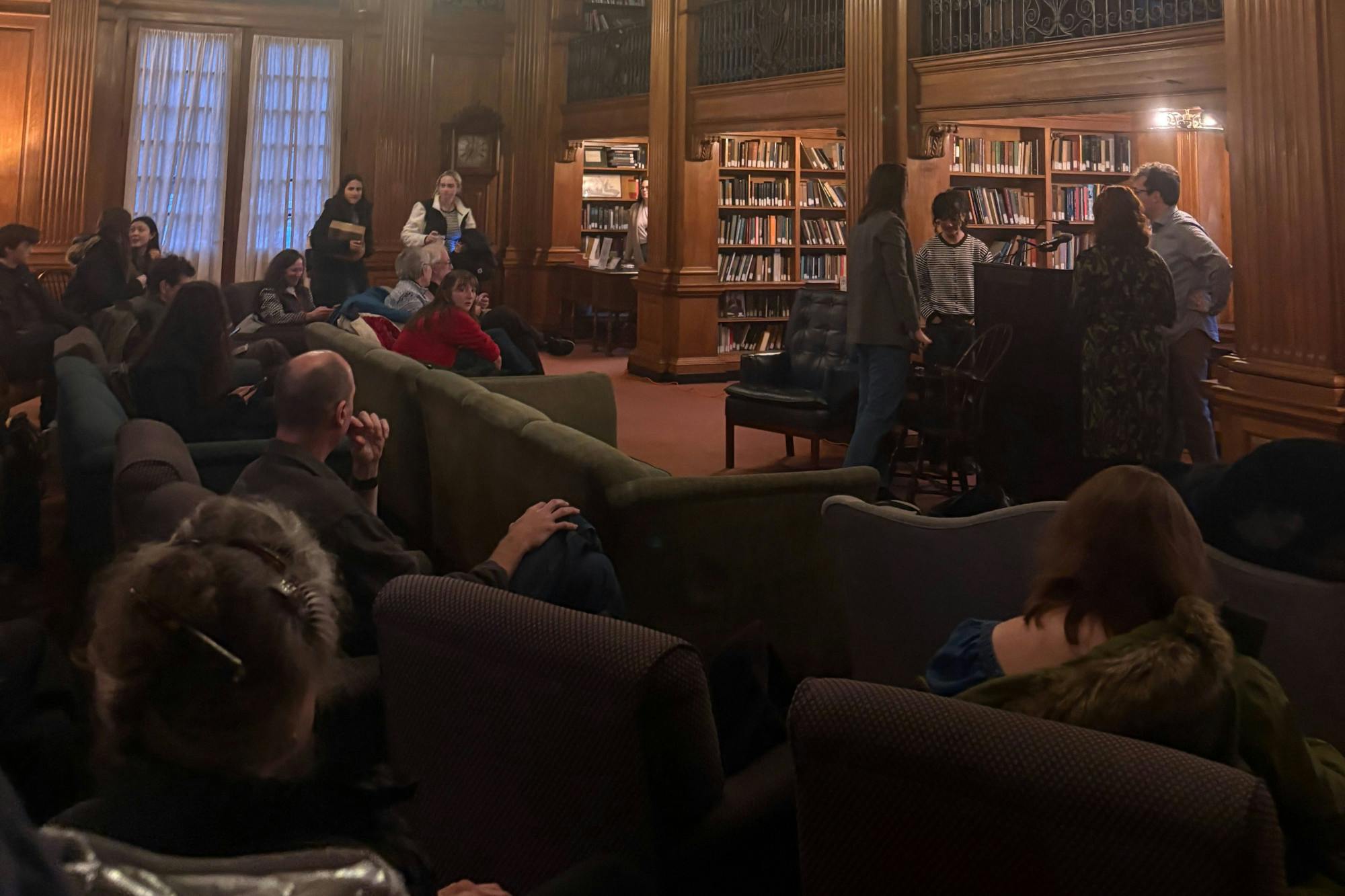
A few hours later — after learning about his method — I attended his talk in Sanborn Library, which was arranged like a huge living room, all the cushy couches and armchairs moved to form an audience in front of a wooden podium. Hearing him read his own thoughts in his own voice reminded me of what he said about reading Kafka. A story is a story.
The other audience members were similarly enthusiastic. Trudy Silver ’26 said that “every time I come to something like this, I think I should spend more time reading my email and seeing all the cool speakers that come to campus.”
Maisie Pike ’26 said that she and her friends felt that Leland’s reading enhanced their experience of his work.
“We’ve been talking a lot about how intimate listening is, and sound and not being able to read along, and I think his talk really brought that to life,” she said.
Earlier, Leland talked about how resistant he was to transitioning to a screen reader and having text read aloud to him. And yet, curled up in Sanborn library, there was something magical about hearing him read his work aloud to us.


