
This article is featured in the 2026 Winter Carnival Issue.
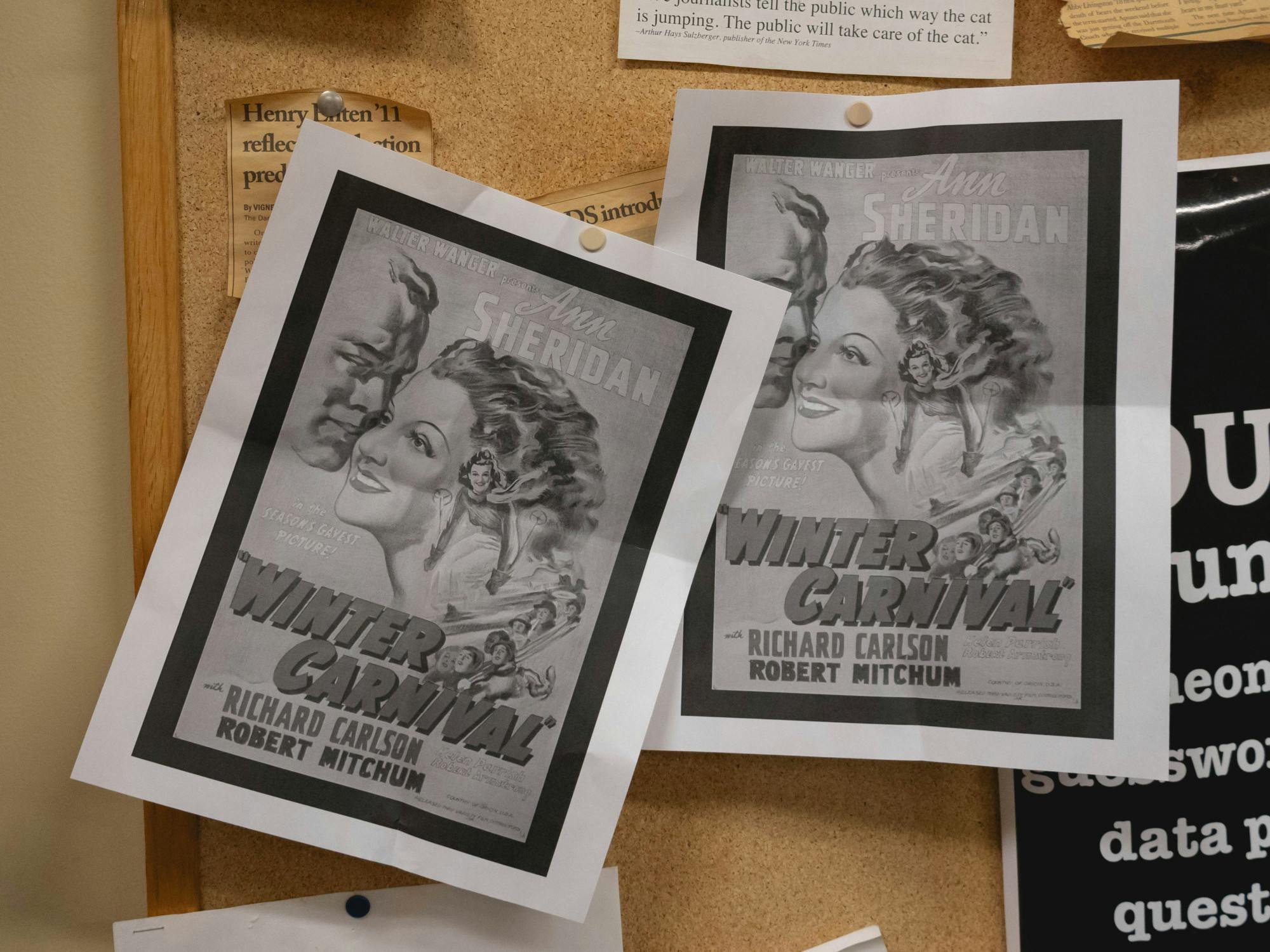
On Feb. 11, 1939, The Dartmouth published a short article detailing the arrival of film producer Walter Wanger, a member of the Class of 1915, and author F. Scott Fitzgerald, alongside a short interview with the two men. In his article, John D. Hess ’39 described how Fitzgerald “looked and talked as if he had long since become tired of being known as the spokesman of that unfortunate lost generation of the 1920’s.” Hess knew that the two men, along with Budd Schulberg ’36, were up in Hanover to prepare for the creation of the 1939 film “Winter Carnival.” What Hess didn’t know was that — as an undergraduate student — he had just penned the final interview of the author of the “Great Gatsby” a year before his death.
Fitzgerald in Hanover
What began as an effort to make progress on Wanger’s screenplay became a disastrous weekend in Hanover, during which Fitzgerald broke his sobriety and entered a period of professional decline.
In a letter to his literary agency, Fitzgerald expressed that he considered his experiences in Hanover trivial compared to other issues.
“Swanson [one of Fitzgerald’s Hollywood agents] argued me into a job with Wanger on ‘Winter Carnival’ with a raise to $1,500,” Fitzgerald wrote. “This was a mistake. I blew up after a trip to Dartmouth and got [the] flu and got drunk and walked out.”
In reality, things were doomed the moment Fitzgerald and Schulberg met. In Matthew Bruccoli’s biography of Fitzgerald, “Some Sort of Epic Grandeur,” he recounted the first impression Schulberg had of Fitzgerald.
“Schulberg was a great admirer of Fitzgerald’s fiction, though he had been under the impression that Fitzgerald was dead,” he wrote. “In his awe he was happy to defer to Fitzgerald, and their collaboration was comfortable — so comfortable that instead of working they talked about books and the new college generation.”
Unable to make any progress, Wanger made the two men come up to Hanover with him for a weekend, ostensibly to show off Fitzgerald to the people of his alma mater. What Wanger didn’t count on was that Schulberg had brought two bottles of champagne on the plane with him and made Fitzgerald drink. The trip turned into a two day bender for Fitzgerald that broke his sobriety. On Saturday night, after attending parties at the Alpha Delta Phi and Psi Upsilon fraternity houses, they returned to the inn to again attempt work on their screenplay, according to The New York Times. He developed an intense sickness and fever that led to his hospitalization.
Later accounts describe the weekend differently. Sheilah Graham, Fitzgerald’s lover in the final years of his life, took over from here in her memoir “Beloved Infidel.”
“The call that came to me from Scott a few days later alarmed,” Graham wrote in her memoir. “He was at the Hanover Inn with Budd: they were making wonderful progress. He bubbled over, he was uproariously funny — I knew then that he was still drinking … Scott had been drinking for days, he had made a spectacle of himself at Dartmouth, he’d gotten into an argument with Wanger, Wanger had ordered them both out of Hanover.”
By the end of the weekend, Wagner fired Fitzgerald and was taken off of the project, according to The New York Times. Schulberg stayed on, though his original idea — the story of a young woman who was trying to outrun her abusive husband with her child and getting stuck at the Dartmouth Winter Carnival — was scrapped in favor of a classic college romance film. Schulberg ended up writing a book about his experience working on the film called “The Disenchanted,” though some names were changed, according to The New Yorker. Finally, on July 28, 1939, “Winter Carnival” was released, according to the Hopkins Center for the Arts.
Review
Such an intense production begs the question: How is the movie? I watched it. It’s not good.
The film follows Dartmouth professor John Wilden, played by the dashing Richard Carlson, as he reunites with his old flame Jill Baxter (Ann Sheridan) at the Dartmouth Winter Carnival in 1939. At the same time, young Mickey Allen (James Corner) is falling in love with Ann Baxter (Helen Parrish), who is vying for the same crown as her sister. Interspersed are scenes of Dartmouth men meeting their newfound flames: women who came up to visit for carnival weekend.
At the onset of the film, it seems that the plot could be interesting. Jill is hiding from a duke that she married years before and is on the move to Montreal before stopping at the Winter Carnival. Schulberg and Fitzgerald’s original idea for the movie seems to have bled through to this plotline, which is what makes it so unfortunate that once Jill arrives at Dartmouth, any mention of the duke or her life before is dropped. Instead, she is thrust into this lackluster love story with Professor Wilden. Sheridan is at her best here, and although other reviewers might not have agreed, Carlson is holding his own as well. However, their plot continually perplexes me.
Jill and John have next to no chemistry, and a truly awkward scene surrounding them trying to take care of a baby together does nothing to establish the type of chemistry needed for the passionate kiss that immediately follows. Even in the very final moments of the film, when John gets on the train with Jill to New York City, their incompatible lifestyles are not reconciled: Jill is still the same free-spirited woman who wants to go where the world takes her and John still wants to stay in Hanover and settle down into suburban life. John simply hopes that seven days in New York City will be enough to persuade Jill to abandon her dreams.
Although the romantic plot in this film is tough to watch, the film is an excellent window into what Dartmouth was like at that time. Much of the film takes place in the former office of The Dartmouth, and there are several Dartmouth standard songs involved in it. Though it’s jarring to see people smoking pipes and cigars in residential halls and The Dartmouth’s offices, the campus still feels quite familiar.
One striking discontinuity with the Dartmouth of today was the absence of women on campus. A record high of 1,150 women come to campus for Winter Carnival in the film, with many of the men on campus set up on blind dates. There even is a special train route that takes the women up to campus called the carnival line. In this pre-coeducation era, the men are portrayed as girl-deprived and very excited for the women to arrive on campus. A woman is crowned the Winter Carnival Queen each year, and the film makes it seem like Winter Carnival was the ultimate weekend for co-ed connection at Dartmouth.
When “THE END” showed up on my screen as John and Jill entered the train, I breathed a sigh of relief. Everyone in the film had gotten what they wanted and the carnival was closed off. Yet at the same time, “THE END” carried a lot more significance for this B-movie than others because of its ties to Fitzgerald. I know that as I plunge into Occom this year, I will remember this film and the odd story behind it.


