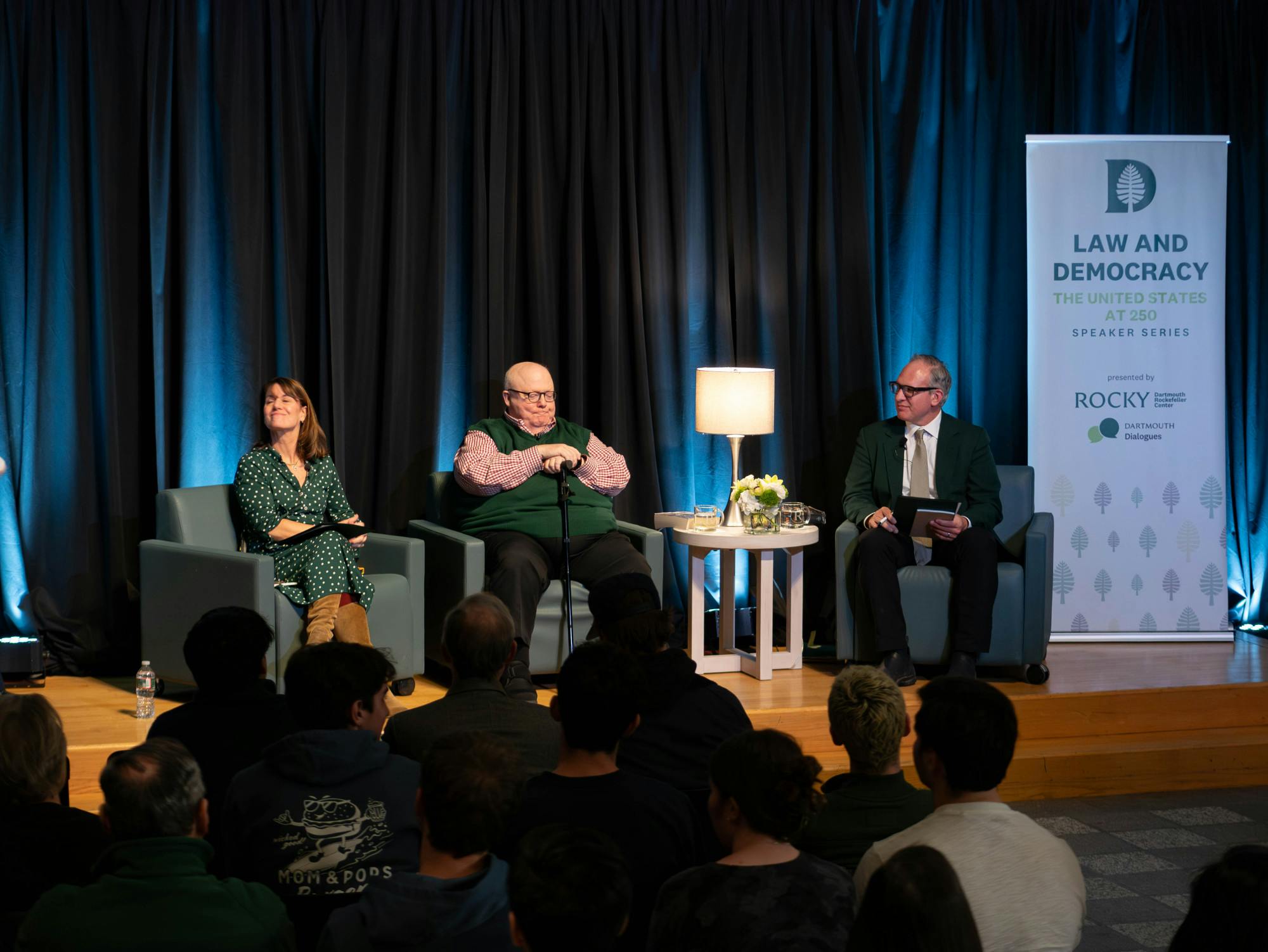
Presidential historian Richard Norton Smith advised community members to be “optimistic about the future” at a Rockefeller Center for Public Policy event on Jan. 14.
Government professor Jason Barabas ’93 and history professor Leslie Butler moderated the discussion, which was attended by approximately 60 members in the Hinman Forum and another 35 virtually. The discussion—which was co-hosted by Dartmouth Dialogues—was part of the speaker series “Law and Democracy: the United States at 250,” which celebrates the upcoming 250th anniversary of the signing of the Declaration of Independence.
Smith has authored biographies of several American politicians, including George Washington, Herbert Hoover, Gerald Ford and Nelson Rockefeller. Smith was a finalist for the 1983 Pulitzer Prize and was awarded the 1998 Goldsmith Book Prize by Harvard University’s John F. Kennedy School of Government.
Smith began the event by describing his experiences in researching and writing about different presidents.
“Every single president so far has been more interesting than I thought they were … and it’s made the experience certainly a lot more enjoyable for me,” Smith said.
Smith added that he was not interested in “judging” historical figures but in understanding them.
“You can only understand a historical figure by his contemporary standards: by the norms, the conventions [and] the limitations that prevailed in his time,” he said.
Smith called presidential rankings “absolutely phony” in that they largely reflect the periods in which they were written. He argued that recent changes in scholarly rankings reflected contemporary public discourse about race.
“Grant has been rediscovered … because he demonstrated real courage, political courage, in committing the federal government to enforce voting rights for newly freed slaves,” Smith said. “Andrew Jackson, on the other hand, has plummeted in public and scholarly esteem, [because] he’s a slave holder [and] an Indian killer of the first rank.”

Shifting to contemporary politics, Smith said that both major political parties have stopped being ideological coalitions and have instead become “conduits for money.” He criticized modern political parties for “enshrining polarization” and contrasted them against the parties of the mid-20th century.
Smith said that he considered the presidency a “dynamic office,” noting that the role of a 19th century president bore “almost no resemblance” to the role of a 20th-century president. However, he said that the current administration’s actions have been “outside the realm of history.”
“What is happening now is beyond the imagination of any political scientist I know,” Smith said.
Smith concluded his talk, however, by urging the audience to place the present moment within a broader historical context before issuing critiques or judgment.
“[The Trump administration’s actions] are historically unprecedented, but it’s not like democracy hasn’t been tested before,” he said.
In an interview with The Dartmouth after the event, attendee McKinlee Williams ’29 said she was excited to attend the event because Smith’s work goes beyond the male perspective.
“[Smith] has written a lot in the past about previous first ladies, which I think is really interesting and not a lens that we get to see a lot from historically,” Williams said.
Attendee Jack Goebel ’27 said he enjoyed the event because it gave him a more positive perspective on American politics.
“I’m leaving more optimistic than when I came in,” he said.