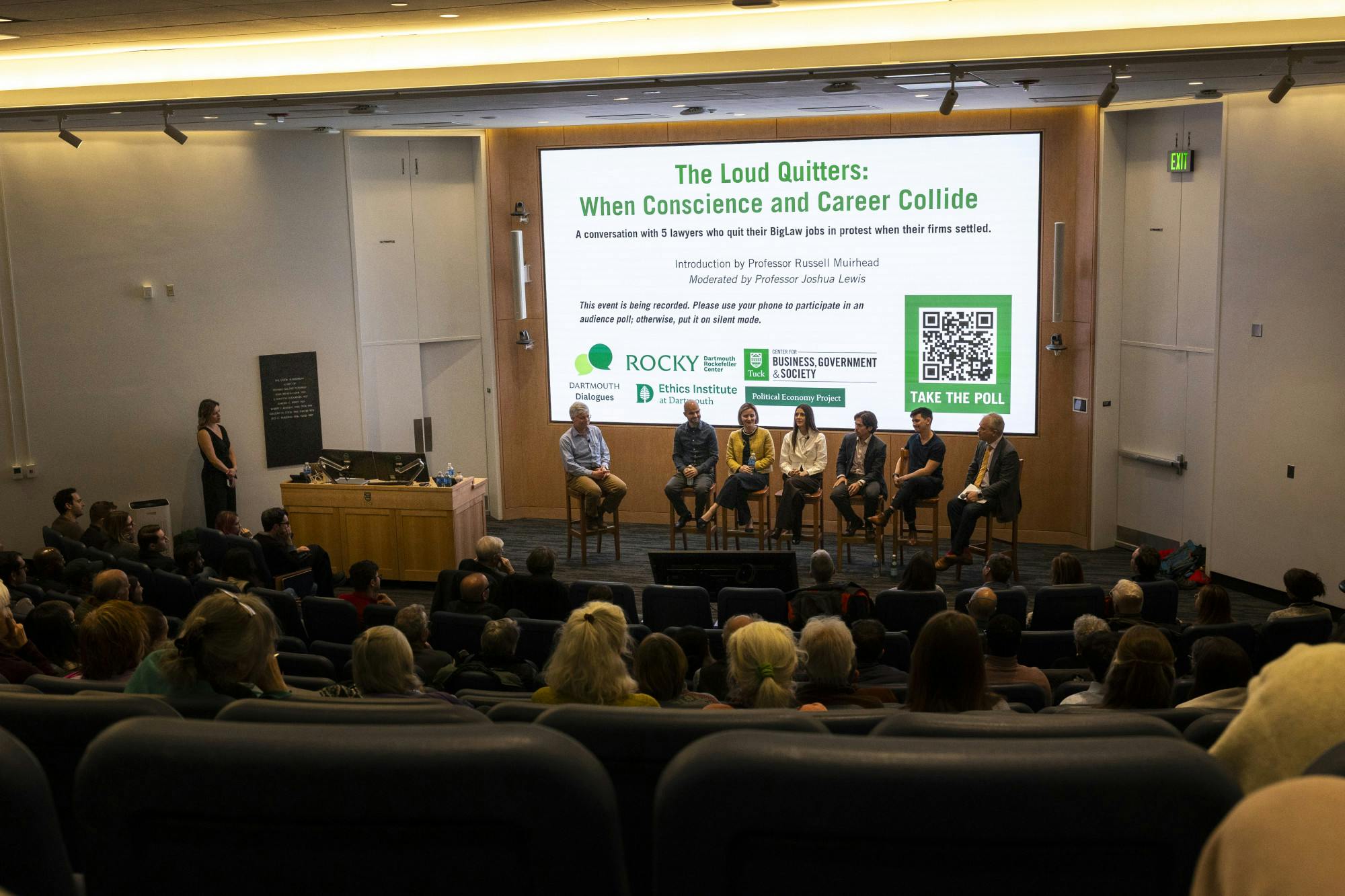
Five lawyers shared their experiences of “loud quitting” — openly leaving a company to draw attention to a workplace or political issue — from elite law firms to protest the Trump administration in a March 3 forum hosted by the Tuck School of Business.
Panelists Brenna Frey, Siunik Moradian, Jacqui Pittman, Thomas Sipp and Sam Wong quit their law firm jobs in early 2025 to protest their firms’ settlements with the Trump administration — in an effort to avoid punitive executive orders.
Approximately 200 people attended the event in Cook Auditorium, according to Tuck’s center for business, government and society executive director Hannah Payson. Tuck professor Josh Lewis and government professor Russell Muirhead moderated the event — which was co-sponsored by Dartmouth Dialogues, the Ethics Institute, the Political Economy Project, the Rockefeller Center for Public Policy and Tuck.
During the panel, Moradian said his decision to quit international law firm Simpson Thacher and Bartlett stemmed from his “individual opposition to fascism.”
“It was at my doorstep because it was at my firm, and history had taught me that you don’t appease fascism, you oppose it,” Moradian said.
Frey, for her part, said that her choice to quit her job at international law firm Skadden, Arps, Slate, Meagher and Flom was “easy.” She believed her firm’s decision to settle compromised its purported values. For example, the firm’s settlement announcement stated that it had promised the Trump administration that it would not engage in “illegal DEI discrimination.”
“This is a firm that for years has touted to law students and clients that we are trying to fix the fact that 65% of big law partners are white men,” Frey said. “ … Now, once your belief has been questioned by the president, you immediately crumple and capitulate.”
Several panelists attributed their firms’ decisions to a fear of legal retribution.

Moradian said despite his firm’s ability to undergo a potentially “very easy legal fight,” it was worried about “extrajudicial concerns,” such as whether the Trump administration would generally block the firms from engaging with federal bodies. Moradian added that the firm was afraid of driving away clients by openly opposing the federal government.
The lawyers also spoke about the consequences they faced after leaving their firms.
Wong said it was “gut wrenching” to leave his colleagues that he considered “family.”
Moradian added that he had to move to another city for his new job, where he makes “a third of what I used to make.”
However, Wong said he has been very “touched and blown away by the outreach and support” that he has received since he quit.
“So many people are afraid and they don’t want to speak out, and they can’t speak out for whatever reason,” Wong said. “But when someone does speak out, people rally behind them.”
In an interview after the event, Jacob Markman ’27 said he found the discussions about how different roles within a firm affect personal decision-making “very interesting.”
“Especially as a school without a law school, we never really get to hear about some of these issues,” Markman said.
Beth Maslinoff Tu ’27 added that the event prompted her to consider “what the rule of law is and what values we want to have as a society.”
“It gave me a lot to chew on,” she said.
Madeline Kahn Ehrlich '29 is a reporter from upstate New York. She is considering studying English and Public Policy. She enjoys creative writing, art and reading historical fiction.