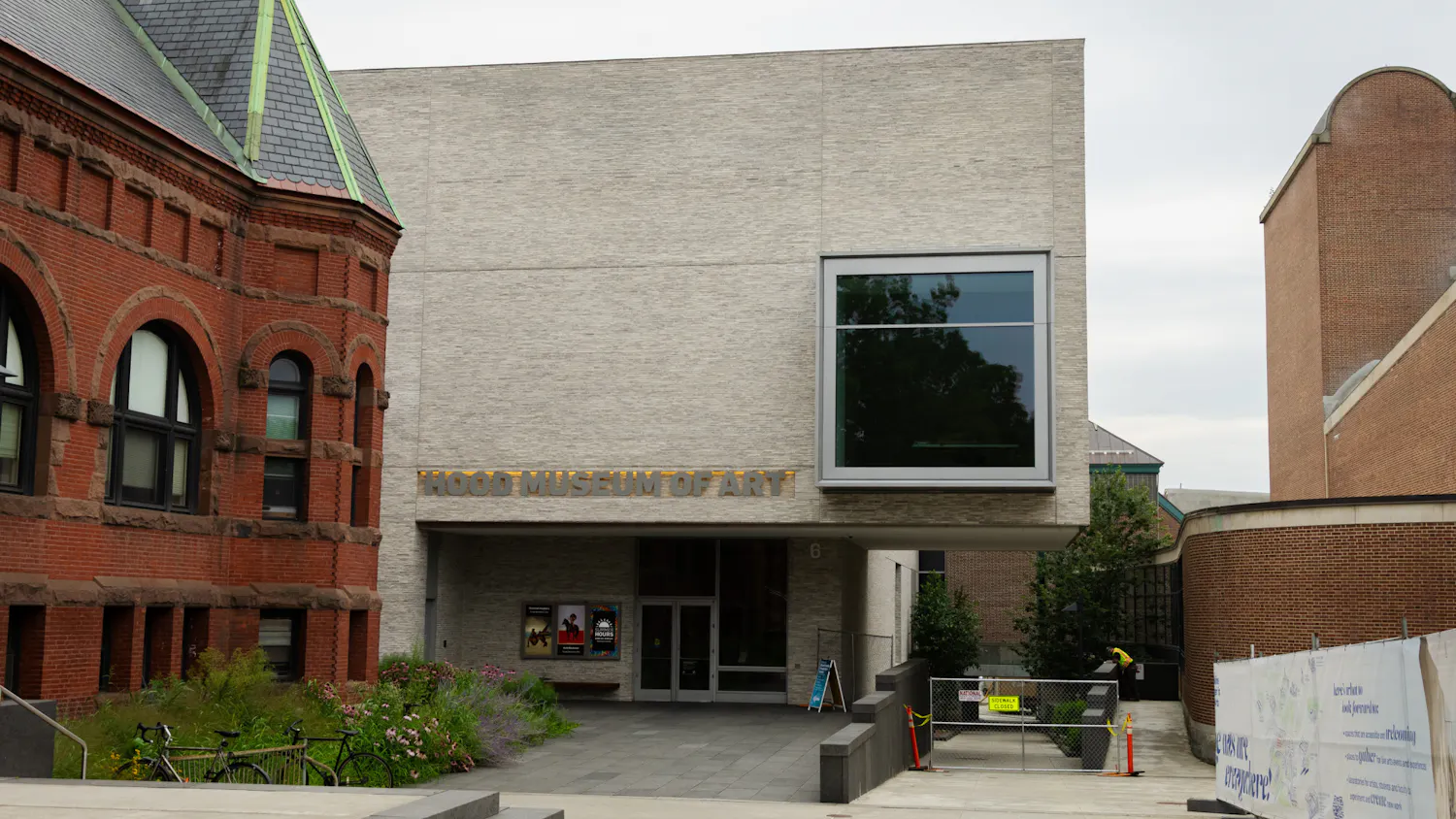
I was recently walking through Novack Café and saw a poster advertising a Hood Museum of Art screening of “Bugonia,” Yorgos Lanthimos’ new movie and an Oscars favorite this year. Seeing this poster profoundly disappointed me, because I believe that the film is symptomatic of a deep cultural malaise that has frozen almost all senses of possibility and action in amber.
Although I strongly disliked the film, you should probably watch it before reading the column. Or not. Either way, spoilers ahead. “Bugonia” deals with heavy themes: wealth inequality, mental disabilities, conspiracy theories and corporate violence. The movie seems to want to comment on many of these things, but only ever uses them as plot devices. The ending is unambiguously bleak — an alien pops Earth’s proverbial “bubble” and every single human instantaneously dies. The movie concludes with long, panning shots of countless corpses in public spaces, people who dropped dead in the midst of everyday activity, as “Where Have All the Flowers Gone?” by Marlene Dietrich plays.
I love grotesque movies. Thinking about death only serves to make you feel more alive. That being said, Bugonia’s grotesqueness is incredibly lazy. It’s essentially a massive middle finger to the rest of the plot. Instead of making any real comment about humanity or our current predicament, Bugonia seems to lean towards burning it all down, concluding that humanity on the whole is a wasted project.
I don’t blame Lanthimos. It’s really hard not to come to this conclusion today. It seems our country is in the midst of a cold winter for justice. I often find myself looking at the news with a deep sense of exhaustion. The most dangerous part of America’s current regime of power might be its eternal assault on positive senses of possibility. The problem is that much of the new media meant to critique this current moment falls into the trap of believing modern power’s lies.
I see two spheres of power in modern America. Although they accomplish their goals with inverse approaches, they each create an intractable sense of inevitability, resulting in a fascinating dialectic of mass influence.
The first sphere of power is the current political regime. Our president has perpetuated a view of the world that assumes institutions are untrustworthy and corrodible, humans are negatively motivated and that transgressive, shocking hate is the ultimate incarnation of power.
Perhaps more frustrating than this, the Congress and Supreme Court which are meant to check the president’s power have either fallen in line to support him, or are too divided and ineffectual to do anything about the administration’s actions. ICE officers are deployed into our neighborhoods and our military is deployed to new countries abroad. As the old “normal” continues to fall by the wayside, the current administration has successfully bred a feeling that its power is inevitable, and that the only thing we can do about it is sit by and watch.
The second sphere of power is the oligopolistic billionaire technocratic class that has come to prop up the rest of America’s stagnating economy. Increasingly, a small group of very wealthy people use their influential platforms to spread radical ideology, using their wealth and business success as a certification of their genius and vision. Peter Thiel labeling political enemies like Greta Thunberg as the Antichrist. Bryan Johnson receiving a donation of blood from his own son as part of his anti-aging regime meant to help him “live forever.”
When it comes to this new class of ultrawealthy individuals, our nation is locked in golden handcuffs. We feel obligated to listen to what they have to say closely and bend the knee to the corporations they head because they define success and make technological innovation inevitable through rhetoric. Contrasting with Congress and an ineffectual government’s inability to do anything, Silicon Valley’s ethos is steeped in moving faster than most can keep up with, pushing forward new ideas and development without asking for consent or whether what they are doing is actually positive.
We are collectively expected to praise this approach as “brave” and “innovative” even if the technological developments that it creates simultaneously seem to render an increasing percentage of humanity useless. As artificial intelligence continues to progress, more and more of us cede our agency to think and create to machines. Through Silicon Valley’s frenzied action, humanity’s uselessness feels inevitable.
This column is not meant to be an all-encompassing rebuke of satire or nihilism. I enjoy these forms of fiction, and they can be powerful drivers of social change. These forms of media tread into problematic territory when their critique of modern society becomes so total that it seems hopeless, depicting a collapse so immense — like the end of humanity in Bugonia — they seem to offer no escape from our problems.
Art and culture are supposed to be the one sphere of power that offers us consistent hope and the ability to imagine beyond what fatalist outlooks of the world might offer. This is why media like “Bugonia” is so discouraging to me. This class of apocalyptic, smug “screw the world” fiction seems to give up on imagining. It buys the narrative so meticulously sold to us by billionaires and political power. Real, difficult to divine art in our time is not fatalistic. It dares to hope in a time that seems utterly hopeless.
Opinion articles represent the views of their author(s), which are not necessarily those of The Dartmouth.
Eli Moyse ’27 is an opinion editor and columnist for The Dartmouth. He studies government and creative writing. He publishes various personal work under a pen name on Substack (https://substack.com/@wesmercer), and you can find his other work in various publications.