
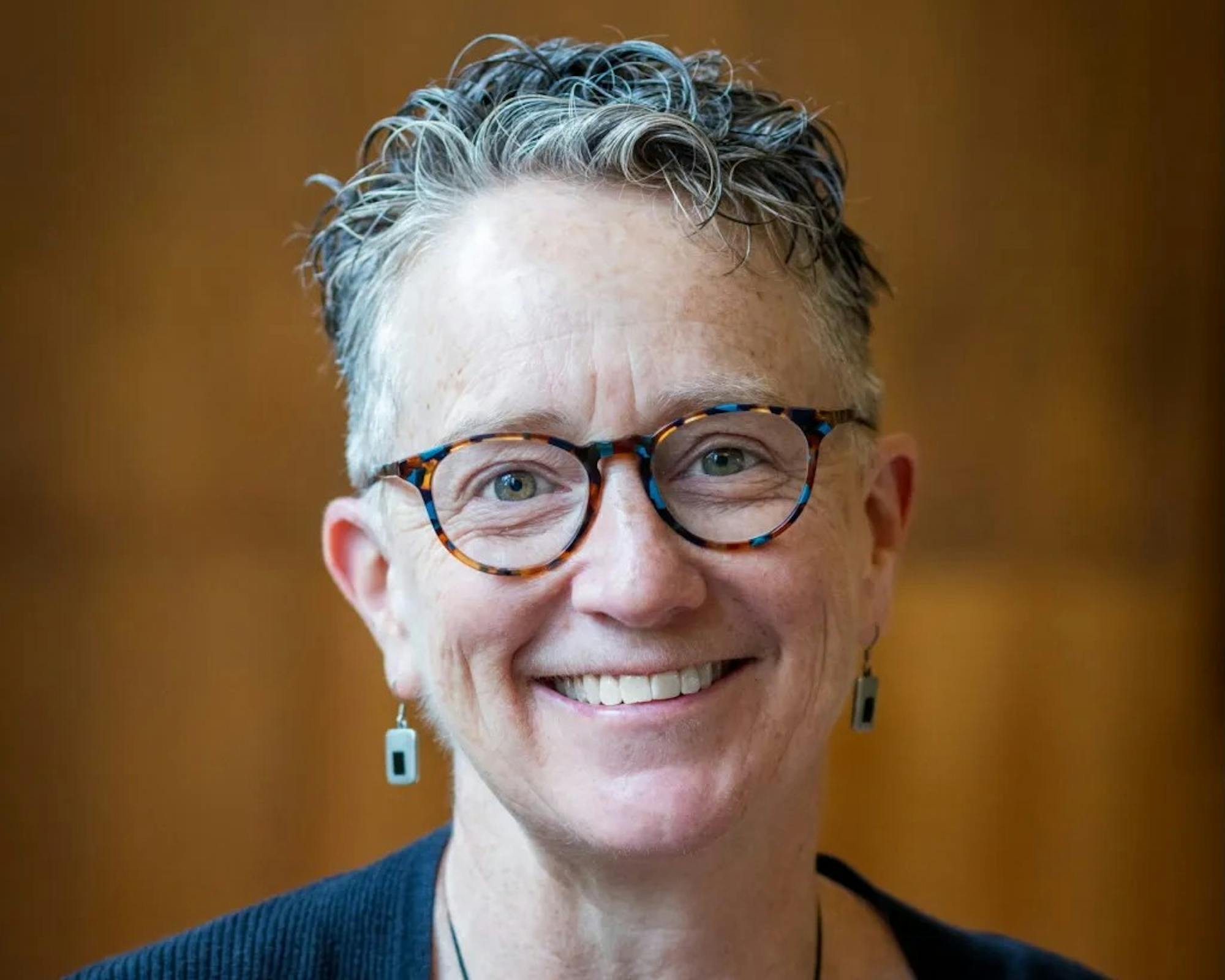
Former climate scientist Andi Lloyd ’89 returned to campus in October 2025 as co-pastor of the Church of Christ at Dartmouth College following a 25-year career as a biology professor at Middlebury College. Lloyd researched climate change in Alaska and Siberia before leaving Middlebury to study at Yale Divinity School and becoming ordained in the United Church of Christ in 2022. The Dartmouth sat down with Lloyd to reflect on her career path and the connections she sees between climate and theology.
How did it feel to return to the College after so many years?
AL: I graduated from Dartmouth in 1989 with a major in geography. I haven’t been back much since, but I am so happy to be back. I love being in the midst of the life and energy of a college campus. It’s fun rediscovering Dartmouth and learning how it has changed and remains the same.
What initially drew you to plant science and ecology?
AL: I came to Dartmouth thinking I would study biology, but I realized I wasn’t interested in many required classes. Geography allowed me to study what I was most interested in — plants and trees — and think about them holistically and interdisciplinarily. I fell in love with the process of learning why a landscape and its ecological communities look the way they do. From there, I went on to graduate school, earning a master’s in biology and a Ph.D. in ecology and evolution, and that was my life, career and passion for about 25 years.
Why did you decide to leave science and higher education to pursue theology and a pastorship?
AL: I went straight from graduate school to Middlebury, working on the impact of climate change on high-latitude forests. It was exciting. I brought students to Alaska almost every summer, was involved in big collaborative projects and worked with scientists of all kinds. Yet my very idealistic notions that I could change the world started to get complicated.
My shift into ministry wasn’t about thinking my work didn’t matter. I’ve always had a very palpable sense of God and a quiet desire to explore my faith. In fall 2017, a dear friend finally convinced me to go to church, and I found myself in a community of people who held a lot of the same questions and beliefs I did. Within a few months, I wanted to be in that world all the time. A pastor helped me say out loud that ministry felt like what I needed to do, so I headed off to divinity school and became a church pastor.
Have you observed similarities between your former role as a biology professor and your current role as a pastor?
AL: I’ve come to think of both careers as expressions of the same thing. In the field of climate science, there was a shared desire to help us better understand the world and live more sustainably. Within my Christian tradition, there is a call to love God and our neighbors and care for creation and this natural world. I’ve experienced an ethos of respect and care in both worlds. Studying climate change was motivated by my love for this world, and I’ve come to understand that the work of ministry will always and forever include that love.
How does your previous experience at Middlebury inform your work as a pastor?
AL: I’ve been surprised by how much has carried over. In the United Church of Christ, decision-making resides with the congregation — that’s really similar to how academia works. In both cases, leadership looks like helping discern and decide the path forward together, which I absolutely love. One of the things pastors do is teach, so I find myself using the teacher muscle in ministry.
How do you interpret the relationship between climate change and theology?
AL: The Judeo-Christian concept of justice has to do with an ordering of human society that allows all people to thrive, takes care of the poor and vulnerable and liberates the oppressed. Climate change is absolutely a justice issue — the people who did the most to cause the problem will suffer the least, while those who did the least suffer the most. I hold this earth to be sacred, so the destruction of big pieces of it feels like desecration, and climate change as a driver of that feels like a matter of Christian concern.
Do you see yourself returning to a more research-focused role again? What are your future plans?
AL: Research was an amazing chapter, but that chapter is over. I plan to continue working on and thinking about climate change. A couple of years ago, I co-wrote a book about climate change, and I want to write more from the vantage point of ecology and theology. I would love to find a way to teach at Dartmouth, bringing together students and community members to talk about climate change. Gathering people to talk about this issue of existential importance is dear to my heart and feels like part of my ministry.
This interview has been edited for clarity and length.
Sahil Gandhi ’29 is a reporter from Staten Island, N.Y., and is majoring in environmental studies and government modified with philosophy and economics. He loves word searches and falling down internet and Wikipedia rabbit holes.


