With the four-year anniversary of Russia’s full-scale invasion of Ukraine approaching on Feb. 24, the war grinds on and the U.S. relationship with its European allies is uncertain. Former U.S. ambassador to Sweden and Poland Mark Brzesinski ’87 argued in a campus talk on Tuesday that diplomacy remains essential.
Brzezinski — who presented credentials as U.S. ambassador to Poland two days prior to Russia’s full-scale invasion of Ukraine on Feb. 24, 2022 — said he organized his embassy “to prepare for the day of the attack.”
“I deployed the mission to learn about every one of the eight water crossings in between Poland and Ukraine,” he said. “I deployed embassy staff from Warsaw to ... the border and we learned every lane, every regional airport, every hospital, every hotel, even every veterinarian in the area, because with refugees traveling, they sometimes bring their pets.”
In an interview with The Dartmouth before the event, Brzezinski said one of his main priorities was “reassuring the Poles” and easing their fears about the ongoing conflict in Ukraine.
“It makes the Poles think they’re next,” Brzezinski said. “I zeroed in on three things — bringing in as many American soldiers into Poland as possible, [establishing] the first-ever permanent U.S. military facility in Poland, called Camp Kościuszko, and modernizing the Polish military in terms of equipment.”
Beyond investment in the military, Brzezinski also believed it was essential to strengthen ties with Poland through diplomatic visits.
“President [Biden] visited twice, Vice President Kamala Harris visited once, along with the entire Joint Chiefs of Staff,” he said. “A tremendous amount of coordination was deployed in Poland to make sure that collective defense worked, and it did.”

By May 2022 — three months after Russia’s full-scale invasion — 3.5 million Ukrainians crossed the border to Poland, according to the United Nations Human Rights Council.
Brzezinski said he was “surprised” by the Poles’ humanitarian response to Ukrainian refugees in the aftermath of the attack. Poles organized through social media fundraising efforts and initiatives to pick up families at the Medyka border crossing, where they would take them to apartments in Bydgoszcz and Poznań.
Brzezinski added that he was also “impressed” by the assistance provided by the thousands of American volunteers, while emphasizing the central role played by the Polish people.
“Poland literally opened its national home, taking people into their homes and apartments,” Brzezinski said.
During the talk, Brzezinski also praised Harris, calling her a “fearsome advocate” for her role in advancing policy and engaging foreign leaders.
Brzezinski also played an immense role in spearheading the first mental health and diplomacy initiative at a U.S. embassy, saying he was motivated by the lack of access to mental health care in Poland.
“What shocked me when I went to Poland is that I learned that this country of 40 million people has only 600 psychiatrists,” Brzezinski said. “Huge regions are essentially untreated, and they do not have the resources to access modern mental health help.”
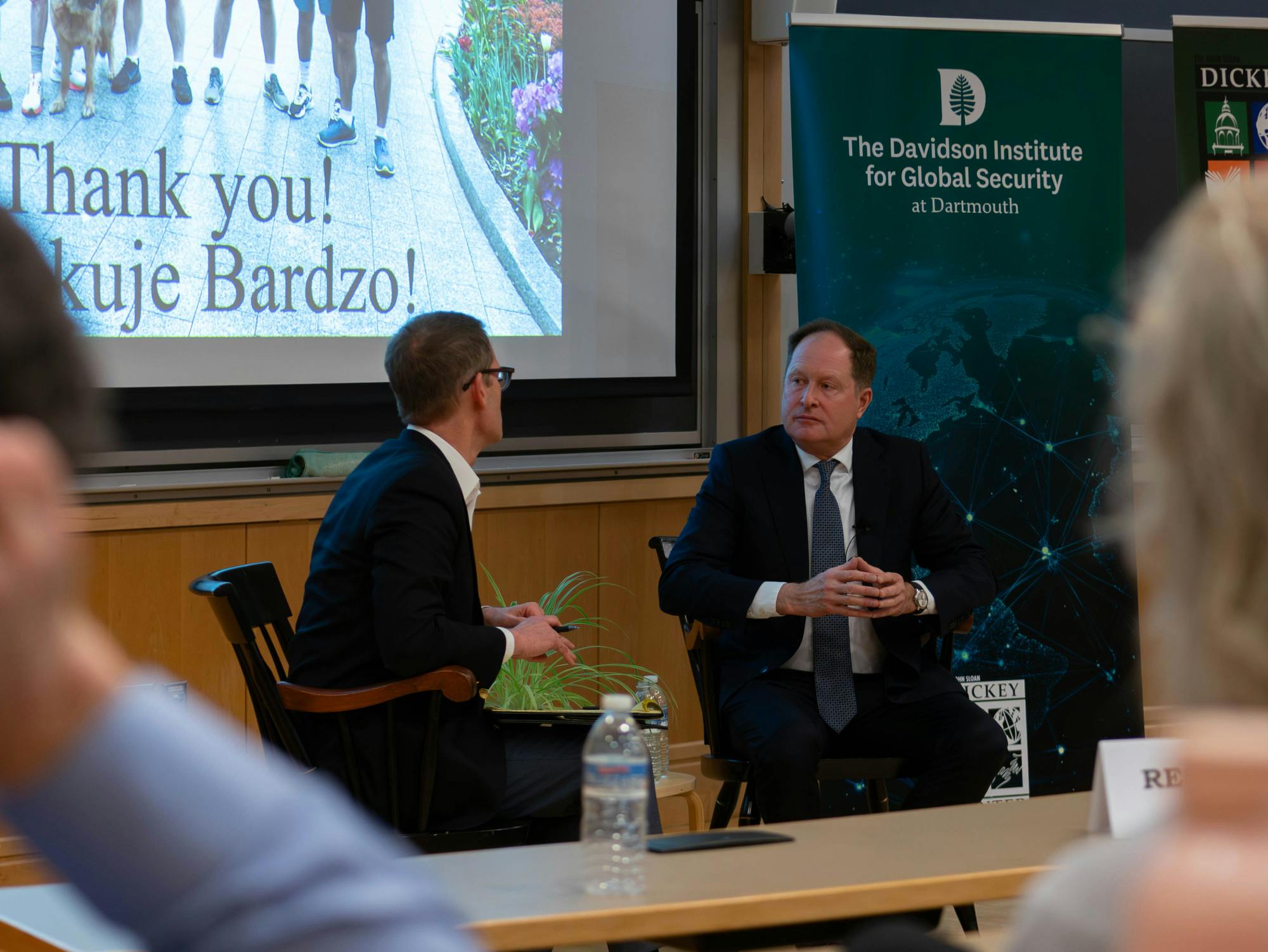
On Jan. 13, the Dickey Center for International Understanding, the Davidson Institute for Global Security and the Institute of Arctic Studies co-sponsored former U.S. ambassador to Sweden and Poland Mark Brzezinski ’87 for a talk titled “Modern Diplomacy on NATO’s Eastern Flank.” Brzezinski discussed humanitarian diplomacy, international security and NATO.

The audience applauds members of the class 1950, Doug and Meredith Smith (center). The class of 1950 co-sponsored the event.
Approximately 60 people attended the event in Haldeman Hall, with another 70 watching the livestream on Zoom, according to Dickey Center program coordinator Naomi Wade.
Audience member Ben Buurma ’29 said he was “glad to learn from someone with a lot of experience in the [foreign policy] area.”
“It was really interesting hearing diverse perspectives from someone who has a lot of experience in the Eastern European region,” Buurma said. “His outlook [on the state of the region] seemed to be a lot more positive than mine and others that I’ve heard about.”
Brzezinski said being U.S. ambassador to Poland was “the honor of [his] lifetime.”
“I am profoundly grateful to President Biden and the American people for the opportunity to represent this country and to work every day to advance America’s interests,” Brzezinski said.